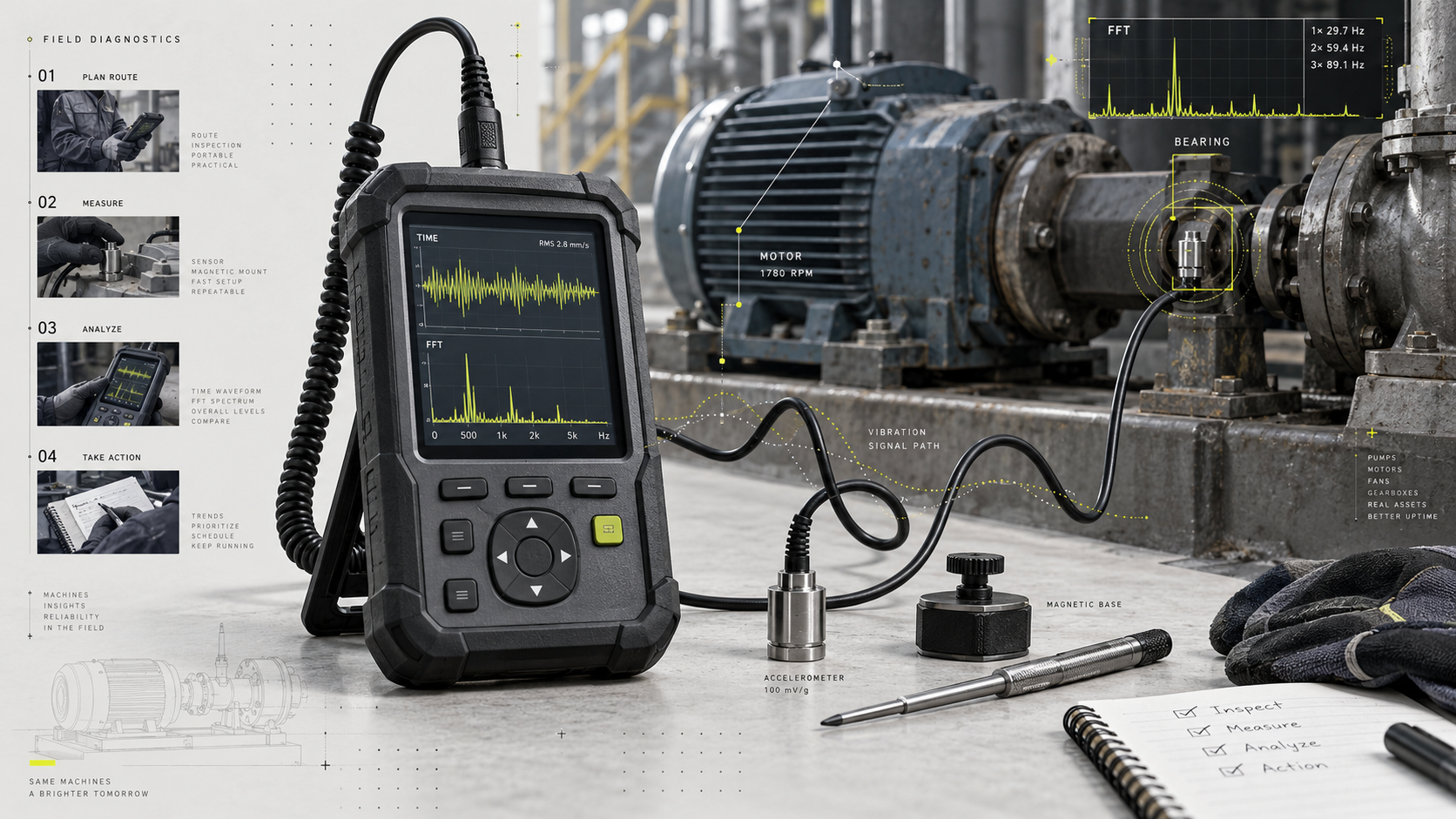
A portable vibration analyzer is a handheld instrument that measures and interprets the vibration of rotating machinery in the field, so a technician can judge machine health on the spot. Unlike a fixed system wired to one asset, it travels a route: a technician carries it machine to machine, takes a reading at each point, and compares it against a baseline and severity standards. It is the workhorse of route-based condition monitoring and, for many plants, the entry point into predictive maintenance.
What Is a Portable Vibration Analyzer?
A portable vibration analyzer packs a sensor, a data collector, and analysis software into a device small enough to carry. The sensor, usually an accelerometer, sits on a bearing housing, and the analyzer turns the signal into a spectrum a technician can read. Bearings are why this matters: across the classic IEEE and EPRI motor reliability surveys, bearing faults cause roughly 41% to 44% of induction motor failures, showing up as changing vibration long before a machine stops.
Continuous vibration monitoring systems stay wired to critical assets around the clock; vibration analysis is the diagnostic discipline both depend on. The portable analyzer is the periodic, walk-the-route option: lower cost per asset, broad coverage, a human in the loop at every reading.
How Do Portable Vibration Analyzers Work?
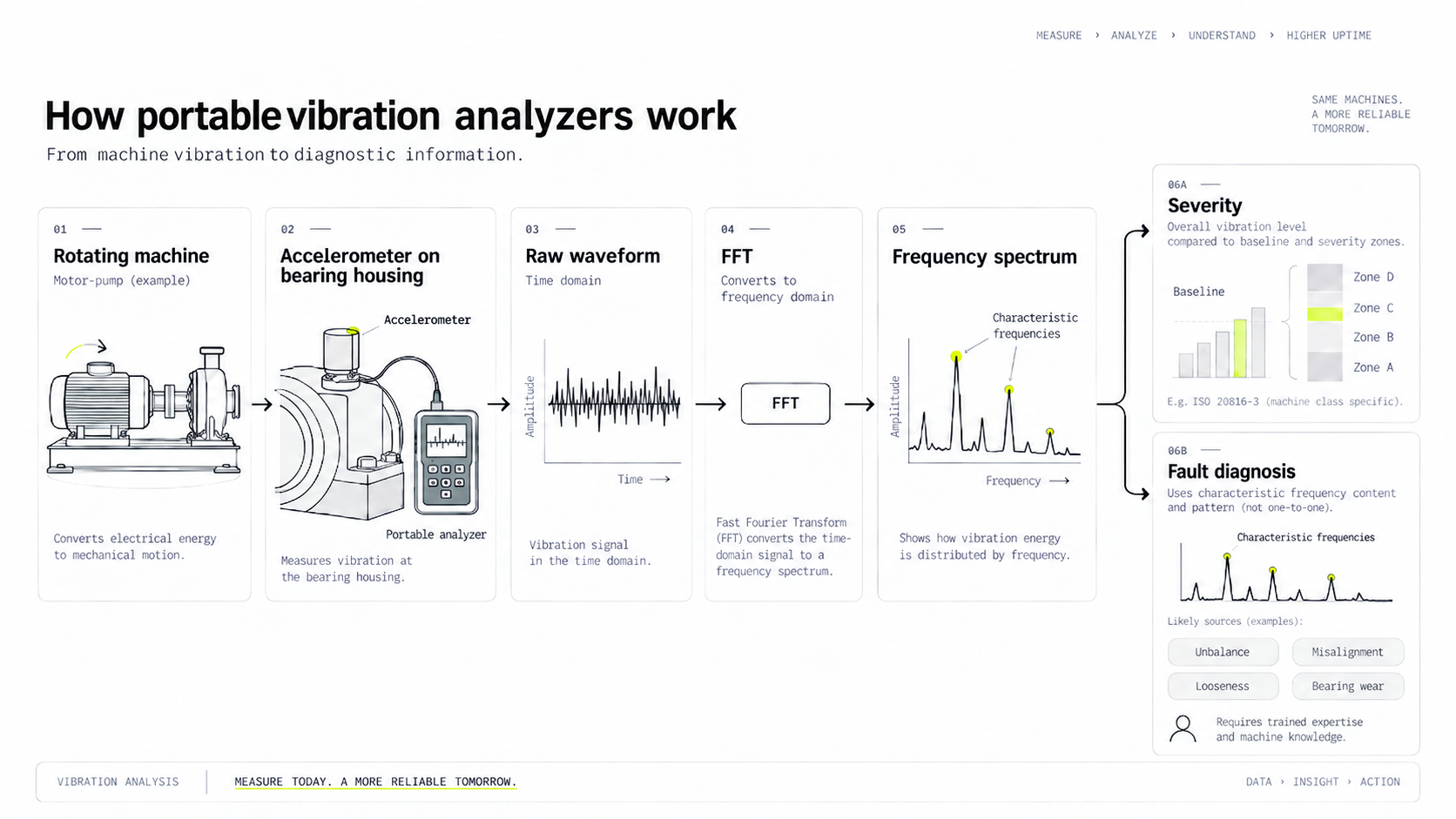
The analyzer captures the raw vibration waveform, then transforms it into a frequency spectrum with a Fast Fourier Transform. That shift from time domain to frequency domain makes diagnosis possible: unbalance, misalignment, looseness, and bearing wear each appear at characteristic frequencies tied to running speed. A rising peak at a bearing's defect frequency points to a specific problem.
Readings are judged against baselines and standards such as ISO 20816-3, which sets broadband severity zones for machines above 15 kW. That standard rates severity but does not diagnose the bearing or gear itself, so reading the spectrum still depends on a trained analyst, and skilled analysts are scarce.
What Are the Benefits of Portable Vibration Analyzers?
The strongest case is coverage for the money. One instrument can service hundreds of measurement points, screening a large asset base without wiring every machine. Readings on a regular route build a trend line, and a trend that climbs from visit to visit is often the first hard evidence a bearing or coupling is degrading. For plants moving from reactive repairs toward condition-based maintenance, it is often the first tool that makes the shift affordable.
How Do You Choose a Portable Vibration Analyzer?
Match the instrument to the machines you run and the people who will use it. Frequency range matters most: the device has to reach the high-frequency content where early bearing defects live, well past running speed. Channel count decides whether you measure one point at a time or several axes at once for phase-based diagnostics. The software matters too: data has to flow into whatever database holds your history, and the interface has to work for technicians who are not full-time specialists. Battery life and ruggedness round out the choice.
Where Are Portable Vibration Analyzers Used?
Any operation with rotating equipment is a candidate. In manufacturing, portable analyzers watch motors, pumps, fans, gearboxes, and conveyors. In energy and heavy industry, they inspect critical drivetrains where an unplanned stop is costly. In aviation and transportation, checks confirm parts are within limits before return to service. The common thread is periodic inspection between scheduled visits.
What Comes After Route-Based Vibration Analysis?
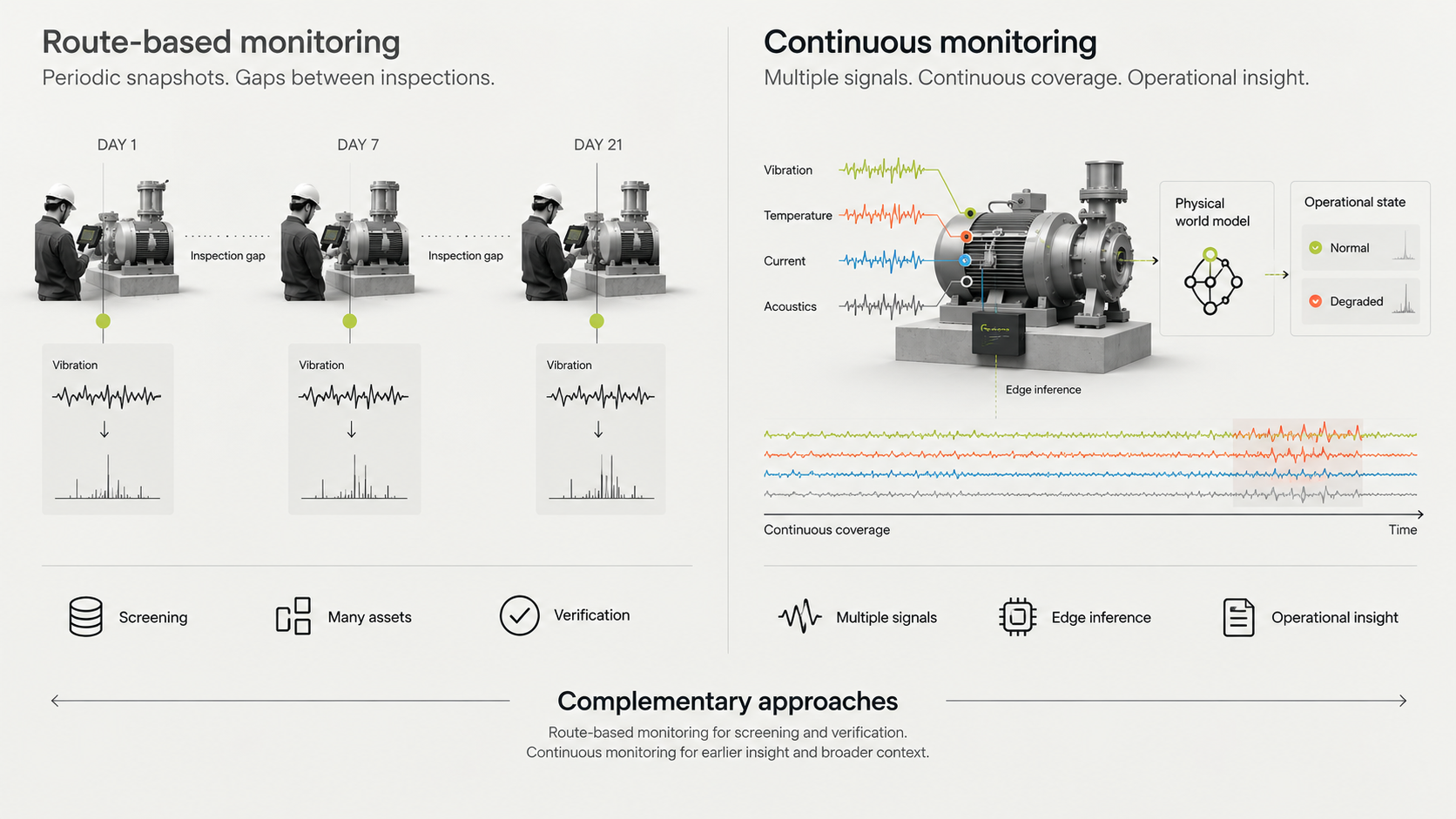
Route-based analysis has a structural limit. It sees a machine only at the moment of measurement, reads vibration alone, and leans on scarce expertise to interpret each spectrum. A bearing can fail between routes, and vibration by itself misses context that temperature, current, and acoustics would supply.
Physical AI is the next step. Newton, Archetype's physical world model, learns directly from sensor data and fuses vibration with other signals into one shared representation, then reports what it finds in an operator's own vocabulary rather than as a spectrum only a specialist can read. Because it generalizes across machines, it adapts to a new asset from as little as one labeled example, with up to 90% accuracy out of the box and no per-machine model to build. It also runs where the equipment is: in one energy-production deployment, a Newton Agent ran on a low-cost edge device at each asset, separating normal pump behavior from degraded states in real time and cutting false-alarm shutdowns. It is continuous coverage a route cannot match, deployed as IoT-based predictive maintenance, not a walkaround. None of this retires the portable analyzer, which stays a low-cost way to screen and verify.
FAQs
How is a portable analyzer different from a vibration monitoring system?
A portable analyzer is carried machine to machine for periodic readings on a route. A monitoring system stays wired to an asset around the clock. Many plants use both, matching the method to how critical each machine is.
Do you need a vibration expert to use one?
Collecting good data can be taught quickly, but reading spectra has traditionally required a trained analyst. Model-based approaches are changing that by reporting findings in plain operational terms rather than raw frequency plots.
