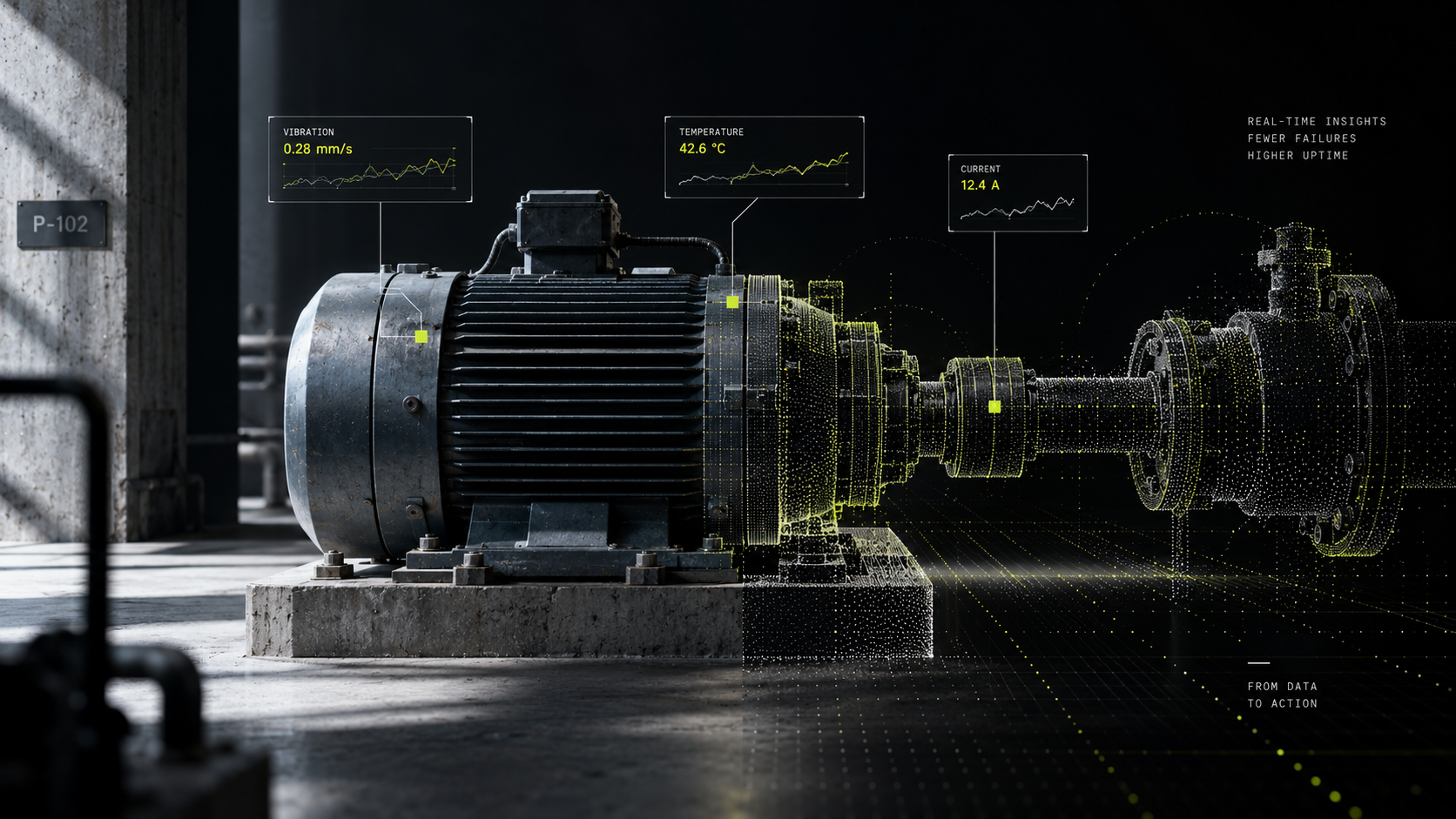
Condition-based maintenance (CBM) is a strategy that triggers maintenance on the measured condition of an asset rather than on a fixed calendar. Instead of servicing a pump every 90 days whether it needs it or not, a CBM program watches parameters like vibration, temperature, and current, and acts only when the data shows a developing fault. The result is fewer surprise failures and less wasted labor on healthy equipment. This guide covers how CBM works, what it costs to run, how to build a program, and how it differs from the preventive and predictive approaches it is often confused with.
What Is Condition-Based Maintenance?
Condition-based maintenance is a maintenance strategy that uses real-time or periodic condition data to decide when to intervene. The governing standard, ISO 17359, frames it as a program built around measurable parameters such as vibration, temperature, tribology, flow, power, and speed, each chosen because it tracks a specific failure mode. When a monitored parameter crosses an alarm threshold or trends toward one, the program schedules work before the asset fails.
How Does Condition-Based Maintenance Work?
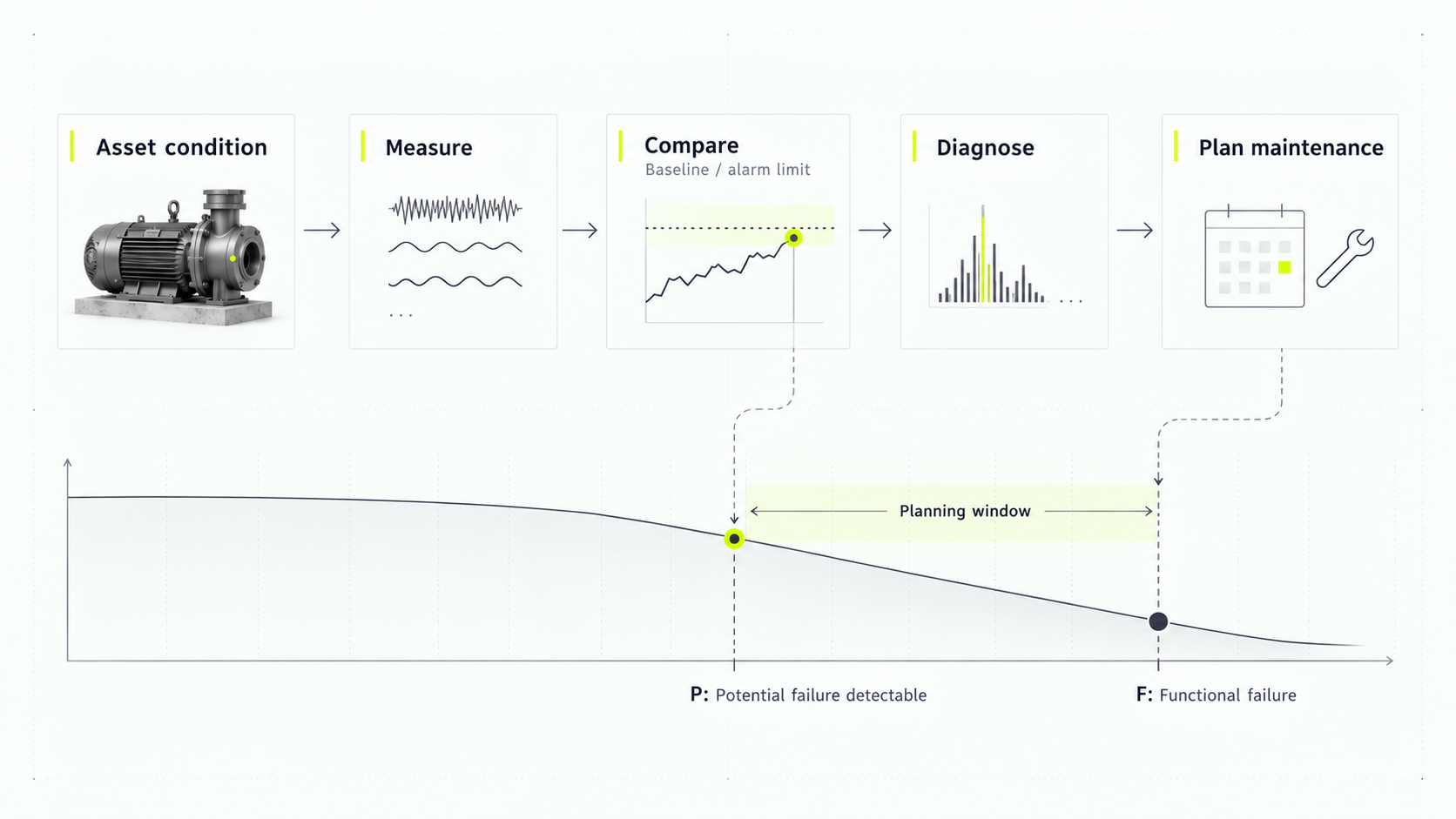
A CBM program runs on a loop: measure, compare, diagnose, act. Sensors sample a condition indicator, the reading is compared against a baseline and alarm limits, and a change that signals a developing fault triggers diagnosis and a planned repair. ISO 17359 organizes this around the P-F curve, the interval between the point where a failure becomes detectable (P) and the point of functional failure (F). The value of condition monitoring lies in detecting the potential failure early enough in that interval to plan the fix on your own schedule instead of reacting to a breakdown.
The quality of a CBM program depends on two choices: which parameters you monitor, and where you set the limits. Monitor the wrong signal and you miss the fault. Set limits too tight and you drown operators in false alarms; too loose and warnings arrive too late to act on.
How Is CBM Different From Predictive Maintenance?
CBM and predictive maintenance are related but not identical. CBM acts on current condition: a reading breaches a limit, so you intervene. Predictive maintenance goes a step further and forecasts the remaining useful life of the asset, estimating when a component will fail rather than only that a fault exists. Predictive maintenance is best understood as an advanced form of CBM, one that adds modeling and prognostics on top of the same condition data. For a deeper treatment of the forecasting side, see our guide on predictive maintenance using AI.
What Are the Benefits of Condition-Based Maintenance?
The core benefit of CBM is that you stop paying for maintenance you do not need while catching failures you would otherwise miss. Fixed-interval servicing wastes parts and labor on assets that are still healthy and still lets faults develop between scheduled visits. Acting on condition removes both problems at once.
Those savings are measurable. A 2025 review in Applied Sciences found that data-driven programs combining high-frequency sensing with analytics can cut downtime by 10 to 20 percent, with global savings estimated in the billions per year. The upside is large because the cost of the failures CBM prevents is large. Siemens puts the true cost of unplanned downtime at roughly $1.4 trillion a year across the world's 500 largest companies, about 11 percent of their combined revenue, and in automotive plants an idle line runs to $2.3 million per hour.
Beyond downtime, catching degradation early extends asset life, because a bearing corrected at the potential-failure stage does not cascade into secondary damage. It also improves safety, since many of the same signals that predict failure also flag hazardous conditions before they reach a person. The market has noticed: the predictive maintenance market is projected to grow from $10.6 billion in 2024 to $47.8 billion by 2029, a 35.1 percent compound annual rate.
What Makes Condition-Based Maintenance Hard to Implement?
CBM is harder to stand up than a calendar-based program, and the difficulty is where most rollouts stall. There are four recurring obstacles.
The first is upfront investment. Sensors, data infrastructure, and monitoring software carry a real cost, though a program can start with the instrumentation many critical assets already carry rather than requiring a full retrofit.
The second is the skills gap. Reading vibration spectra or interpreting thermographic trends is specialized work, and the experienced analysts who do it well are retiring faster than they are being replaced. A program that depends on a handful of experts does not survive their departure.
The third is integration with existing systems. Condition data has to flow into the CMMS and the historian and reach the people who schedule work, and legacy equipment rarely speaks a modern protocol without a translation layer.
The fourth is data management. More sensors mean more data, and a 2025 systematic review of machine-learning maintenance found that limited data availability, scalability, and sensor integration remain the practical hurdles that keep programs from generalizing beyond the first few assets. Collecting signals is not the hard part. Turning them into a decision an operator trusts is.
Which Technologies Enable Condition-Based Maintenance?
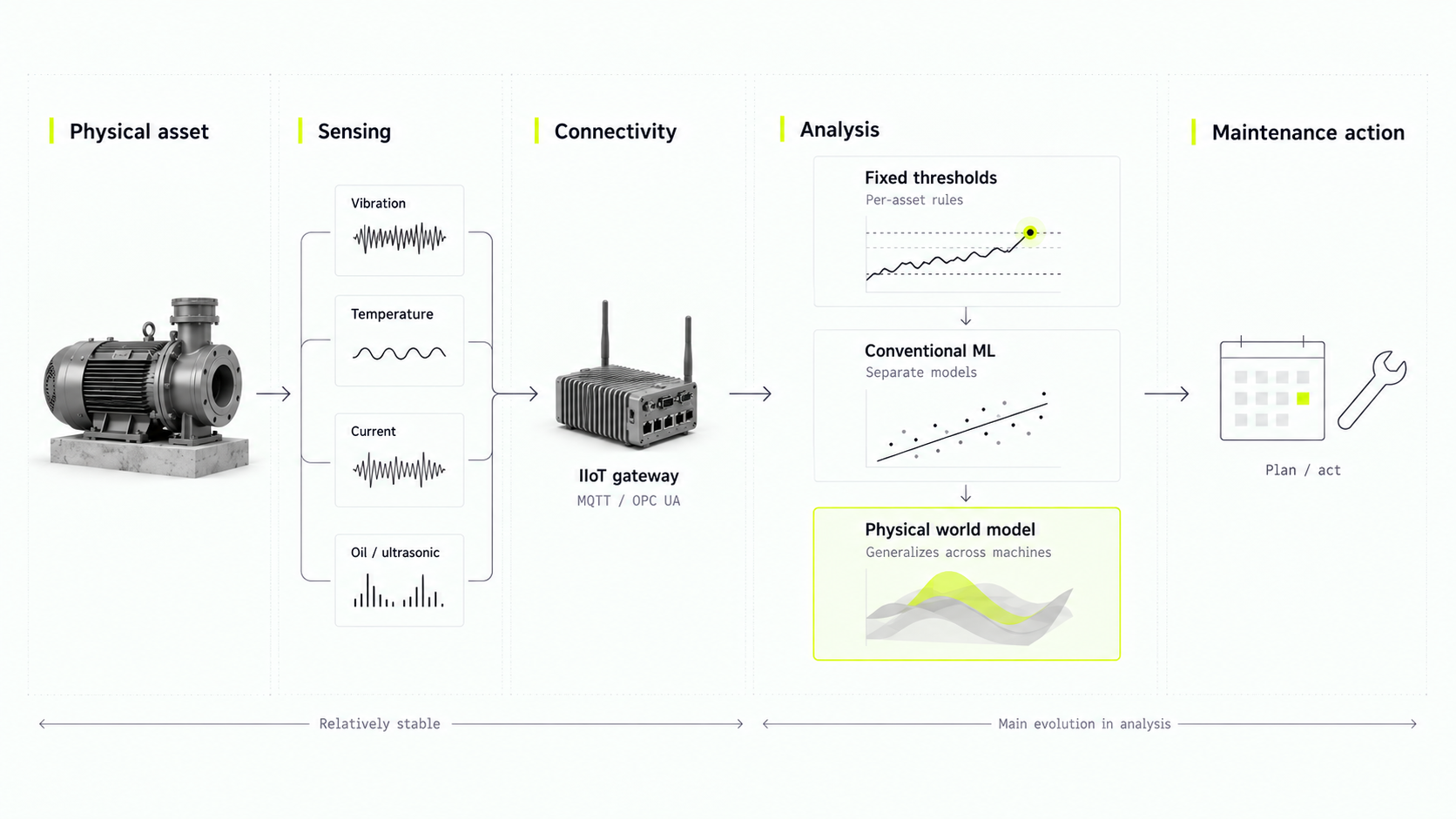
CBM rests on three technology layers: sensing, connectivity, and analysis. The first two are mature. The third is where the field is moving fastest.
Sensing covers the condition indicators themselves, and the choice of technique follows the failure mode. Vibration analysis catches imbalance, misalignment, and bearing wear in rotating equipment. Infrared thermography finds electrical and mechanical hot spots. Oil analysis and ultrasonic testing cover lubrication and early bearing defects. Connectivity, typically through industrial IoT gateways and protocols like MQTT and OPC UA, moves those readings off the asset and into a system that can act on them.
Analysis is the layer being rethought. Classic CBM sets fixed thresholds per parameter per asset, which is transparent but brittle: it fires false alarms when operating conditions shift and misses failure modes nobody wrote a rule for. The response has been to add machine learning, which learns each asset's normal behavior and flags deviations from it. That works, but conventional machine learning has a scaling problem the reviews above name directly. It builds one model per asset or per use case, each needing labeled failure data and retraining when the equipment or its context changes. A plant with a hundred distinct assets faces a hundred modeling projects.
Physical AI is the next step in that analysis layer. A physical world model like Newton, from Archetype AI, is pre-trained on billions of cross-modal sensor measurements, so it arrives already understanding how vibration, temperature, and current behave rather than learning each asset from scratch. It generalizes across machines out of the box, adapting to a new asset from as little as one labeled example and reaching up to 90 percent accuracy with no model training. Because it learns normal behavior by observation, it surfaces both known faults and failure modes nobody has seen before, the exact category fixed rules cannot cover. For how this differs from threshold-based approaches, see our comparison of AI versus rule-based monitoring systems.
How Do You Build a Condition-Based Maintenance Strategy?
A CBM program is built in four stages, and skipping the first one is the most common reason programs fail.
Start with a criticality assessment. Rank assets by the consequence of their failure, in safety, production, and cost, and target CBM at the ones where early warning pays for the instrumentation. Not every asset justifies continuous monitoring, and treating them all the same wastes budget.
Next, map failure modes to indicators. For each targeted asset, identify how it fails and which measurable parameter reveals that failure developing. This is the step ISO 17359 emphasizes, directing monitoring at root-cause failure modes rather than measuring whatever is convenient. It determines every downstream choice about sensors and limits.
Then define the metrics that tell you the program is working. Track warning lead time, the share of alerts that convert to real work orders, false alarm rate, mean time to detect, and mean time to repair. A rising false alarm rate erodes operator trust faster than almost anything else, so watch it closely.
Finally, build in review. Alarm limits set on day one will not hold as assets age and operating conditions change, so revisit them, feed confirmed failures back into your diagnostics, and expand coverage to the next tier of assets once the first tier is stable.
How Does CBM Compare to Preventive and Reactive Maintenance?
The four maintenance strategies sit on a spectrum of how much you know before you act. Reactive maintenance waits for failure, which is cheap to administer and expensive to absorb, since unplanned failures bring the secondary damage, safety exposure, and downtime costs quantified above. Preventive maintenance services assets on a fixed schedule, which prevents many failures but wastes resources on healthy equipment and still misses faults that develop between visits.
Condition-based maintenance acts on the actual state of the asset, intervening when the data warrants it and not before. Predictive maintenance extends CBM with forecasting, using the condition history to estimate remaining useful life and time the intervention even more precisely. The P-F curve from ISO 17359 explains why the condition-driven approaches win: the earlier in the P-F interval you can detect a developing failure, the more room you have to plan the repair on your terms. Reactive maintenance operates at point F, with no room at all. CBM and predictive maintenance operate near point P, with the whole interval to work with.
In practice most operations run a mix, reserving reactive maintenance for non-critical assets, preventive schedules for well-understood wear items, and CBM for the critical equipment where a surprise failure is the one you cannot afford.
Where Is Condition-Based Maintenance Heading?
CBM is moving from fixed rules toward models that learn, and from the cloud toward the edge. The direction of travel is set by the obstacles above: the skills gap, the per-asset scaling problem, and the cost and latency of sending every sensor stream to a data center.
Learning-driven monitoring addresses the first two. As the machine-learning reviews note, CBM is shifting from static threshold alerts to adaptive systems that model each asset's behavior and adjust as conditions change, which reduces both the false alarms that erode trust and the dependence on a shrinking pool of expert analysts. A physical world model pushes this further by generalizing across assets instead of modeling them one at a time, so coverage expands without a new project for every machine.
Edge deployment addresses the cost and latency problem. Running analysis where the data is generated avoids the bandwidth of streaming raw sensor data and the delay of a cloud round trip, which matters when a decision has to be made in milliseconds. Newton is built to run this way, from the cloud down to hardware as constrained as an Intel Atom, keeping proprietary operational data on site. In one wind-energy deployment, a physical world model fused more than 40 sensors across 63 turbines from unlabeled data and surfaced nine previously unknown failure patterns, the kind of cross-asset generalization that fixed-rule and single-asset models are not designed to reach.
Sustainability is the quieter trend. Equipment running in a monitored, healthy state consumes less energy and produces less waste than equipment limping toward failure, so a well-run CBM program contributes to efficiency targets alongside reliability ones.
Frequently Asked Questions
What is the difference between condition-based maintenance and predictive maintenance?
CBM acts on the current measured condition of an asset, intervening when a parameter crosses a limit. Predictive maintenance adds forecasting, using the same condition data to estimate remaining useful life and predict when failure will occur. Predictive maintenance is effectively an advanced form of CBM.
When should a company implement condition-based maintenance?
CBM makes sense for critical assets where an unplanned failure carries a high cost in safety, production, or repair, and where a measurable parameter reveals the failure developing. For low-criticality assets or simple wear items, a preventive schedule is often more economical.
What tools are needed for condition-based maintenance?
A program needs condition sensors matched to the failure modes you care about, such as vibration, thermal, or current sensors, connectivity to move the data off the asset, a system to store and analyze it, and an integration into the CMMS so alerts become scheduled work.
Can condition-based maintenance work alongside other strategies?
Yes, and most operations run a mix. Reactive maintenance suits non-critical assets, preventive schedules suit well-understood wear items, and CBM covers the critical equipment where early warning justifies the instrumentation.
Which industries benefit most from condition-based maintenance?
Asset-intensive sectors see the largest returns, including manufacturing, energy and utilities, oil and gas, and heavy industry, where equipment is expensive, downtime is costly, and failures carry safety consequences.
