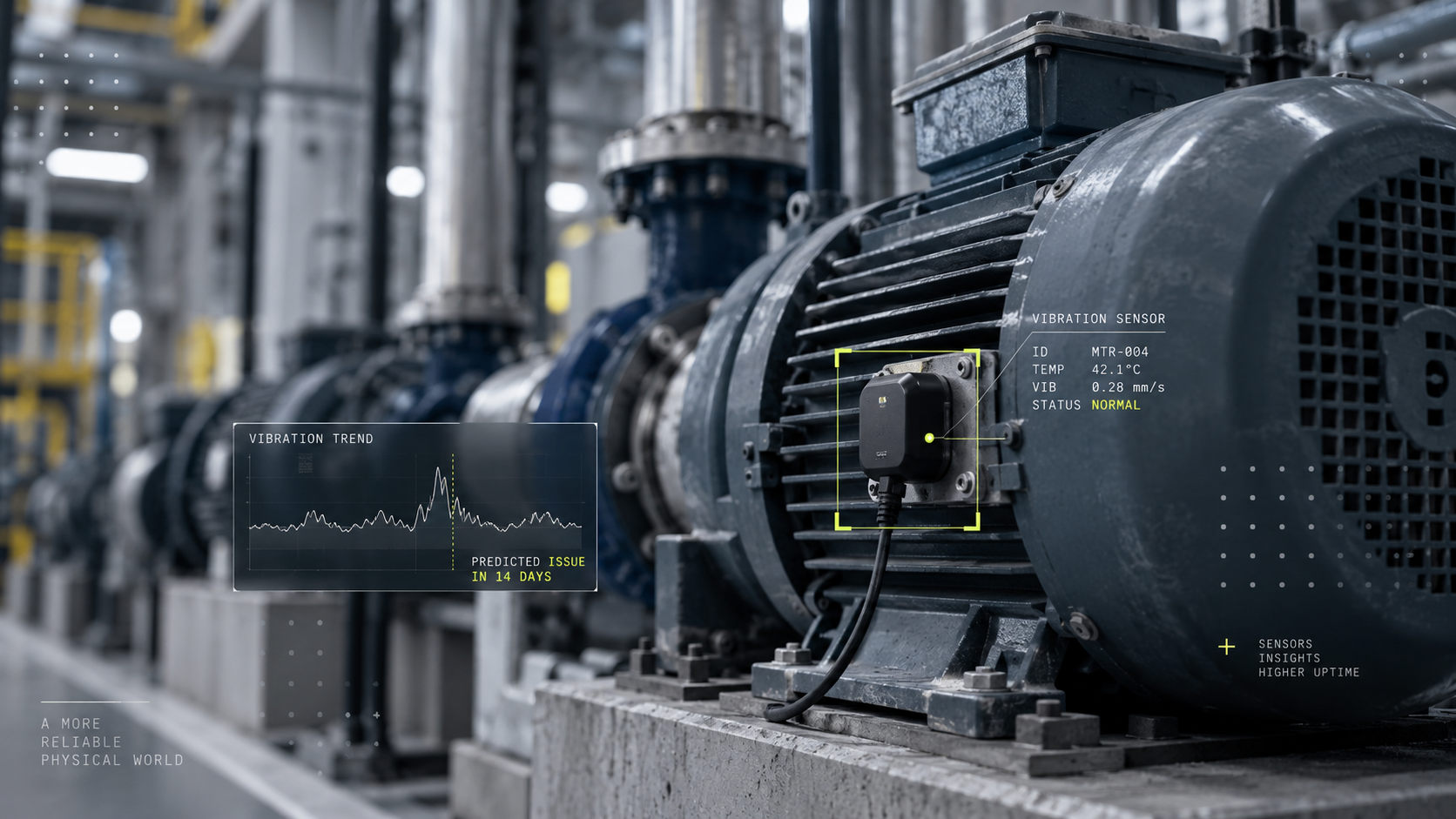
Predictive maintenance used to mean scheduled inspections and the occasional handheld reading. Connected sensors changed that. The industrial internet of things (IIoT) puts continuous eyes on equipment, streaming vibration, temperature, current, and acoustic data off machines in real time. That steady flow is what turns maintenance from a calendar exercise into a condition-driven practice, where teams act on how an asset is actually behaving rather than on how old it is. This guide covers how IoT reshaped predictive maintenance strategy, which sensors matter, how the raw data becomes action, and where the field is heading next.
How Did IoT Change Predictive Maintenance?
IoT changed predictive maintenance by replacing periodic manual checks with a continuous stream of machine data, so faults are caught as they develop rather than at the next scheduled inspection.
Traditional maintenance runs on two settings: fix it after it breaks, or service it on a fixed calendar whether it needs attention or not. Both waste money. Reactive repair invites catastrophic failure, and calendar-based service replaces parts that still have life left. Predictive maintenance sits between them, timing intervention to the actual condition of the asset. IoT is what makes that workable across a real plant. Low-cost wireless sensors, cheap compute, and standard protocols like MQTT and OPC UA mean thousands of assets can report their condition continuously instead of once a quarter. The stakes are high. Siemens' True Cost of Downtime 2024 research put unplanned downtime at roughly $1.4 trillion a year across the world's 500 largest companies, about 11 percent of their revenue and up from 8 percent in 2019. Continuous condition data is the first step toward keeping assets out of that column.
Which IoT Sensors Feed Predictive Maintenance?
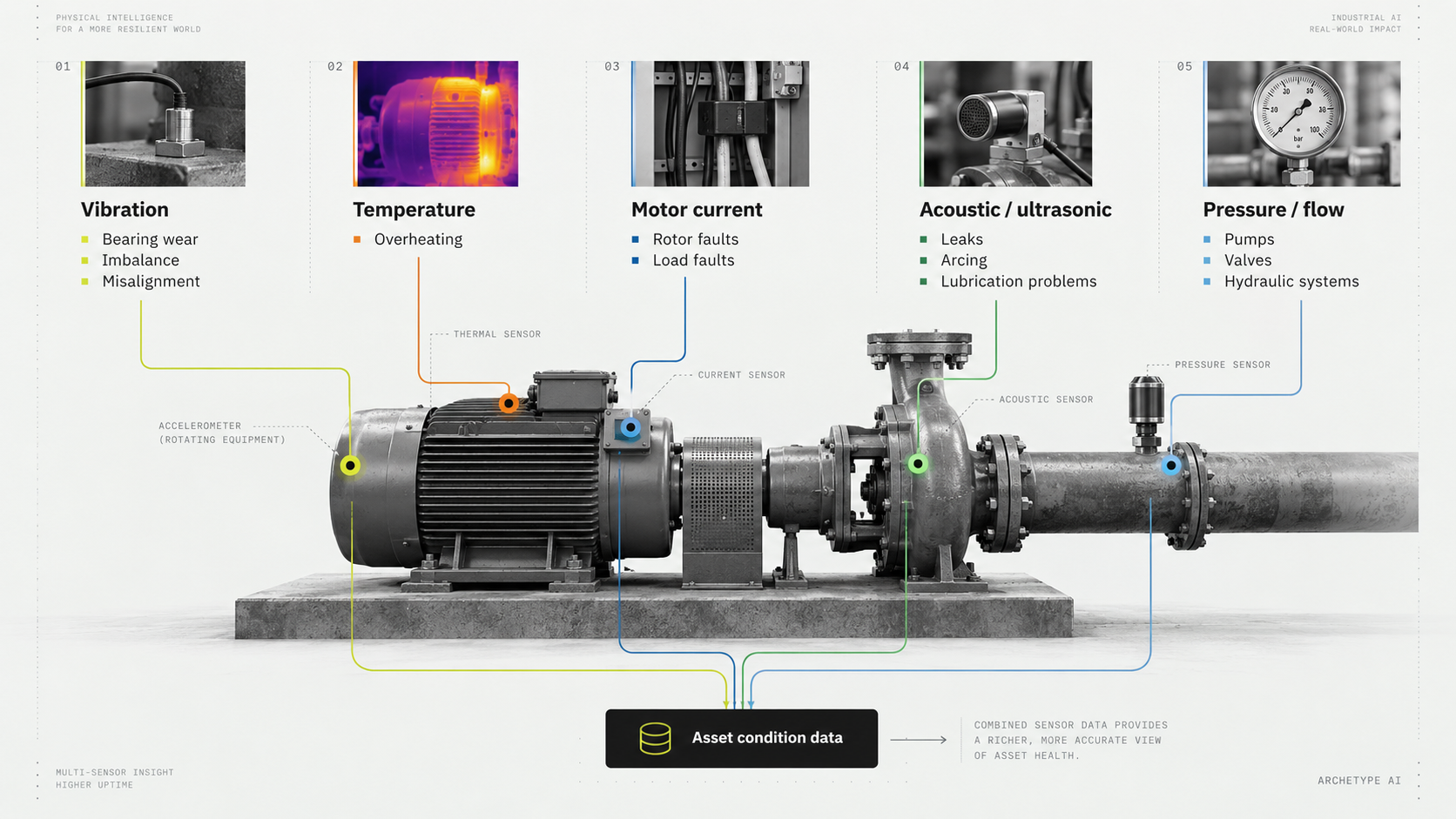
The core sensors are vibration, temperature, motor current, acoustic and ultrasonic, and pressure, each matched to the failure modes of a given asset class.
Rotating equipment leans on accelerometers, since bearing wear, imbalance, and misalignment all show up as characteristic vibration signatures. Thermal and infrared sensors catch overheating in motors, electrical connections, and steam systems. Motor current signature analysis reads electrical draw to flag rotor and load faults without touching the machine. Acoustic and ultrasonic sensors surface early-stage issues like leaks, arcing, and lubrication problems before a technician could hear them. Pressure and flow sensors round out coverage for pumps, valves, and hydraulic systems. A 2025 peer-reviewed review of machine-learning predictive maintenance across 60 studies found that combining diverse sensor data, rather than relying on a single signal, is what lifts prediction accuracy across manufacturing, energy, and transportation. Getting that data off the asset reliably matters as much as the sensor itself, which is why lightweight protocols and local edge gateways have become standard parts of an IIoT deployment.
How Does IoT Data Become Maintenance Action?
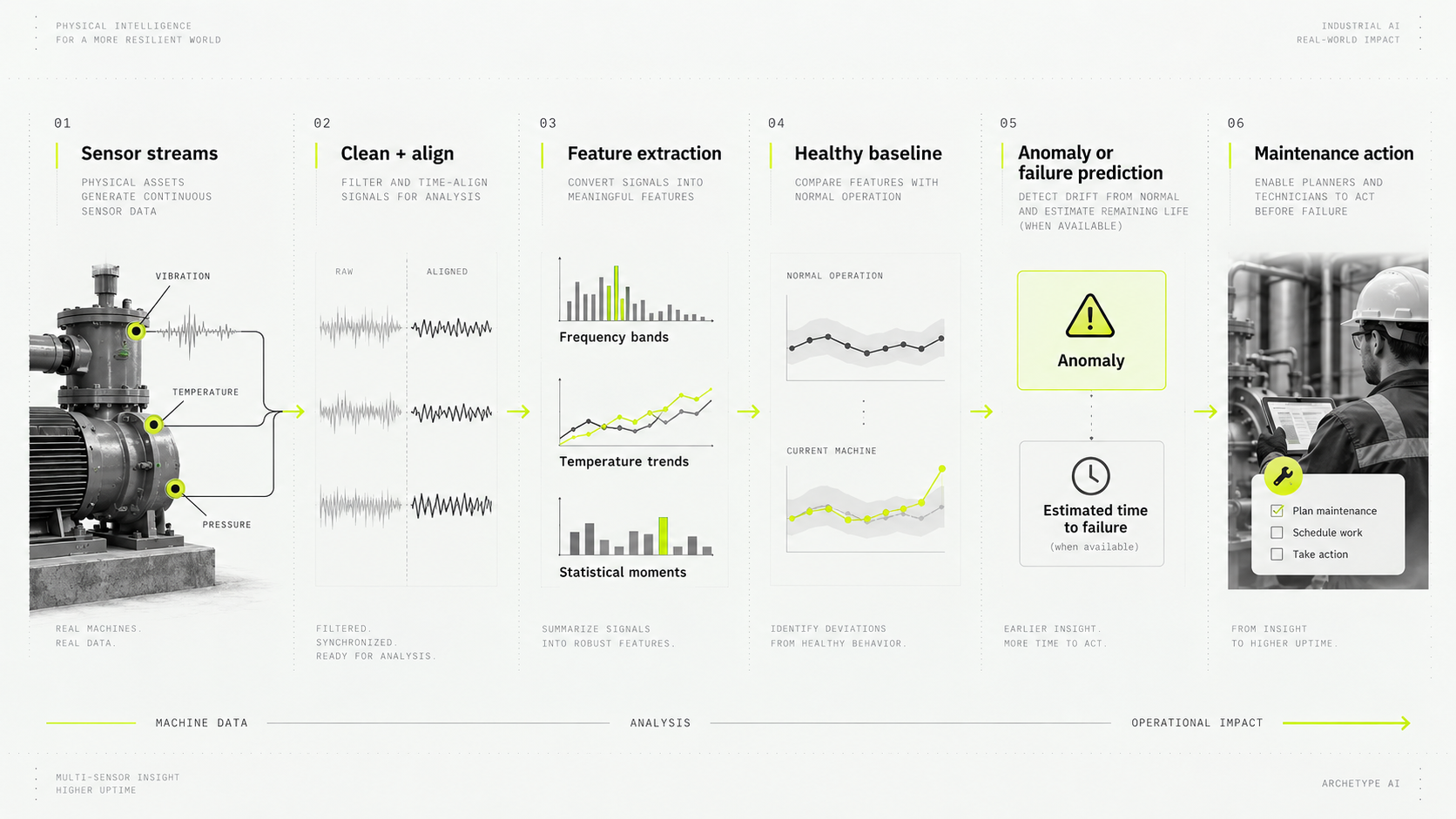
Sensor streams are cleaned, turned into features, scored against a model of normal behavior, and routed into scheduling so a technician acts before failure.
The pipeline is consistent across vendors. Raw signals are filtered and time-aligned, converted into features such as frequency bands, temperature trends, and statistical moments, and compared against a baseline of healthy operation. When the data drifts, the system raises an anomaly and, ideally, an estimated time to failure that planners can act on. Classical machine learning does this well for one asset at a time. The catch is that each model is typically built, labeled, and tuned for a specific machine and sensor set, so a plant with a hundred asset types needs a hundred models to maintain, and every new machine starts from zero. Physical AI platforms are the next step here, which is why a physical world model changes the economics. Newton, Archetype AI's physical world model, learns the language of sensor data directly and fuses many modalities into one shared representation, so it generalizes across machines instead of being rebuilt per asset. In one deployment, Newton fused more than 40 sensors across 63 wind turbines from roughly a year of unlabeled data and surfaced nine previously unknown failure patterns, with an estimated $50 million a year in potential downtime impact.
Where Does IoT Predictive Maintenance Deliver Most?
The strongest fits are asset-heavy, well-instrumented operations: manufacturing, energy and utilities, and oil and gas.
Manufacturing is the classic case, since motors, gearboxes, spindles, and conveyors are numerous, repeatable, and often already wired for vibration and current monitoring. Catching bearing wear or imbalance early means fewer line stoppages and calmer changeovers. Energy and utilities monitor transformers, turbines, and pumps, where a single failure carries safety and availability consequences and where degradation modes repeat across similar assets from site to site. Oil and gas is harder: surface and downhole sensors are noisy, and labeled failure examples are scarce. This is where a model that adapts from a handful of examples earns its place. Archetype's platform has identified operationally meaningful rig states from surface and downhole streams using only a few labeled examples, reaching more than 95 percent accuracy once fine-tuned to the operation. The same cross-asset lift shows up in live manufacturing deployments, where one model adapts per site and catches quality and maintenance issues without retraining.
What Makes IoT Predictive Maintenance Hard?
The main barriers are data integration, the cost of a model per asset, connectivity and latency, and a shrinking pool of experts who can read the results.
Sensor data arrives in different formats, sampling rates, and protocols, and stitching it into one coherent view across legacy and modern equipment is real work. The per-asset model problem compounds it, because every custom model is another thing to label, validate, and keep from drifting as conditions change. Connectivity adds friction, since sending high-rate sensor data to the cloud introduces latency, cost, and exposure that many operations cannot accept on safety-critical lines. The human factor is getting harder, not easier. Deloitte and The Manufacturing Institute projected that U.S. manufacturing could need 3.8 million workers between 2024 and 2033, with up to 1.9 million roles going unfilled if the skills gap is not closed. The veterans who can read a vibration spectrum are retiring faster than they can be replaced. A model that adapts to a new machine from as little as one labeled example, and runs where the data is, addresses the two hardest of these at once: it removes most of the per-asset build cost, and it keeps sensitive data on site.
Where Is IoT Predictive Maintenance Heading?
It is heading toward real-time intelligence that runs at the edge, on the asset, rather than in a distant cloud.
The clearest trend is inference moving to where the data lives. Edge hardware and 5G shrink the gap between a signal and a decision, which matters when a shutdown call has to happen in milliseconds. The peer-reviewed literature points the same way, treating edge deployment as a central research direction for industrial predictive maintenance rather than an afterthought. A physical world model fits this shift because it can be distilled to run on modest hardware. Newton runs as a 7-billion-parameter model, distilled to 1 billion parameters on a roughly 2GB GPU with no loss in performance, and down to an 80-million-parameter version for constrained edge devices, with telco-edge inference around 500 milliseconds. In one energy deployment, a containerized Newton Agent ran on a low-cost edge device at each asset, separating normal from degraded pump states in real time, cutting false-alarm shutdowns while adding runtime. That is the direction of travel: continuous sensor data from the IIoT, interpreted on the spot by a model that understands physical signals, deployed from cloud to edge on the operator's own terms.
Frequently Asked Questions
What is IoT predictive maintenance?
It is a maintenance approach that uses networked sensors on equipment to stream condition data such as vibration, temperature, and current continuously, then applies analytics or AI to predict failures before they happen. The IoT layer supplies the real-time data, and the models turn it into a maintenance decision.
How is IoT predictive maintenance different from traditional condition monitoring?
Traditional condition monitoring often relies on periodic manual readings and single-signal thresholds. IoT predictive maintenance streams multiple sensor types continuously and can fuse them, catching developing faults earlier and across far more assets than route-based checks allow.
Does IoT predictive maintenance require sending data to the cloud?
No. Many deployments use cloud analytics, but sensor data can also be processed at the edge, on or near the asset. Edge processing lowers latency and keeps sensitive operational data on site, which matters for safety-critical and regulated environments.
Can one model work across different types of equipment and sensors?
Classical machine learning usually needs a separate model per asset and sensor set. A physical world model like Newton is trained across many sensor types and generalizes to new machines with few or no labeled examples, so a single model can cover equipment that would otherwise require many.
