
Archetype AI Team
Physical industries — energy, manufacturing, transportation, infrastructure, and more — account for roughly 85% of global economic activity. Yet while modern AI has transformed the digital world, the systems that power the physical world remain largely opaque to it.
Physical systems do not express themselves through text or images alone. Their behavior emerges across vibration, pressure, temperature, acoustics, electrical current, telemetry, radar, and other sensor signals — each capturing only a partial view of a far more complex hidden system. Understanding what a machine is actually doing requires interpreting all of those signals together as evidence of an operational state that no individual sensor measures directly.
Today, that interpretation depends on human expertise.
Experienced operators develop intuition over years spent observing how specific machines behave — how subtle changes in vibration relate to degradation, how temperature shifts precede instability, how seemingly disconnected signals form recognizable operational patterns. The expertise is invaluable, but it doesn’t scale. Industrial systems are becoming more complex, experienced workforces are shrinking, and the operational intelligence gap continues to widen.
We believe closing that gap requires a new paradigm for Physical AI — Adaptive World Models. These are systems that autonomously discover their own operational patterns directly from sensor observations, grounded in their own physics and environment. In our new position paper, Physical System Understanding Requires Locally Adapted World Models, we lay out the full case — the requirements, architecture, and the path forward.
Introducing Adaptive World Models
Physical system intelligence must emerge from observation, not predefined assumptions.
Machines should be able to autonomously discover the operational structure that governs their behavior directly from sensor observations, grounded in their own physics and environment.
That requires three capabilities working together:
1. Structure must be learned, not specified
The most important operational regimes are often unknown in advance. Degradation pathways, anomalous transitions, and machine-specific behaviors cannot always be predefined through labels or taxonomies. Systems need to discover these structures autonomously.
2. Understanding must be locally grounded
Every machine operates within its own physical context. A globally pre-trained foundation model provides broad prior knowledge, but real operational understanding must adapt locally to the dynamics of each deployment.
3. Intelligence must be operational
Learned structure must ultimately become actionable. Models need to represent operational behavior as discrete, understandable states and transitions — what we call an operational ontology. These discrete regimes make reasoning, memory, uncertainty estimation, and human-machine collaboration possible.
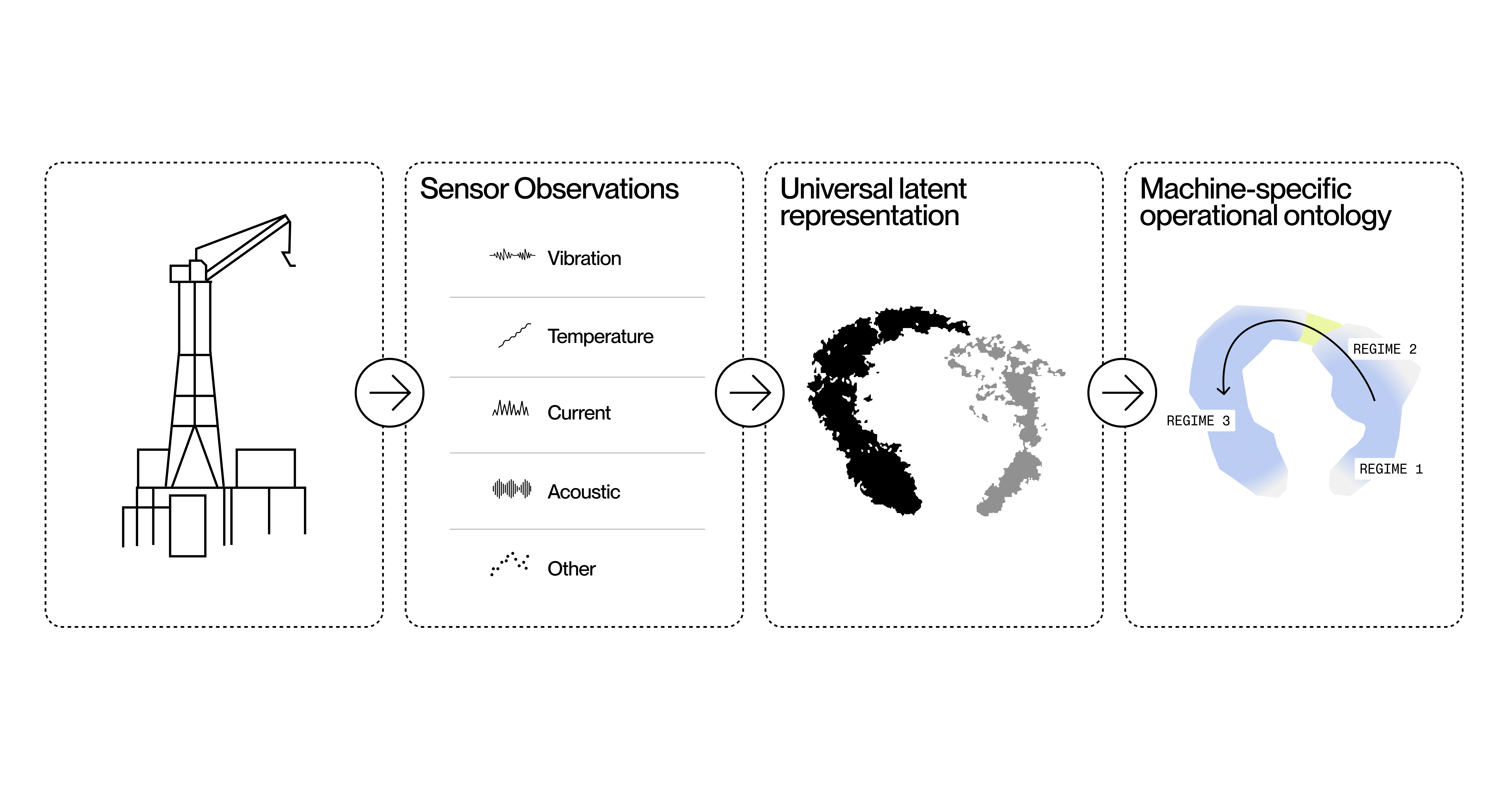
We call this paradigm Adaptive World Models: AI systems that autonomously discover their specific operational structure directly from sensor observations. The architecture combines a universal pre-trained foundation model with adaptive layers that continuously learn each machine’s operational ontology and evolving dynamics over time.
Scaling Operational Intelligence with AI
Imagine every machine, vehicle, production line, and industrial system — not just instrumented, but understood.
Instead of relying entirely on predefined rules, handcrafted taxonomies, or decades of operator intuition, industrial systems learn operational behavior directly from observation. They recognize recurring operational regimes, adapt to machine-specific dynamics, and identify meaningful shifts in behavior before they become failures.
This builds on our existing work showing that AI can learn physical behavior directly from sensor data, without being explicitly taught the underlying laws (see Can AI Learn Physics from Sensor Data?). Adaptive World Models extend that foundation with the local, discrete structure each machine needs to understand its own operational behavior.
As operational structure becomes increasingly discoverable from observation, understanding physical systems becomes a far more scalable — extending modern AI beyond language and vision into the systems that generate energy, move goods, manufacture products, and power critical infrastructure.
The operational intelligence gap does not have to keep widening. Adaptive World Models represent a path toward closing it.
Want to go deeper? Dive into the details in our position paper: Physical System Understanding Requires Locally Adapted World Models.

.webp)