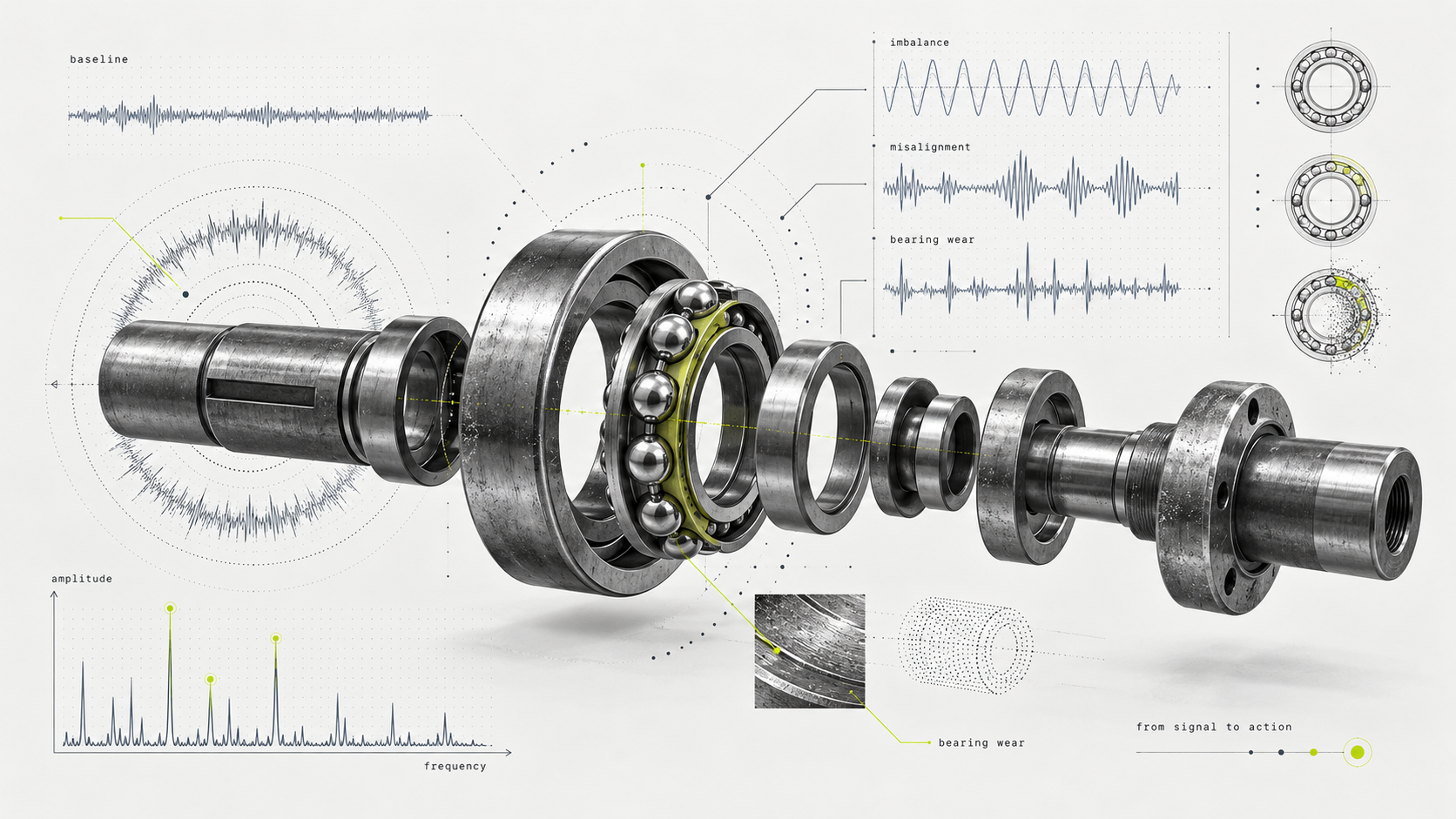
Vibration analysis is the practice of measuring how a machine oscillates and reading those signals for early signs of mechanical wear. It is the most established and, by most accounts, the most commonly used technique in predictive maintenance, because a rotating machine broadcasts its condition through vibration long before a failure becomes visible or audible. The discipline turns raw motion into a decision: keep running, watch closely, or intervene.
This guide covers what vibration analysis measures, the core analytical methods, where it fits inside predictive maintenance, and where foundation models for sensor data are taking the field.
What Is Vibration Analysis?
Vibration analysis is the interpretation of a machine's vibration signature to detect and characterize developing faults. Every rotating asset produces a baseline pattern of motion. When a bearing spalls, a shaft misaligns, or an impeller loads unevenly, that pattern shifts in ways that map to specific mechanical causes. The analyst's job is to separate meaningful change from normal operating noise.
The value is timing. Vibration opens a detection window early in the failure curve, which is why it anchors most condition monitoring programs for rotating equipment. Catching a bearing defect while it is still a faint high-frequency signature, rather than after it has scored a shaft, is the difference between a planned parts swap and an unplanned line stop.
Vibration rarely stands alone. It sits alongside temperature, acoustic, and current monitoring inside a broader predictive maintenance program, each modality covering faults the others miss. Vibration is the backbone for mechanical faults in rotating machinery; the rest extend coverage.
How Does Vibration Analysis Work?
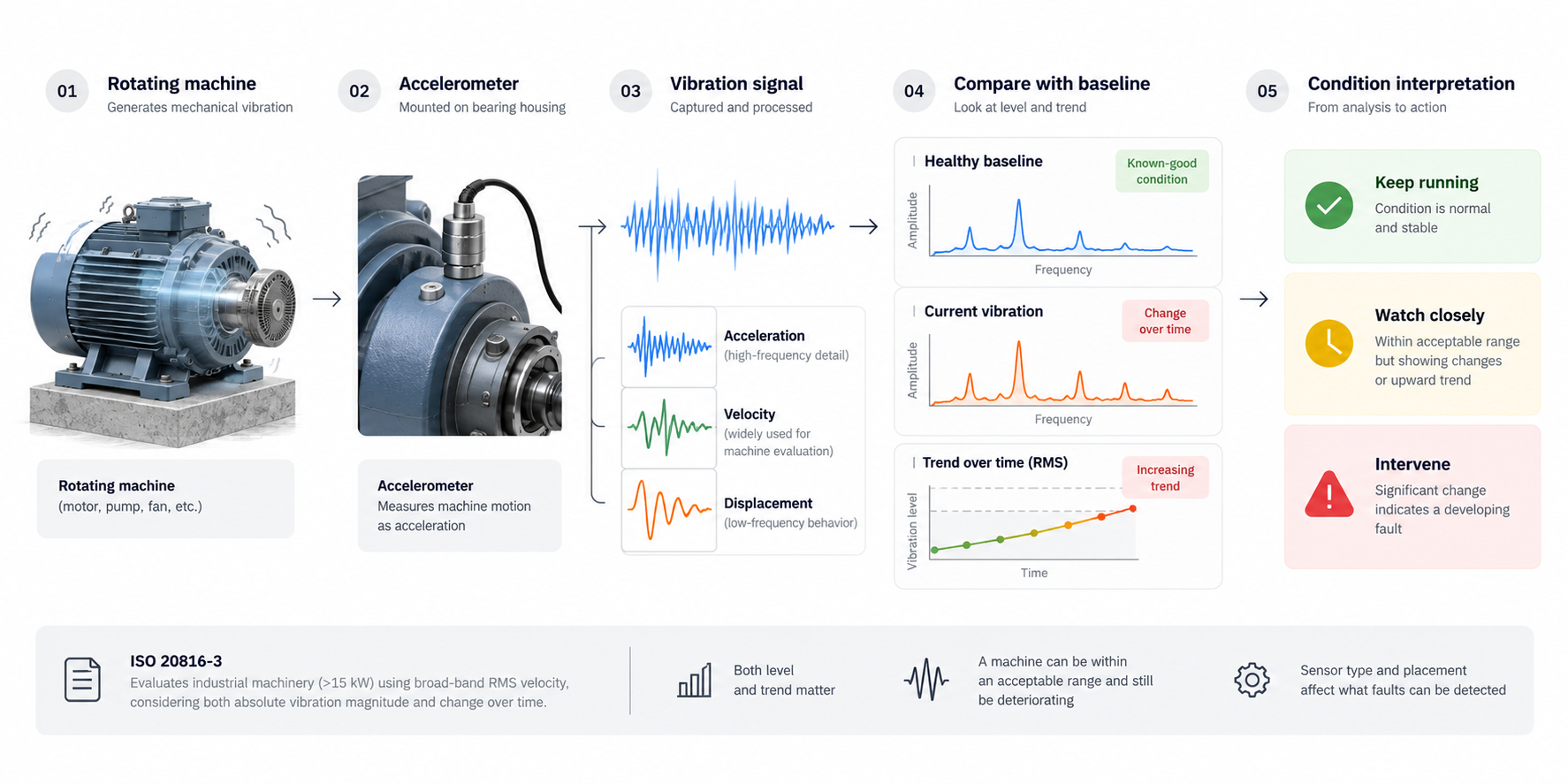
Vibration analysis works by capturing motion at the machine, converting it to a signal, and comparing that signal against a known-good baseline. Accelerometers mounted on bearing housings record acceleration, which is integrated to velocity or displacement depending on the fault and frequency range of interest. Sensor choice and placement determine what the analysis can see, a topic covered in depth in our guide to vibration sensors.
Machines vibrate in two modes. Free vibration is the response of a structure disturbed and left alone, decaying at its resonant frequencies. Forced vibration comes from ongoing excitation, an unbalanced rotor or a meshing gear, and holds steady while the source persists. Most diagnostic work concerns forced vibration, because its frequency content points back to the component producing it.
Severity is judged against published criteria rather than intuition. ISO 20816-3 sets evaluation zones for industrial machines above 15 kW, based on broad-band velocity measured in RMS, and it weighs two things: the absolute magnitude of vibration and the change in that magnitude over time. A reading inside an acceptable zone that is trending upward can matter more than a higher but stable one. That emphasis on change over absolute level is what makes vibration a leading indicator.
Which Vibration Analysis Techniques Matter Most?
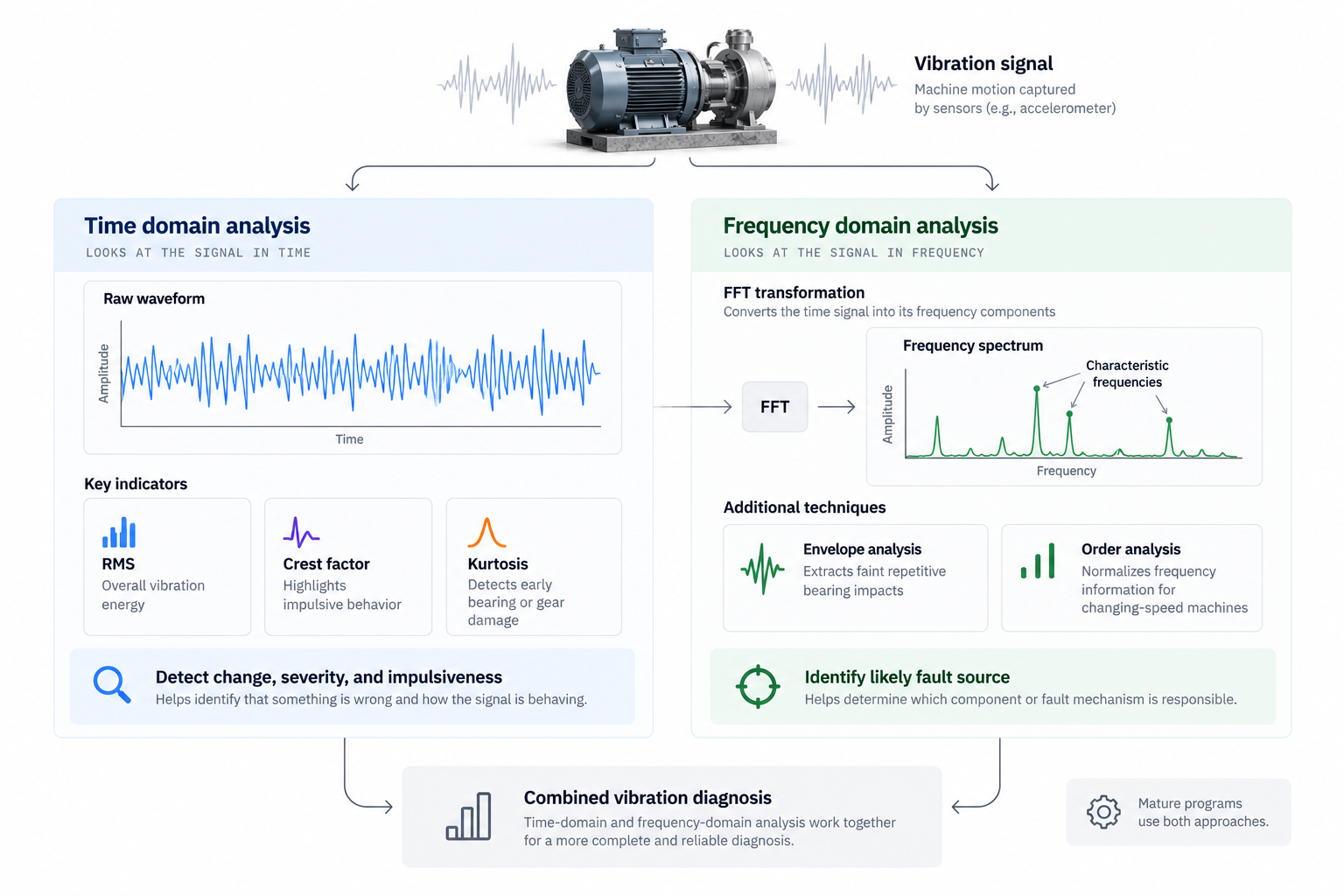
The core methods split across the time domain and the frequency domain, and mature programs use both, as a 2025 review of vibration-based predictive maintenance lays out.
Time-domain analysis reads the raw waveform and its statistics. RMS tracks overall energy and flags progressing imbalance, misalignment, and load change. Crest factor and kurtosis pick up impulsiveness, the sparse shock trains that mark early bearing and gear pitting, before they raise the overall level enough to trip a simple threshold.
Frequency-domain analysis, built on the Fast Fourier Transform, is where diagnosis happens. The FFT decomposes the waveform into its component frequencies, and because each fault excites characteristic frequencies, the spectrum reveals which component is failing rather than only that something is wrong. Envelope analysis, or demodulation, isolates the faint, repetitive impacts of a defective bearing from louder background rotation. Order analysis normalizes the spectrum to shaft speed, which keeps signatures readable on machines that change speed. Matching those signatures to specific defects is the province of vibration diagnostics, a discipline in its own right.
Where Is Vibration Analysis Applied?
Vibration analysis applies anywhere rotating or reciprocating machinery drives production. Motors, pumps, fans, compressors, gearboxes, and turbines are the standard candidates, and the industries that depend on them, manufacturing, power generation, oil and gas, water treatment, are the heaviest users. Bearing wear, imbalance, misalignment, and looseness account for a large share of the faults these programs catch.
The ceiling of traditional practice is scope. A route-based analyst covers a fixed set of points on a schedule, and a single-signal model watches one asset for one fault type. Physical AI platforms are the next step, because a model trained across sensor types and machines can read many streams at once. In one wind-energy deployment, Archetype's Newton model fused data from more than 40 sensors across 63 turbines and surfaced nine previously unknown failure patterns, correlations that per-asset monitoring was not built to find, with an estimated $50 million in annual downtime impact.
How Does Vibration Analysis Fit Into Predictive Maintenance?
Vibration analysis is the sensing layer that makes condition-based intervention possible for rotating equipment. Predictive maintenance replaces fixed schedules with action driven by measured state, and the payoff scales with how expensive stoppage is. Siemens' True Cost of Downtime 2024 put unplanned downtime at roughly $1.4 trillion a year across the world's 500 largest companies, about 11 percent of revenue. Vibration is often the earliest warning that keeps an asset out of that column.
The recurring obstacles are data volume, interpretation expertise, and false alarms. Skilled analysts are scarce, spectra take training to read, and threshold-based alerts fire on benign transients often enough to erode trust. Physical AI platforms ease the interpretation bottleneck: rather than one hand-built model per machine, a physical world model like Newton learns generalizable structure from sensor data and adapts to a new asset from as little as one labeled example, with no retraining. In one energy-production deployment, a containerized Newton agent on a low-cost edge device per pump separated normal from degraded states in real time, keeping assets running longer and cutting false-alarm shutdowns.
How To Choose a Vibration Analysis Approach
Match the approach to the criticality of the asset and the decisions you need to make, not to a feature list. Frequency range and resolution set what faults are visible, since bearing and gear defects live at higher frequencies than imbalance. Monitoring cadence is the next choice: portable route-based collection suits many assets checked periodically, while permanently mounted continuous sensors suit critical machines where a missed week is unacceptable. Analytics is where programs increasingly differ, from manual spectral review to automated pattern recognition. Deployment location matters too. Running analysis at the edge cuts latency and bandwidth and keeps operating data local, which is why Newton distills from a 7-billion-parameter model to a 1-billion version that runs on a roughly 2 GB GPU, with edge inference near 500 milliseconds. Whatever the stack, it has to feed the maintenance workflow, or the diagnosis never becomes a work order.
What Is Next for Vibration Analysis?
The direction is from single-signal, single-asset models toward foundation models that generalize across equipment. Classical practice pairs a fixed threshold or a bespoke machine-learning model with one sensor stream, and both struggle to transfer: a model tuned on one pump rarely carries to the next without rework.
Newton represents a distinct third path. It is neither a rule-based alarm system nor a conventional per-asset model, but a physical world model pretrained on billions of cross-modal sensor measurements, so it arrives already reading vibration, temperature, current, and acoustics together. That pretraining is what lets it generalize across machines and reach up to 90 percent accuracy out of the box, before any site-specific tuning. In the framing Archetype's founders use, Newton is to the physical world what ChatGPT is to language: a general model that adapts to specific tasks rather than one built from scratch for each. For vibration programs, that shifts the work from maintaining a library of narrow models toward supervising one that already speaks the physics.
Frequently Asked Questions
How does vibration analysis detect machine faults?
It compares a machine's current vibration signature against its healthy baseline. Developing faults change the amplitude and frequency content in characteristic ways, so imbalance, misalignment, looseness, and bearing wear each leave a recognizable fingerprint in the data.
What is the difference between time-domain and frequency-domain vibration analysis?
Time-domain analysis reads the raw waveform and its statistics, such as RMS and kurtosis, and is good at flagging that a problem exists and how severe it is. Frequency-domain analysis uses the FFT to reveal which component is failing. Diagnosis usually needs both.
Can vibration analysis predict machine failure?
Yes, within limits. Many mechanical faults progress gradually and show up in vibration early, so analysis can flag a developing problem well before breakdown. Accuracy depends on sensor quality, correct baselines, and interpretation, and vibration covers mechanical faults better than electrical or process ones.
Does AI-based vibration analysis need labeled failure data?
Traditional machine-learning models generally need substantial labeled examples per asset. Physical world models change that: pretrained on large volumes of sensor data, Newton adapts to a new machine or fault from as little as one labeled example, which makes it practical across large, varied fleets.
