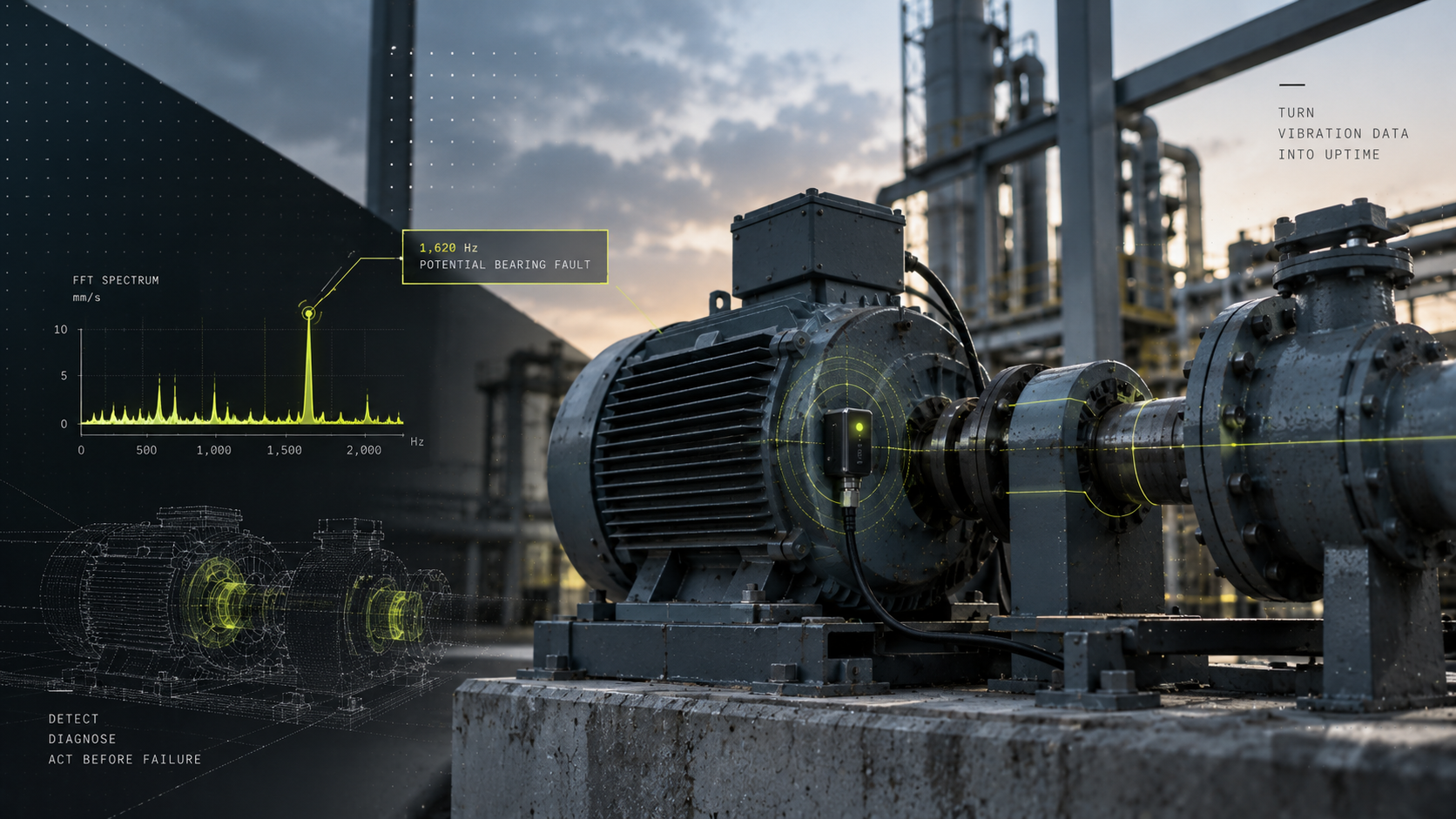
A vibration monitoring system measures the oscillations a machine produces and turns them into an early read on its mechanical health. On rotating equipment such as motors, pumps, fans, and gearboxes, shifts in vibration reveal imbalance, misalignment, looseness, and bearing wear well before they force a shutdown. That early warning is why vibration monitoring sits at the center of most predictive maintenance programs. This guide covers how these systems work, what they are built from, the measurement methods they depend on, and where the technology is heading.
What Is a Vibration Monitoring System?
A vibration monitoring system is the combination of sensors, data acquisition, and analysis that tracks a machine's vibration over time to catch developing faults.
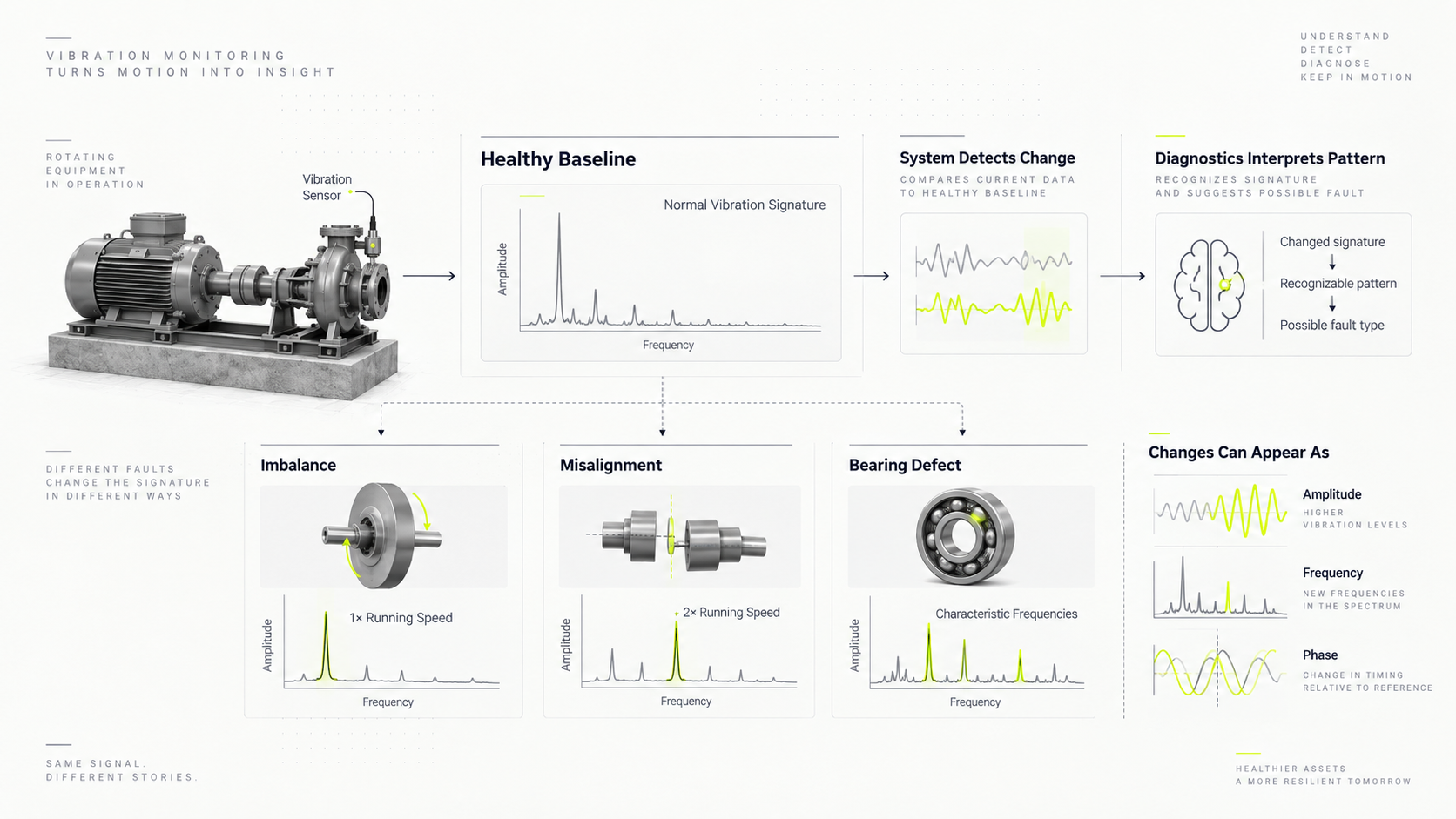
Every healthy machine has a characteristic vibration signature, the pattern it produces when running normally. As a component degrades, that signature changes: amplitude climbs, new frequencies appear, or the phase between measurement points drifts. A monitoring system exists to detect those changes and flag them while there is still time to act.
Interpretation depends entirely on knowing what normal looks like, so a solid baseline is the foundation of the method. Baselines are set when equipment is confirmed healthy, and every later reading is compared against them. Different faults leave different marks. Imbalance tends to raise vibration at running speed, misalignment often shows at twice running speed, and rolling-element bearing defects appear at their own characteristic frequencies. Recognizing those patterns is the work of vibration diagnostics; the monitoring system is what surfaces the change in the first place.
How Does Vibration Monitoring Fit Into Predictive Maintenance?
It gives predictive maintenance the condition data it needs to schedule work by actual wear rather than by the calendar.
Reactive maintenance waits for failure and absorbs the cost of the stoppage. Preventive maintenance services equipment on fixed intervals, which wastes parts and labor on healthy machines and still misses faults that develop between service dates. Predictive maintenance uses condition data, vibration foremost among it, to intervene only when a machine actually shows signs of trouble.
The stakes are large. Siemens, in its True Cost of Downtime 2024 report, put the cost of unplanned downtime to the world's 500 largest companies at roughly $1.4 trillion a year, about 11 percent of their combined revenue. Because vibration changes are among the earliest indicators of mechanical decline, continuous monitoring is one of the most direct ways to keep assets out of that column.
Physical AI platforms are the next step in predictive maintenance, which is why a physical world model like Newton learns each machine's normal behavior directly from its own sensor data rather than depending on fixed alarm thresholds or a separate model hand-built for every asset.
What Are the Key Components of a Vibration Monitoring System?
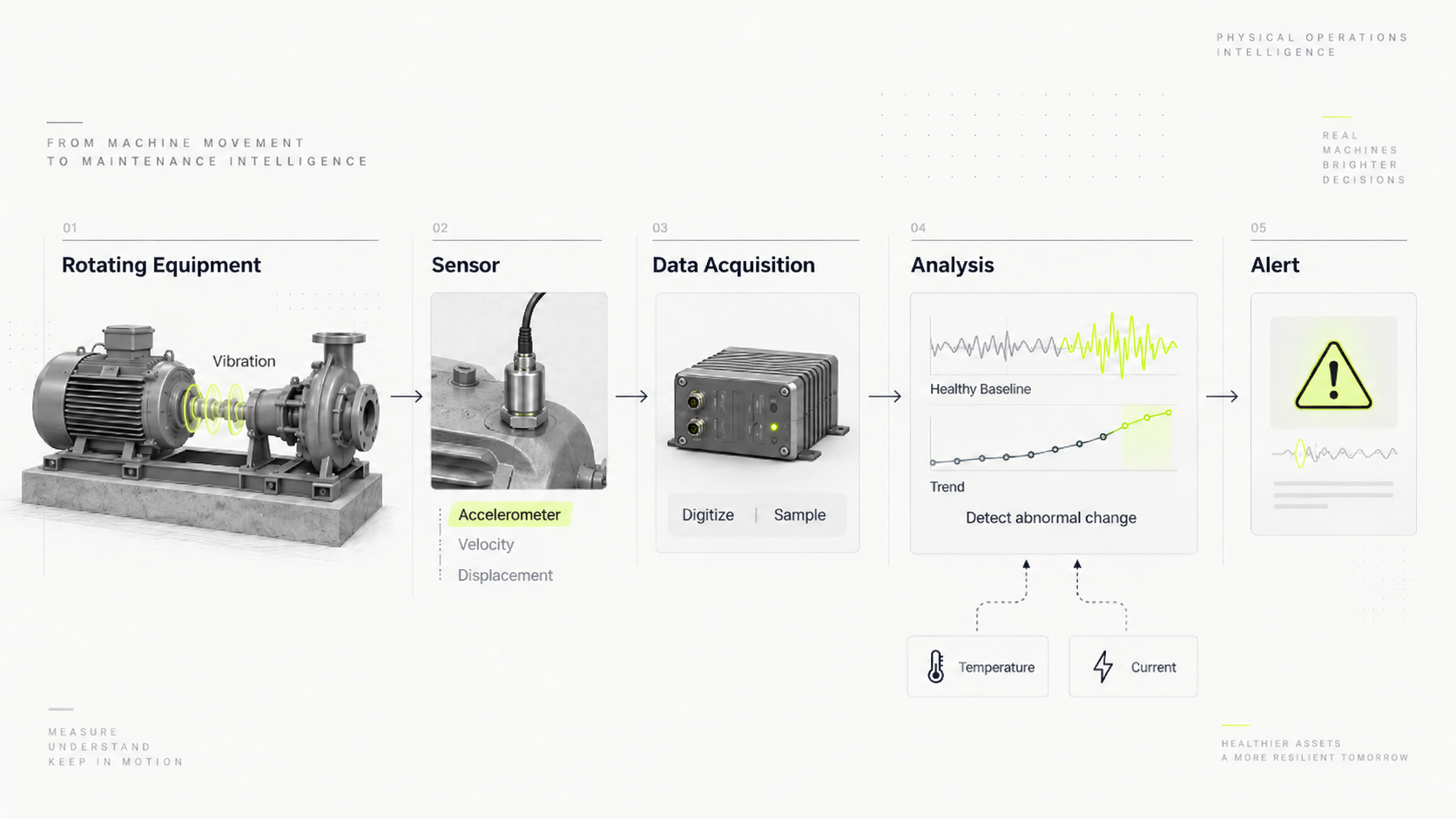
Three parts work together: sensing, acquisition, and analysis.
Sensing usually starts with an accelerometer, the most common transducer because it covers the frequency range where most machine faults appear. Velocity and displacement sensors serve narrower cases. Sensor choice, mounting, and placement decide whether the rest of the chain gets clean data.
Data acquisition digitizes the sensor signal, samples it fast enough to capture the frequencies of interest, and moves it to where analysis happens. Analysis software then compares readings against the baseline, trends them over time, and raises alerts. Feeding that stream into a broader industrial monitoring system lets vibration sit alongside temperature, current, and other signals rather than living in isolation.
Which Measurement Techniques Do Vibration Monitoring Systems Use?
Systems read vibration in two complementary domains, time and frequency, and add targeted techniques for specific faults.
Time-domain measurement tracks the overall vibration level, most often as RMS velocity, which gives a stable indicator of general machine health across a wide speed range. The ISO 20816 series defines severity zones for evaluating those overall levels, giving teams a common reference for when a reading has moved from acceptable to alarming.
Frequency-domain analysis is where individual faults become visible. The Fast Fourier Transform breaks a signal into its component frequencies so an analyst can tie a peak to a specific mechanism. A peer-reviewed review of vibration monitoring for rotating machinery describes how time-frequency methods extend this further, resolving faults in signals that shift as a machine changes speed or load. Envelope, or demodulation, analysis is a specialized technique that pulls the faint, repetitive impacts of an early bearing defect out from under stronger background vibration.
What Are the Challenges and Limitations of Vibration Monitoring?
The method is powerful, but three limits shape how well it works in practice.
The first is false alarms. Fixed thresholds struggle to separate a real fault from a normal change in load, speed, or ambient conditions, and every nuisance alert erodes trust and triggers an unnecessary inspection. The second is variability. Machines that run at changing speeds, or very slowly, produce signals that are hard to read with standard techniques. The third is interpretation itself. That same review notes that maintenance can account for between 15 and 60 percent of the production cost of a finished product, yet the experienced analysts who can read a spectrum reliably are in short supply, and many are retiring.
Physical AI platforms are the next step here as well. Because Newton learns each machine's own baseline from its sensor data, it can tell a genuine change from routine operating variation, which cuts the false alarms that come from static limits. In one energy-production deployment, a containerized version of Newton running on a low-cost edge device per asset separated normal from degrading pump behavior in real time, keeping machines running longer while reducing false-alarm shutdowns. That connects vibration monitoring to broader industrial anomaly detection rather than treating each signal alone.
Where Is Vibration Monitoring Technology Heading?
The direction is clear: cheaper sensing, smarter analysis, and monitoring that runs where the data is.
Wireless nodes built on low-cost MEMS accelerometers are widening coverage from a handful of critical machines to entire fleets. Research on low-cost, edge-based vibration monitoring shows on-device extraction of RMS and frequency features, with only meaningful alerts sent upstream, making continuous monitoring practical where manual routes never reached. On the analysis side, learned baselines are replacing static thresholds, and multimodal fusion is combining vibration with temperature, current, and acoustics for a fuller picture of machine state.
This is where a physical world model changes what a monitoring program can do. Where classical industrial AI builds one model per asset, Newton is pre-trained on billions of cross-modal sensor measurements and generalizes across machines with little or no labeled data, reaching up to 90 percent accuracy out of the box and adapting to a new machine from as little as one labeled example. It runs from cloud to the edge on a single off-the-shelf GPU, and it finds unknown failure modes, not only the ones someone thought to write a rule for. In one wind-energy deployment, Newton fused data from more than 40 sensors across 63 turbines and surfaced nine previously unknown failure patterns. That capability is a core part of what Physical AI brings to condition monitoring.
Frequently Asked Questions
What is the difference between condition monitoring and vibration monitoring?
Condition monitoring is the broad practice of tracking machine health through any indicator, including temperature, oil analysis, ultrasound, and vibration. Vibration monitoring is the specific technique that measures and analyzes machine oscillation, and it is one of the most widely used condition-monitoring methods for rotating equipment.
How often should machine vibration be measured?
It depends on how critical the asset is. Critical machines are increasingly monitored continuously with permanently mounted sensors, while less critical equipment is often checked on periodic routes. The trend, driven by low-cost wireless sensors, is toward continuous coverage of a much larger share of the fleet.
Can vibration monitoring predict bearing failure?
Yes. Bearing defects are among the faults vibration monitoring catches earliest, because they produce characteristic high-frequency impacts that envelope analysis isolates well before the bearing fails, giving teams weeks or months of lead time.
Does vibration monitoring require labeled failure data?
Traditional machine-learning approaches usually need labeled examples of past failures, which are rare in practice. A physical world model like Newton learns normal behavior from unlabeled sensor data and adapts to a new machine from as little as one labeled example, so a program can start without a long history of recorded breakdowns.
