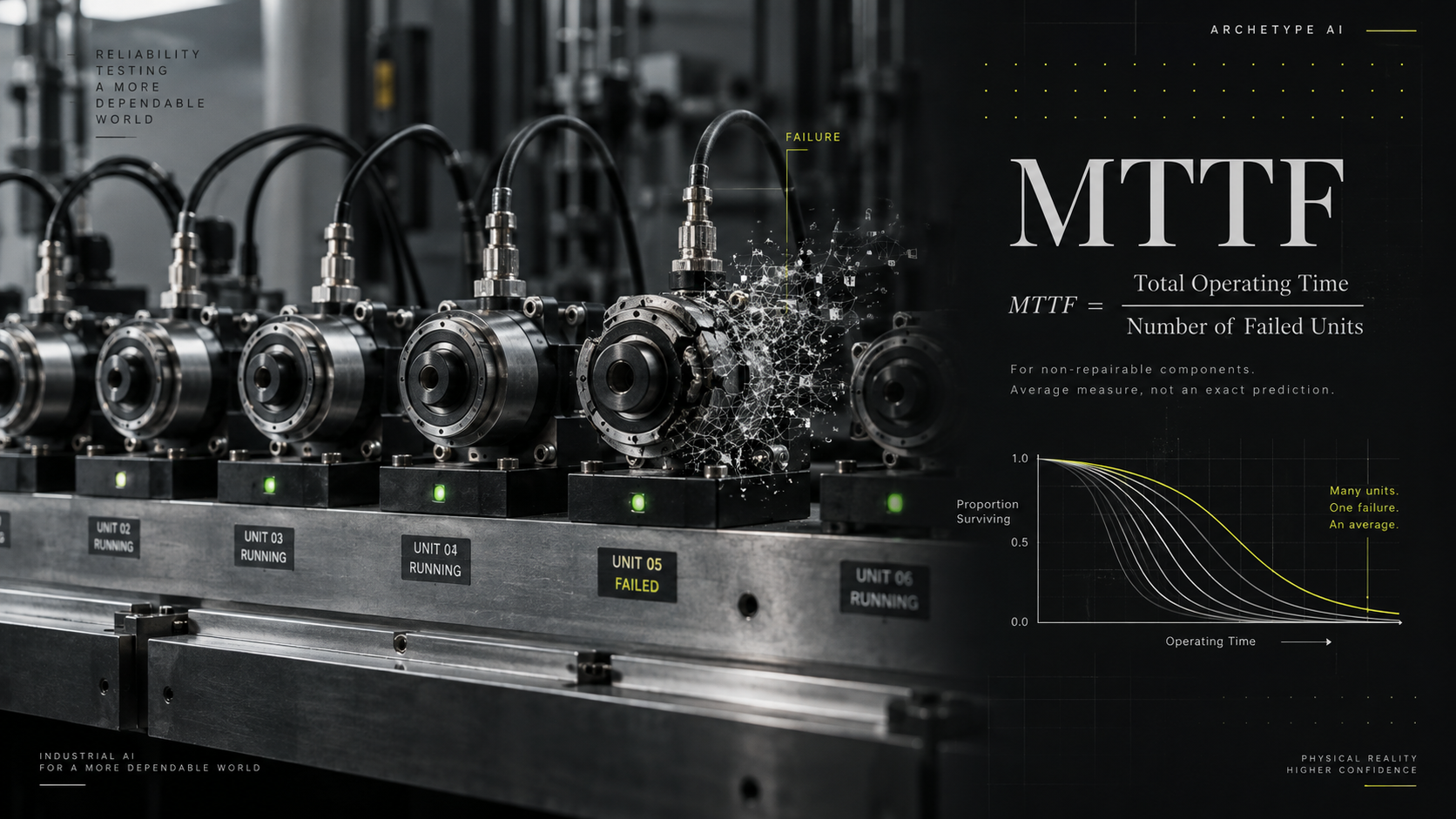
Mean time to failure (MTTF) is the average operating time a non-repairable component lasts before it fails and has to be replaced. It answers one narrow question well: for the parts you discard rather than fix, how long do they typically last? Used correctly, MTTF guides replacement planning and spares inventory. Used loosely, it gets confused with MTBF and treated as a guaranteed lifespan, which it is not. This guide covers what MTTF measures, how to calculate it, what shifts it, and where reliability prediction is heading.
What Is Mean Time to Failure (MTTF)?
MTTF is the mean operating time to failure for a population of identical non-repairable items. The international dependability vocabulary maintained by the IEC, IEC 60050-192, lists "mean operating time to failure" as a standard term, and the definition is settled across the reliability literature. A non-repairable component is one you replace instead of repair when it fails, such as a bearing, a filter, a fuse, a sensor, or an LED. Its MTTF is the average life from installation to failure across many identical units.
Because it is an average, MTTF describes a population, not any single part. A bearing rated at 50,000 hours is not promised to run 50,000 hours. Some units fail earlier, some later, and the mean sits somewhere inside that spread. Treating MTTF as a warranty is the most common way teams misuse it, and it leads to replacement schedules that are either too cautious or dangerously late. MTTF is most useful when you have many identical parts and care about the behavior of the fleet, not the fate of one item.
MTTF shows up wherever assets are made of consumable parts. Electronics makers quote it for boards, capacitors, and LEDs; storage vendors quote it for drives; and plants track it for the bearings, seals, filters, and belts that wear out inside larger machinery. Bearings are the classic case, since a worn bearing is replaced rather than rebuilt and its failure often cascades into the equipment around it, as covered in our guide to bearing failure. In each setting the metric earns its keep the same way: it turns scattered failure records into an expected life you can plan spares and budgets around.
MTTF vs MTBF vs MTTR: What Is the Difference?
The metric you choose depends on whether the asset is repaired or replaced. MTBF, mean time between failures, applies to repairable systems and measures the average operating time between one failure and the next. MTTF applies to non-repairable components and measures the average life from installation to a single, final failure. MTTR, mean time to repair or restore, measures how long it takes to bring a failed asset back into service. A pump has an MTBF; the bearing inside it has an MTTF; the hours spent swapping that bearing feed MTTR.
The distinction is not academic. Quoting an MTBF for a part you actually throw away, or reading MTTF as the interval between repeated repairs, produces reliability plans built on the wrong math. For the full picture of how these metrics combine into availability targets and a reliability program, see our guide to equipment reliability, which treats MTBF and availability in depth. This page stays focused on MTTF and the non-repairable case.
How Do You Calculate MTTF?
The basic formula is simple: divide the total operating time accumulated by a group of identical units by the number of units that failed. When every unit in the sample runs until it fails, that is the same as averaging each unit's time to failure.
As a worked example, suppose you install 20 identical sensors and run them until each one fails. Their operating lives sum to 700,000 hours. The MTTF is 700,000 divided by 20, or 35,000 hours per sensor. That figure now describes the expected life of the next sensor of the same type under the same conditions.
Three pitfalls trip people up. The first is censoring: if some units are still running when you calculate, dividing by only the failed count overstates the true average, so you need methods that account for the survivors. The second is mixing conditions: pooling units that ran hot with units that ran cool produces a number that describes neither group. The third is small samples, where a single early failure swings the result. It is also worth remembering that MTTF is the mean of a failure distribution. When the failure rate is roughly constant over the useful life, MTTF equals one divided by that failure rate, but many real components wear out on a rising curve where that shortcut breaks down. Maintenance software can automate the arithmetic, but the output is only as good as the operating data you feed it.
What Factors Influence MTTF?
MTTF is set long before a part reaches the end of its life. Material and build quality come first: tighter tolerances, better metallurgy, and cleaner manufacturing push the average life up, which is why two components with the same rating can behave very differently in the field.
Operating conditions matter just as much. Heat, vibration, electrical load, humidity, and contamination all accelerate wear, and a component run near its limits will post a far shorter MTTF than the same part run gently. This is why a manufacturer's rated MTTF, measured under controlled conditions, rarely matches what a plant sees on the floor.
Installation and maintenance practices are the third lever. Misalignment, poor lubrication, contamination introduced during service, and incorrect fitting all shorten real-world life. Poor maintenance strategy has a measurable cost at the plant level: Deloitte estimates that it can cut a plant's overall productive capacity by 5 to 20 percent. The upside is that these factors are controllable, which is what makes MTTF a metric you can actively improve rather than just record.
How Can You Improve MTTF?
Start with the vendor-neutral fundamentals. Specify higher-quality components where the failure of a cheap part carries a high downtime cost. Control the operating environment so parts run within their design envelope. Tighten installation and lubrication standards so avoidable early failures disappear. And shift from fixing parts after they fail toward catching degradation early, because unplanned downtime is expensive: Deloitte puts the cost to industrial manufacturers at roughly $50 billion a year. The same analysis finds that predictive approaches, which estimate the remaining runtime of assets rather than replace on a fixed calendar, can raise equipment uptime by 10 to 20 percent and cut overall maintenance costs by 5 to 10 percent. Condition-based programs and trained staff who know what early wear looks like turn those averages into practice; our guide to condition-based maintenance covers how to set that up.
Physical AI platforms are the next step in reliability, because they change what "improving MTTF" can mean. A population-average MTTF tells you when the typical part fails; it cannot tell you whether the specific unit in front of you is about to. Newton, Archetype AI's physical world model, learns the normal behavior of an asset directly from its sensor data and flags the developing failure on that individual unit, so replacement is driven by the actual condition of the part rather than a fleet average. In one industrial deployment, Newton identified developing failures in submersible pumps with 95% accuracy, the kind of early warning that lets teams replace a component just before it fails instead of well before or just after.
How Is AI Changing MTTF and Reliability Prediction?
Classical MTTF assumes every unit behaves like the average, which is a reasonable planning tool but a poor early-warning system. The clear direction of travel is toward per-asset prediction. Data-driven models now estimate the remaining useful life of an individual component from its sensor history, and a 2024 review in Mechanical Systems and Signal Processing documents how quickly these methods have matured. The honest caveat, from the same review, is that purely data-driven prediction depends heavily on the volume and quality of failure data and often generalizes poorly to assets it was not trained on.
That limitation is exactly where the approaches differ. Rule-based thresholds are cheap but blind to anything nobody set a rule for. Conventional machine learning is more capable but usually needs a large, labeled failure history for each asset type, which most plants do not have for their long-lived, rarely-failing parts. A physical world model sits in a distinct third category. Newton is pretrained on how physical systems behave, so it can be deployed with few or no labeled failures, generalizes across different assets and sensor types rather than being rebuilt per machine, and runs at the edge on standard hardware where the sensor data already lives. For non-repairable parts, that means moving past a single rated MTTF toward a live estimate of how much life a specific component has left, without waiting to accumulate years of run-to-failure records. You can read more in our guide to predictive maintenance using AI and how AI handles time series analysis.
MTTF is not going away. It remains the right metric for spares planning, purchasing decisions, and comparing the inherent reliability of non-repairable parts. What changes is that the population average becomes a baseline rather than the whole story, with condition-based prediction filling in what the average cannot see.
Frequently Asked Questions
What is mean time to failure (MTTF)?
MTTF is the average operating time a non-repairable component runs before it fails and is replaced, calculated across a population of identical units. It applies to parts that are discarded rather than repaired, such as bearings, filters, and sensors.
How do you calculate MTTF?
Divide the total operating time of a group of identical units by the number that failed. If 20 sensors accumulate 700,000 operating hours before all failing, the MTTF is 35,000 hours per sensor. Account for any units still running rather than dividing by the failed count alone.
What is the difference between MTTF and MTBF?
MTTF is for non-repairable components that are replaced after a single failure, while MTBF is for repairable systems and measures the average time between successive failures. A bearing has an MTTF; the machine it sits in has an MTBF.
What factors affect MTTF?
Material and build quality, operating conditions such as heat, vibration and load, and installation and maintenance practices all shift MTTF. A part run near its limits or serviced poorly will show a far shorter real-world MTTF than its rated figure.
Is MTTF a guarantee of how long a part will last?
No. MTTF is a statistical average across many units, not a promised lifespan for any single part. Individual components fail on both sides of the mean, which is why condition monitoring is used alongside MTTF for critical assets.
