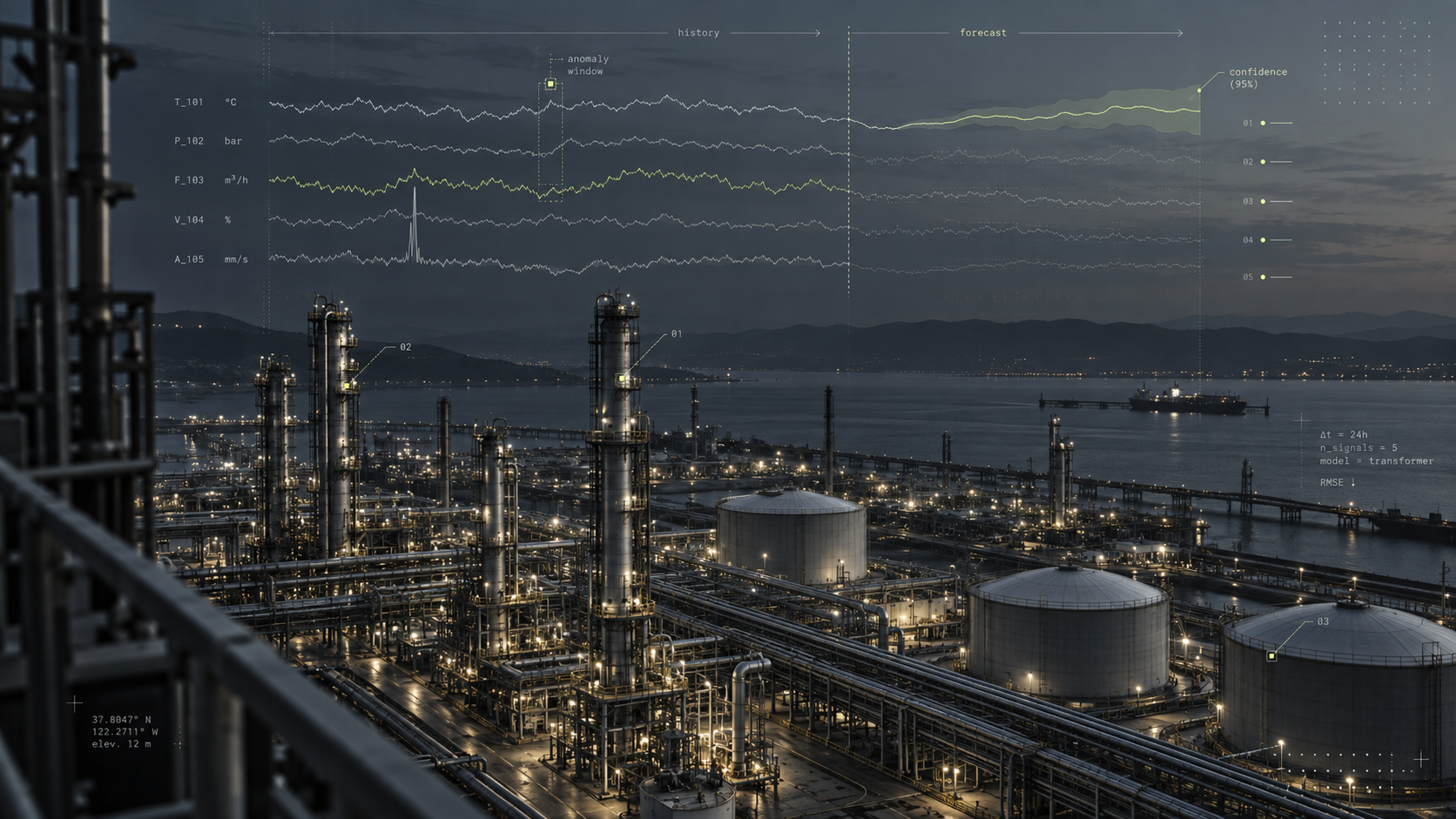
AI for time series analysis is the practice of using machine learning and deep learning to find patterns in data ordered through time, then using those patterns to forecast what happens next or flag when something goes wrong. It matters because the highest-value data most organizations hold arrives as a stream: sales by the hour, power draw by the second, vibration by the millisecond. This guide covers what makes time series data hard for AI, which techniques and model types work, where the approach delivers, where it breaks, and how physical world models are reshaping what sensor streams can tell you.
What Is Time Series Data, and Why Is It Hard for AI?
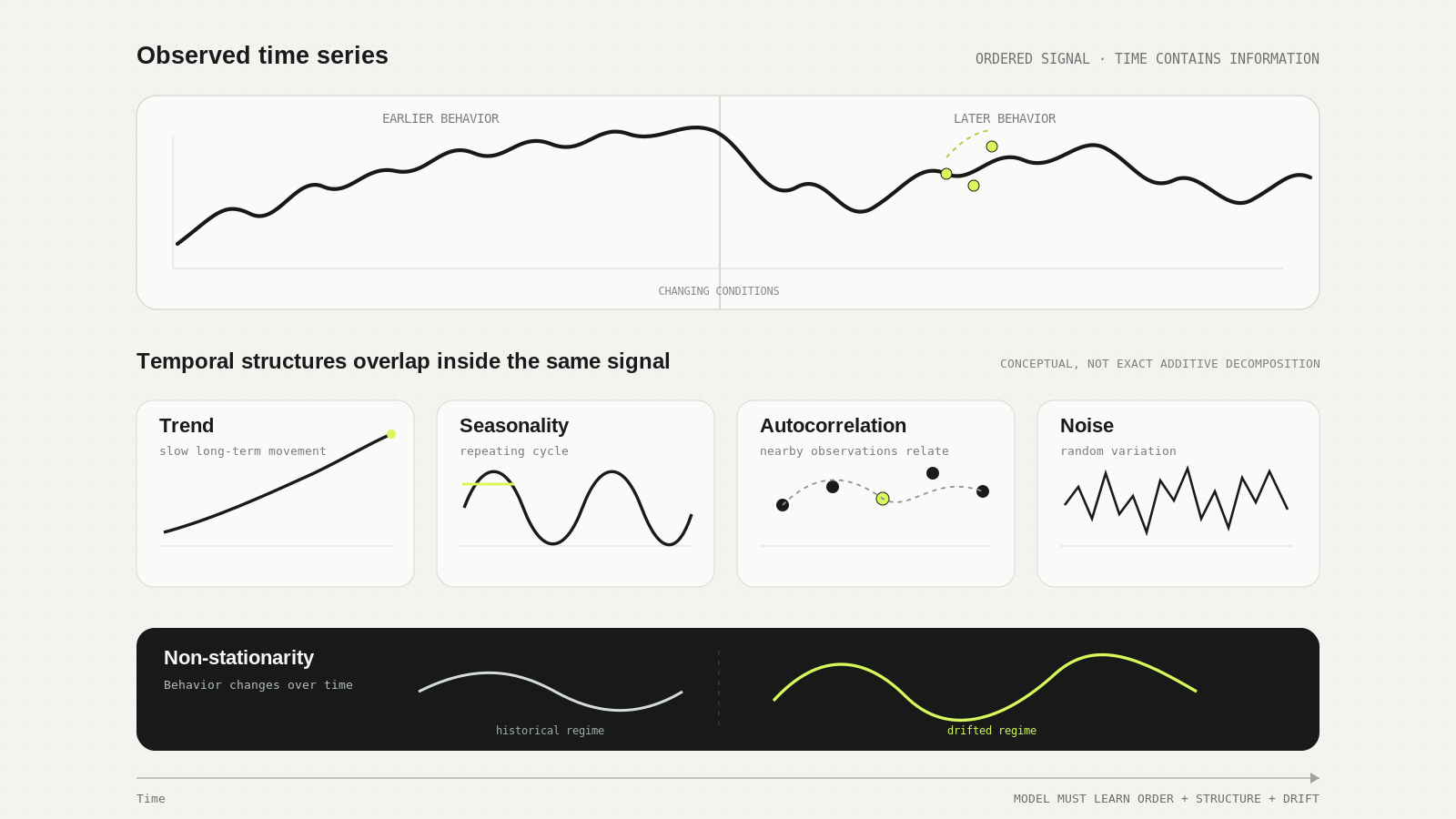
Time series data is any sequence of observations recorded in order over time, where the order itself carries meaning. That property is what separates it from a spreadsheet of independent rows. A reading at 10:00 is related to the reading at 9:59, and shuffling the rows destroys the signal.
Most real time series carry several structures at once: trend, the long slow drift up or down; seasonality, the repeating daily, weekly, or annual cycle; autocorrelation, where recent values predict near ones; and noise, the random variation that hides the rest. A model has to separate these without being told which is which.
The sources span every industry, from tick-by-tick finance prices to retail demand curves to the vibration, temperature, and current a single production line emits from thousands of sensors. Each domain has its own frequency, periodicity, and noise profile, which is why a model tuned for one rarely transfers to another, as a 2024 review of deep learning for time series forecasting documents.
The deeper difficulty is that these signals are non-stationary. Their statistical properties change over time, so a model trained on last year's behavior can quietly degrade as conditions drift. Handling that drift is the central problem in time series work.
Which AI Techniques Work Best for Time Series Analysis?
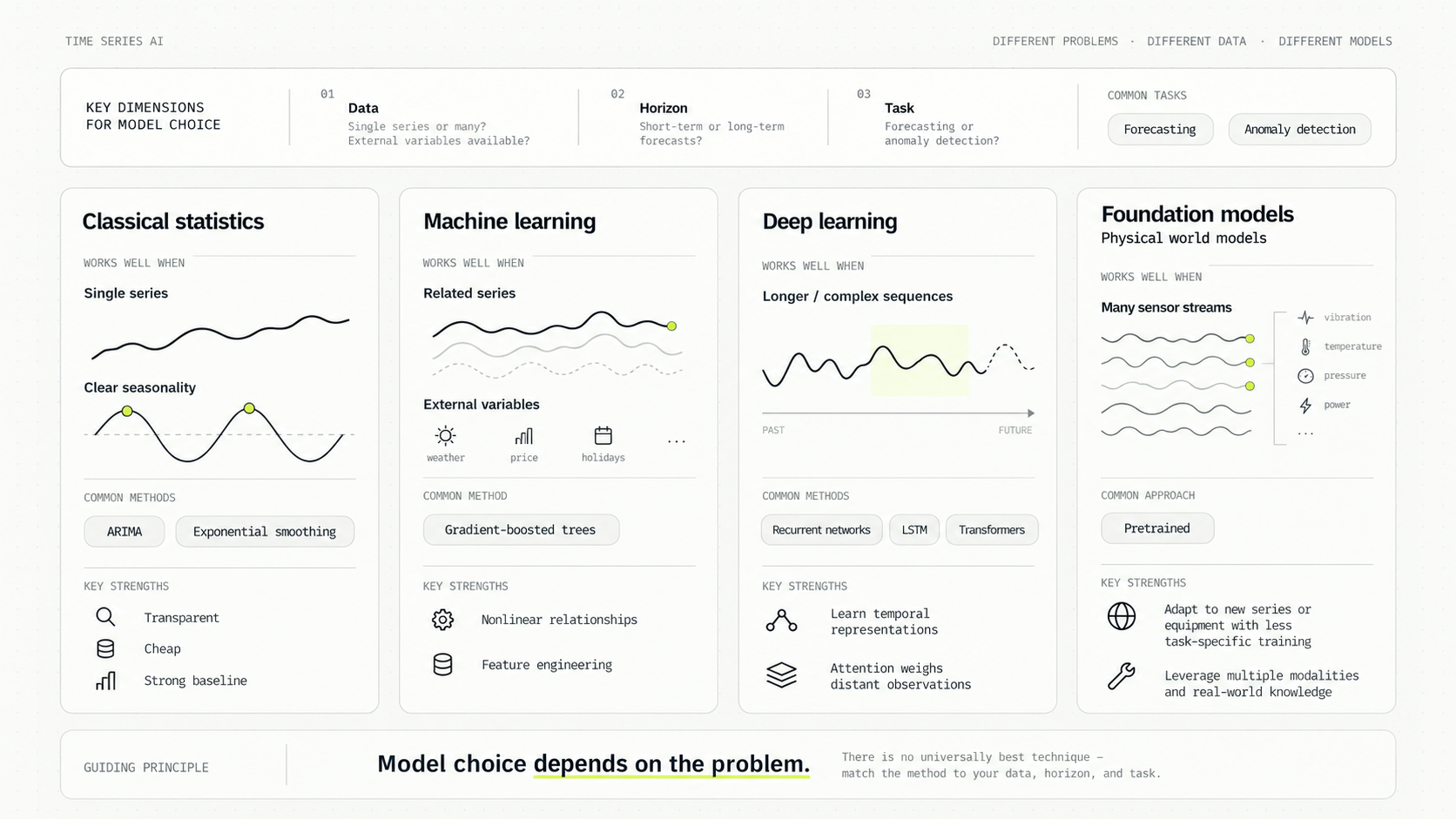
The right technique depends on how much data you have, how far ahead you need to see, and whether the goal is forecasting or catching anomalies. The field runs from classical statistics to deep learning, and the strongest programs use more than one.
Classical statistical methods such as ARIMA and exponential smoothing remain a hard baseline: transparent, cheap to run, and often accurate on single, well-behaved series with clear seasonality. Many teams reach for a neural network when one of these would have won.
Machine learning models such as gradient-boosted trees enter when you have many related series and useful external variables, like price, weather, or holidays. They handle nonlinear relationships that linear methods miss, at the cost of more feature engineering.
Deep learning is where recent gains concentrate. Recurrent networks and their long short-term memory variants were built to carry information across long sequences. Transformers, adapted from language modeling, now lead many long-horizon benchmarks because attention lets a model weigh distant points directly, a shift the same 2024 review traces across a decade of architectures.
Anomaly detection deserves its own note. Forecasting predicts the expected value; anomaly detection flags the observation that does not fit the learned normal. The two run together, because a good forecast is also a baseline against which the unexpected stands out. For industrial signals, real-time multimodal anomaly detection fuses several streams so a fault shows up as a pattern across sensors rather than a single spike.
Physical world models are the next step in this progression. Where a conventional model learns one asset or one series, a model like Newton learns the shared structure across many sensor streams at once and reports what it finds as named operating states a person can act on. Archetype AI's research on teaching language models to read sensor time series shows the direction: turning raw signals into plain-language insight rather than another chart to interpret.
What Model Types Power Time Series Forecasting Today?
There is no single best tool. The practical choice is between building a bespoke model per series, adopting a pretrained foundation model, or combining both.
Purpose-built pipelines still make sense when you have one high-value series, deep history, and time to tune it. Statistical libraries and gradient-boosting frameworks cover this ground well and stay interpretable, which regulated forecasting often requires.
The larger shift is the arrival of time series foundation models. Following the pattern set in language, these are pretrained on billions of observations across many domains, then applied to a new series with little or no task-specific training. A 2024 survey of foundation models for time series catalogs a wave of these models and their zero-shot behavior. Researchers have even shown that large language models can forecast time series with no time-series training at all, treating numeric sequences as another language to complete. The appeal is fewer models to build and a starting point that already knows what a trend and a cycle look like.
Foundation models split by what they consume. Most forecast a single numeric channel; a smaller set is multimodal, fusing sensor readings with text or video. Archetype's TimeFusion, a 2.0 billion-parameter model, unifies human language and time-series sensor data so an operator can ask a machine what is happening and get an answer grounded in the signal. On sensor benchmarks it outperforms language models many times its size, which matters because raw parameter count is a poor guide to performance on physical data.
Model type follows data type. Univariate business forecasting is well served by statistical and boosting methods, with a foundation model as a zero-shot baseline. Multivariate sensor data from physical operations is where a physical world model earns its place, because the value lives in the relationships between streams, not in any one of them.
How Is AI for Time Series Used in the Real World?
AI for time series shows up wherever a decision depends on what a stream is about to do. The clearest returns come from finance, supply chain, and industrial operations, though the maturity varies.
In finance, models forecast volatility, detect fraudulent transaction patterns, and flag market anomalies in real time. Because financial series are close to random in the short run, the wins concentrate in risk and anomaly work rather than in predicting price outright.
In supply chain and retail, forecasting aligns inventory with demand. Machine learning models fold in promotions, weather, and local events that static baselines ignore, reducing both stockouts and the cost of carrying excess. This is the most widely deployed use of time series AI.
Industrial operations are where multivariate sensor forecasting pays off most directly, because the alternative is unplanned downtime. Siemens' True Cost of Downtime 2024 puts the annual loss at $1.4 trillion for the world's 500 largest companies, 11 percent of their combined revenue. AI that reads equipment signals ahead of failure attacks that number directly, which is why AI predictive maintenance has become the anchor use case for sensor time series.
A physical world model widens what counts as a case study here. In one wind-energy deployment, Newton fused more than 40 sensors across 63 turbines straight out of the box, using roughly a year of unlabeled data, and surfaced nine previously unknown failure patterns that single-signal monitoring had missed. That is a model finding structure across dozens of correlated streams, which per-series forecasting cannot do.
What Are the Limits of AI for Time Series Forecasting?
AI for time series is powerful but not magic, and most failed projects trace to a handful of predictable limits.
Data quality is the first constraint. Time series models are unusually sensitive to gaps, irregular sampling, and sensor faults, because a missing stretch breaks the continuity the model depends on. Much of the real work is cleaning and aligning streams before any model runs.
Overfitting and generalization are the second. A model can fit historical patterns beautifully and still fail when the regime shifts, since past behavior is a lossy guide to a non-stationary future. The 2024 deep learning review flags this as an open problem: foundation models inherit strong priors from pretraining, yet their zero-shot accuracy still depends on how close the new domain sits to what they saw in training.
Compute and scalability are the third. Deep models are expensive to train and, more importantly, expensive to serve on high-frequency streams. When decisions have to happen in milliseconds at the machine, sending every reading to the cloud adds latency and cost the operation cannot absorb.
This is where deployment location becomes a design choice. Running intelligence at the edge, where the data is generated, keeps latency low and proprietary data on site. Newton is built to run this way, distilling down to versions that fit a modest on-site GPU, so the same time series intelligence works in the cloud for fleet analysis and at the edge for real-time response. Choosing AI over rule-based monitoring only helps if the model can run where the signal lives.
Where Is AI for Time Series Analysis Heading?
The direction is clear: away from one model per series and toward general models that adapt with little supervision. Three shifts define the next few years.
Foundation models are the headline. As pretrained time series models mature, the default is inverting. Instead of building a model for each new asset, teams start from one that already understands temporal structure and adapt it with a handful of examples. For industrial anomaly detection this collapses deployment from months to weeks.
Multimodal fusion is the second shift. The most useful signal is rarely one stream; it is vibration read alongside temperature, current, and a maintenance log. Models that fuse sensor data with language and video capture the cross-signal dynamics that matter and explain them in terms a person already uses.
The move to the edge is the third. As distillation makes capable models small enough to run on commodity hardware, real-time intelligence stops being a cloud service and becomes a property of the machine itself. That closes the loop between sensing and acting, which is the promise of applying AI to the physical world's time series.
Frequently Asked Questions
What AI techniques are used for time series forecasting?
The main families are classical statistical methods such as ARIMA and exponential smoothing, machine learning models such as gradient-boosted trees, and deep learning models including long short-term memory networks and transformers. Statistical methods win on single, well-behaved series; deep learning leads on long horizons and many correlated series. Strong programs combine them and use a foundation model as a zero-shot baseline.
How is a time series foundation model different from a large language model?
Both are pretrained on huge datasets and applied to new tasks with little or no retraining, but a language model learns from text while a time series foundation model learns from sequences of numeric measurements. Physical world models go further, learning from multimodal sensor data and grounding predictions in how equipment actually behaves rather than in language about it.
Can AI forecast time series without labeled training data?
Yes. Pretrained foundation models can forecast a new series zero-shot, using only recent history as context rather than a labeled training set. Multimodal physical world models extend this to sensor data, adapting to a new machine from as little as one example, which makes them practical in operations that have never labeled their historical signals.
What is the hardest part of using AI for time series data?
Non-stationarity. Because the statistical properties of a series change over time, a model that fit the past can degrade as conditions drift. Handling that drift, along with missing and irregular data, is harder than choosing the architecture, and it is where most of the engineering effort goes.
