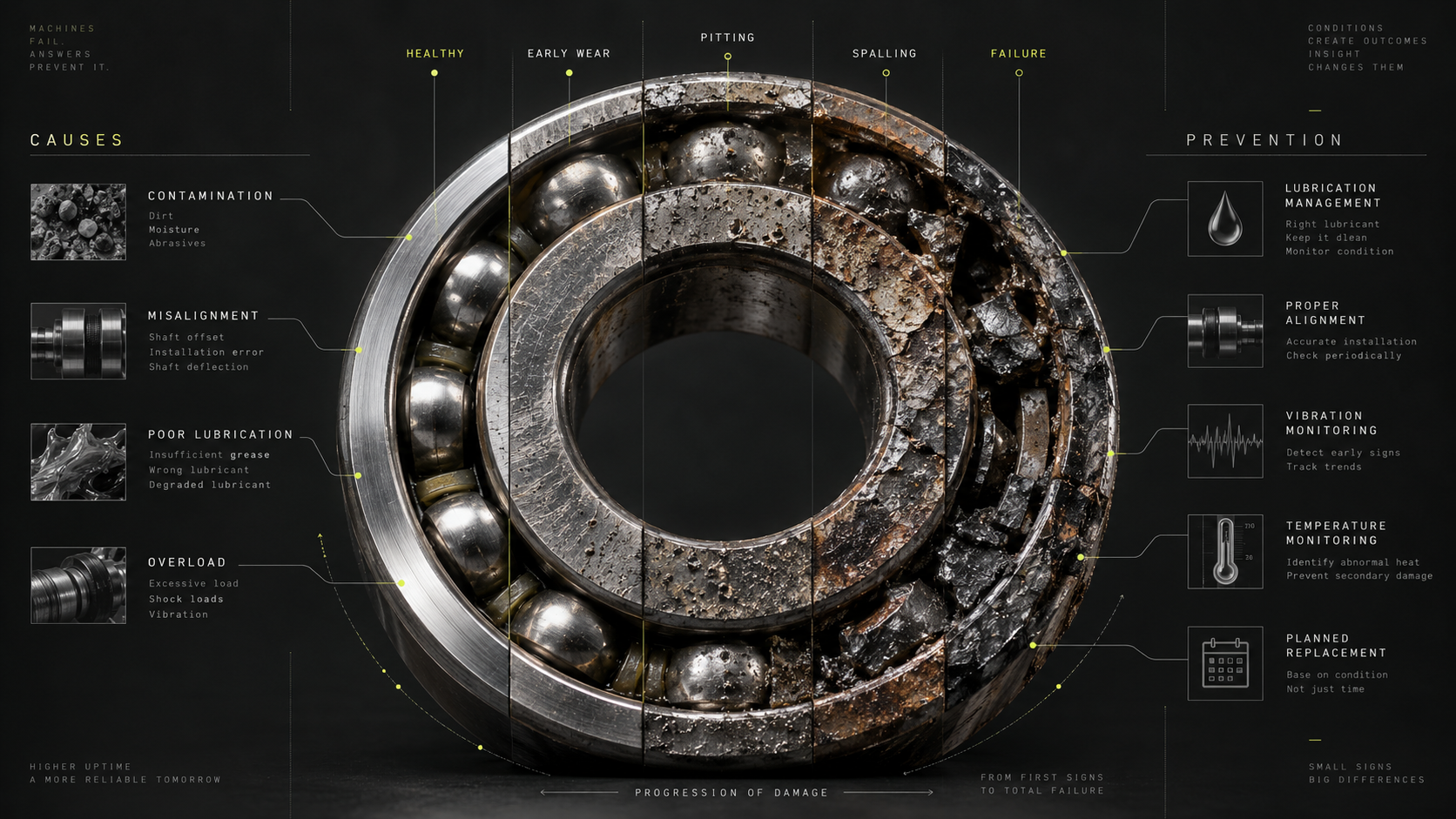
Bearing failure is the breakdown of a rolling-element bearing to the point where it can no longer carry load, locate the shaft, or run within acceptable friction and temperature limits. It matters because bearings sit at the mechanical heart of almost every rotating machine, and when one lets go it rarely fails alone. A seized bearing can wreck a shaft, a gearbox, or a motor winding, and it can stop a production line for hours. The encouraging part is that most bearing failures are not random. They follow recognizable causes and a predictable progression, which means they can be detected early and, in most cases, prevented outright.
This guide covers what bearing failure is, the four stages a bearing moves through as it degrades, the root causes behind premature failure, how to detect and diagnose problems before they become breakdowns, the operational cost of getting it wrong, and where bearing reliability is heading as sensor intelligence improves.
What Is Bearing Failure?
Bearing failure is any loss of a bearing's ability to perform its function, from surface damage that shortens life to the complete seizure that halts a machine. In practice, engineers separate two ideas that often get blurred together. Damage is the physical change to the bearing surfaces, such as a pit, a crack, or a smear. Failure is the point at which that damage makes the bearing unfit for service. A bearing can carry visible damage for weeks before it actually fails, and that window is exactly what condition monitoring exists to exploit.
The most useful framework for classifying what goes wrong is ISO 15243, the international standard that groups bearing damage into six primary modes based on visible characteristics: rolling contact fatigue, wear, corrosion, electrical erosion, plastic deformation, and cracking or fracture. The standard is deliberately built around appearance rather than assumed cause, because a single failure usually involves several mechanisms at once. Major manufacturers including SKF, Schaeffler, and NSK use this same classification as the basis for their own damage analysis, which makes it the common language for root cause work across the industry.
Most industrial machines run rolling-element bearings, and the type shapes how they fail. Deep-groove ball bearings handle moderate radial and axial loads and are the workhorses of pumps, motors, and fans. Cylindrical and tapered roller bearings carry heavier radial and combined loads in gearboxes, axles, and heavy drivetrains. Spherical roller bearings tolerate misalignment in demanding applications such as conveyors and vibrating screens. Plain and sleeve bearings, which rely on a fluid film rather than rolling elements, fail through different mechanisms but face the same underlying enemies of contamination and lost lubrication.
The consequences of a failure ripple outward. Bearings are among the most common failure points in rotating machinery, and a failure that starts as a microscopic subsurface crack can end as a catastrophic seizure that damages the shaft, the housing, and connected components. In electric motors specifically, decades of reliability surveys by IEEE and EPRI attribute roughly 40 percent of all failures to bearings, making them the single largest mechanical failure source in the installed base. That concentration is good news for maintenance teams, because it means attention paid to bearings returns more reliability per hour of effort than almost anywhere else on the machine.
What Are the Four Stages of Bearing Failure?
Bearing failure almost never happens instantly. It develops through four stages, and each one produces a distinct signature that vibration and acoustic instruments can read, which is why a bearing can be caught months before it fails rather than minutes after. Understanding these stages is the foundation of every early-warning program.
In the first stage, damage is invisible. Subsurface fatigue and the earliest micro-cracking beneath the raceway generate tiny stress waves at ultrasonic frequencies, well above the range of ordinary vibration analysis and far above anything a human can hear. There is no heat rise, no audible noise, and nothing to see even under magnification. Detecting a bearing this early requires high-frequency techniques such as acoustic emission and ultrasound, and this is the point of maximum lead time. A stage-one indication can appear well ahead of functional failure, giving planners the widest possible window to act.
In the second stage, the micro-cracks reach the surface as initial pitting and spalling, and the bearing begins to ring at its natural frequencies, typically in the low kilohertz range. This is where classic vibration analysis becomes the primary tool. The energy is still modest and the machine runs normally, but the signature is now clear enough to trend. On critical assets, this is the stage where teams schedule a replacement at the next planned opportunity rather than waiting.
In the third stage, the damage becomes discrete and readable. Specific bearing defect frequencies appear in the vibration spectrum, driven by the geometry of the fault. A defect on the outer race, inner race, rolling element, or cage each produces its own characteristic frequency, and harmonics and sidebands multiply as the damage spreads. Temperature starts to climb and the noise may become audible. At this point the failure is advanced and often visible on inspection, and replacement should not be deferred.
In the fourth and final stage, the bearing is close to seizure. Overall vibration rises sharply, clearances open up into looseness, and the once-clean defect frequencies begin to smear into broadband random vibration as the surfaces tear apart. Temperature can spike quickly as friction runs away. Counterintuitively, the discrete high-frequency signatures can actually drop in this stage because the sharp edges of the defects round over, which is why relying on a single indicator is risky. Once a bearing reaches stage four, functional failure is imminent and the surrounding components are already at risk.
The practical takeaway is that the earlier stages carry the most value. The gap between the first detectable signal and functional failure, known in reliability work as the P-F interval, is where all the planning advantage lives. A program that only catches bearings in stage three or four is really only documenting failures. One that catches them in stage one or two is preventing them. This is the discipline covered in depth in our guide to vibration analysis.
What Causes Bearing Failure?
Most bearings never fail in service at all. SKF's long-running damage analysis found that roughly 90 percent of bearings outlive the equipment they are fitted to. The failures that do occur are overwhelmingly premature, meaning the bearing died well before its rated fatigue life, and premature failures are almost always caused by conditions the operator controls. That reframing matters, because it moves the conversation from bad luck to preventable root causes.
You will often see the claim that lubrication is responsible for 80 percent of bearing failures. Treat that figure with care. It uses a very wide definition that sweeps in any failure with any lubrication link, and it is not the same as the scoped studies that define their terms. In SKF's analysis of premature failures, the picture is more balanced: roughly a third trace to lubrication problems, roughly a third to fatigue, and the remainder split between contamination and application factors such as improper mounting and handling. The honest summary is that lubrication and contamination together account for around half of premature failures, and both are preventable.
Lubrication is the first major cause. A bearing needs a lubricant film thick enough to keep the rolling elements from touching the raceway, and that film depends on the right lubricant, in the right quantity, at the right interval. Too little grease starves the contact and drives metal-to-metal wear. Too much grease churns and overheats. The wrong base oil viscosity for the operating speed and temperature fails to build an adequate film even when the quantity is correct, which is a selection error rather than a quantity error. Grease also degrades over time and loses its ability to protect, so an interval that was correct at commissioning can become inadequate as conditions change.
Contamination is the second. Solid particles that get past the seals, whether from a dirty environment, ineffective sealing, or debris left in the housing during assembly, get over-rolled by the rolling elements. Each particle dents the raceway, and those dents become stress raisers that seed spalling and fatigue. Water and moisture are equally damaging, emulsifying the grease and driving corrosion that leaves an abrasive rust film. In wet or dusty environments, contamination control through better seals and cleaner handling often delivers the single largest reliability gain available.
Mechanical and installation factors make up the rest. Misalignment forces the bearing to carry load unevenly and concentrates stress where it was never designed to go. Overloading, whether from process changes or an undersized bearing, shortens fatigue life dramatically; doubling the load on a ball bearing cuts its rated life by a factor of eight. Improper mounting, such as hammering a bearing onto a shaft or pressing on the wrong ring, brinells the raceways before the machine ever runs. A newer and often overlooked cause is electrical erosion, where stray currents from variable-frequency drives arc across the lubricant film and pit the surfaces, a mode that ISO 15243 now classifies explicitly because it has become common on modern motor systems.
How Can You Prevent Bearing Failure?
Preventing bearing failure comes down to controlling the handful of conditions that cause premature damage, then catching the rare failures early enough to act on them. The practices are well established and mostly inexpensive relative to the cost of a breakdown.
Lubrication management is the highest-impact practice, because it addresses the largest controllable cause. That means selecting the correct lubricant for the load, speed, and temperature rather than defaulting to whatever is on the shelf, applying the right quantity rather than over-greasing on instinct, and setting relubrication intervals based on operating conditions rather than a fixed calendar. Precision lubrication programs, where technicians are trained to measure rather than guess, consistently extend bearing life. Ultrasonic tools that let a technician hear when a bearing has received enough grease take much of the guesswork out of the task.
Contamination control is the close second. Effective seals matched to the environment keep particles and water out. Clean handling during storage and assembly keeps debris from being sealed inside the housing in the first place. Where the environment is genuinely hostile, upgrading to better sealing arrangements or adding protective measures pays for itself quickly, because a dent that takes a second to form can take months to surface as a failure.
Correct installation and alignment prevent a large share of the failures that lubrication and sealing cannot. Bearings should be mounted with the proper tools and techniques, using heat or hydraulic methods rather than force, and shafts should be aligned within tolerance so the load lands where the bearing was designed to carry it. Training the people who do this work is not a soft investment. Because so many premature failures trace to handling, mounting, and lubrication practice, the skill of the maintenance team is often the deciding variable in how long a bearing lasts.
The final layer is moving from fixed-interval maintenance to a condition-based approach, where action is triggered by the actual state of the bearing rather than a calendar. Replacing a bearing on a schedule wastes remaining life if the bearing is healthy and misses the failure if it degrades faster than expected. Monitoring the bearing directly and acting on its real condition captures the full life while still catching the early warning. This strategy, and how to build it, is the subject of our guide to condition-based maintenance.
How Do You Detect and Diagnose Bearing Failures?
Detecting a failing bearing means picking up the signatures of the four stages before the bearing reaches the end of its useful life, and several complementary techniques each cover a different part of that progression. No single method sees everything, which is why mature programs layer them.
Vibration analysis is the backbone. Because bearing defects generate impacts, and each defect location produces its own characteristic frequency, a vibration spectrum can not only confirm that a bearing is failing but also identify which element is damaged and roughly how far the damage has progressed. Outer-race, inner-race, rolling-element, and cage defects each announce themselves at predictable frequencies, and the appearance of harmonics and sidebands tracks the severity. High-frequency techniques such as acoustic emission and enveloping extend the reach into the earliest stage, before ordinary velocity spectra show anything. Continuous vibration monitoring systems make this coverage permanent rather than dependent on a quarterly route.
Thermal monitoring adds a second, independent view. As friction rises through the later stages of failure, so does temperature, and infrared thermography or embedded temperature sensors catch that rise. Thermal signals arrive later than vibration signals, so temperature alone is not an early-warning tool, but it is an excellent confirmation and a reliable last line of defense against runaway seizure. Acoustic and ultrasonic methods, meanwhile, are strongest at the opposite end, hearing the ultrasonic stress waves of stage one and the grease-starvation signatures that precede damage.
Oil and grease analysis rounds out the toolkit for larger and oil-lubricated bearings. Counting and identifying the wear particles in a lubricant sample reveals both the presence of damage and, from the metallurgy of the particles, which component is shedding material. Together these methods give a complete picture, but they also generate a flood of data across many sensors and many assets, and interpreting that data is where most programs strain.
This is where a Physical AI approach is the next step in bearing diagnosis. Traditional monitoring depends either on fixed thresholds, which fire late and generate false alarms, or on a custom machine-learning model trained per asset, which is expensive to build and does not transfer to the next machine. Newton, the physical world model from Archetype AI, learns what healthy operation looks like for a given machine directly from its sensor data and fuses vibration, temperature, and acoustic streams into one shared representation rather than analyzing each in isolation. Because it generalizes across assets, an Anomaly Discovery capability can surface an emerging bearing fault, including failure modes nobody defined in advance, without a hand-built model for every bearing on the plant.
What Is the Operational Impact of Bearing Failure?
The operational impact of bearing failure is measured less in the price of the bearing than in the cost of the stoppage it causes. A bearing might cost a few dollars, but the downtime it triggers can cost thousands per hour, and that asymmetry is the entire economic argument for early detection.
The scale is routinely underestimated. According to Siemens' True Cost of Downtime 2024 report, unplanned downtime now costs the world's 500 largest companies around $1.4 trillion a year, equal to 11 percent of their combined revenue and up from 8 percent five years earlier. The per-hour figures explain why a single failed bearing can be so expensive. In automotive manufacturing, an idle line runs at roughly $2.3 million an hour, which is more than $600 a second. In heavy industry, the exposure at a large plant reaches tens of millions of dollars a year. Against numbers like these, the bearing itself is a rounding error, and the value of catching it early is enormous.
Beyond the direct cost of lost production, a bearing failure disrupts everything downstream of it. An unplanned stoppage forces an unplanned repair, which means emergency parts at premium prices, overtime labor, and a scramble that pulls maintenance staff off planned work. Schedules slip, downstream processes starve or back up, and the recovery costs, from recalibration and quality checks to warm-up cycles, extend the effective downtime well past the moment the line restarts. Siemens notes that these hidden costs have driven a large share of the increase in downtime expense even as incidents have become less frequent, because leaner operations feel every disruption more sharply.
Safety is the impact that never appears on a cost sheet but weighs heaviest. A bearing that seizes at speed can throw a coupling, whip a belt, or send a fractured component across a work area. A failure on a fan, a hoist, or a large drive is a genuine hazard to anyone nearby, and the release of hot lubricant or the sudden loss of a critical function can turn a maintenance issue into an injury. Catching bearing degradation early is therefore not only an economic decision but a safety one, because a planned replacement on a de-energized machine is a fundamentally different event from a seizure under load.
What Do Bearing Failures Look Like in the Field?
Bearing failures follow the same physics everywhere, but they wear different clothes depending on the industry, and a few representative patterns show how the causes and stages play out in real operations.
In general manufacturing, the classic case is a motor or gearbox bearing on a production line, where the assets are numerous, repetitive, and well instrumented. A lubrication interval that drifted out of date, or a seal that let in a fine airborne dust, seeds contamination damage that progresses quietly through the early stages. Because these lines are so densely monitored, the failure is highly catchable, yet it often slips through because the volume of data across hundreds of similar bearings overwhelms a team relying on fixed alarm thresholds. The failures that get caught are the ones where someone was trending the specific bearing, and the ones that get missed are lost in the noise.
In energy and utilities, the assets are high value and safety critical, and bearing failures on turbines, pumps, and large drives carry outsized consequences. Wind turbines are a telling example, because their main-shaft and gearbox bearings run under variable load in remote locations where a manual inspection route is impractical. In one wind deployment, Newton fused more than 40 sensors across 63 turbines using about a year of unlabeled operating data and surfaced nine previously unknown failure patterns that no predefined rule had been written to catch, with the potential to avoid tens of millions of dollars in annual losses. That is the difference between monitoring for faults you already expect and discovering the ones you do not.
In power generation and heavy process industries, pump and fan bearings fail under continuous duty, and the cost of a false alarm can rival the cost of a missed failure, because an unnecessary shutdown of a critical asset is itself expensive. In one energy-production case, a compact Newton Agent ran on a low-cost edge device attached to each asset and separated normal operation from early degradation in real time, keeping machines running longer while cutting the false-alarm shutdowns that erode trust in a monitoring program. The lesson across all three sectors is the same. The bearing physics is well understood, but the bottleneck is turning a torrent of multi-sensor data into a trustworthy, early, and specific call, on every asset rather than only the ones a specialist happens to be watching.
What Is Next for Bearing Reliability?
Bearing reliability is improving on three fronts at once: the bearings themselves, the lubricants that protect them, and the intelligence that watches them. Each is worth understanding, because the biggest near-term gains are coming from the third.
On the materials side, advances in bearing steels, surface engineering, and ceramic hybrid designs are pushing fatigue life higher and tolerance for marginal lubrication further. Ceramic rolling elements resist the electrical erosion that plagues motors on variable-frequency drives, and improved coatings extend performance in corrosive and high-temperature settings. On the lubricant side, better greases and oils with more stable additive packages hold their protective film longer and degrade more gracefully, widening the safe interval between relubrication and reducing the failures that come from a film breaking down before its scheduled service.
The largest shift, though, is in how bearings are monitored. Low-cost sensors and edge computing have made it practical to instrument every bearing rather than only the most critical few, and to process the data where it is generated instead of shipping it to the cloud. This is the ground that predictive maintenance built on connected sensors now occupies, and it is covered in our guide to predictive maintenance using AI. The constraint is no longer collecting the data. It is interpreting it well enough to act.
Physical AI is the next step in that interpretation, and it represents a genuinely different approach from the two that came before. Rule-based monitoring fires on fixed thresholds and cannot tell a real fault from a load change. Conventional machine learning improves on that but demands a bespoke model for each asset, which does not scale to a plant full of different bearings. Newton is a third category. As a physical world model trained on billions of sensor measurements, it learns the normal behavior of a machine from its own signals, adapts to a new asset from as little as a single labeled example with no retraining, and generalizes across machines and use cases so that experience gained on one bearing transfers to the next. It runs from the cloud down to a small edge device, which means the same intelligence that watches a fleet of turbines can sit on a single pump. For a failure mode as common and as costly as bearing degradation, that combination of early detection, cross-asset generalization, and edge deployment is what moves a program from documenting failures to preventing them.
Frequently Asked Questions
What is the most common cause of bearing failure?
Among premature failures, lubrication problems and rolling contact fatigue are the two largest causes, each accounting for roughly a third in SKF's damage analysis, with contamination and mounting or handling errors making up most of the rest. The widely repeated claim that lubrication causes 80 percent of failures uses a much looser definition and should be treated with caution. The practical point is that lubrication and contamination together account for about half of premature failures, and both are within the operator's control.
What are the warning signs of a failing bearing?
The earliest signs are invisible to the senses and show up only on high-frequency vibration or ultrasonic instruments, which is why early detection depends on monitoring rather than inspection. As the failure progresses, the signs become noticeable: increased vibration, discrete defect frequencies in the spectrum, then audible noise and a rising temperature. By the time a bearing is hot or loud, it is usually in the later stages and close to failure, so the goal of any monitoring program is to catch it well before that point.
How long does a bearing last?
A correctly selected, installed, lubricated, and protected bearing usually outlives the machine it is fitted to; SKF estimates around 90 percent of bearings do exactly that. The bearings that fail early almost always do so because of a controllable condition rather than reaching their fatigue limit, which is why realistic bearing life depends far more on maintenance practice than on the catalog rating.
Can a failing bearing be repaired?
In most cases a damaged rolling-element bearing is replaced rather than repaired, because the surface damage that defines the failure cannot be undone. Catching the problem early makes replacement a planned, low-cost event instead of a breakdown, and it protects the shaft, housing, and connected components that a late-stage seizure would damage. As important as replacing the bearing is diagnosing and fixing the root cause, because a new bearing installed into the same conditions will fail the same way.
How is bearing failure detected before it happens?
It is detected by monitoring the signatures a bearing produces as it degrades, primarily through vibration analysis, supported by thermal, acoustic, and lubricant analysis. Each method covers a different stage of the failure, so layering them gives the widest warning. Increasingly, machine-learning and Physical AI systems interpret these signals automatically across many assets at once, flagging the early deviations that a threshold-based system would miss and doing it on every bearing rather than only the ones under manual watch.
Which industries are most affected by bearing failures?
Any industry that runs rotating equipment is exposed, but manufacturing, energy and utilities, and heavy process industries feel it most, because their assets run continuously and a single bearing failure can stop a high-value line or a safety-critical machine. In these settings the cost of the downtime dwarfs the cost of the bearing, which is why bearing monitoring tends to deliver the strongest return of any reliability investment.
