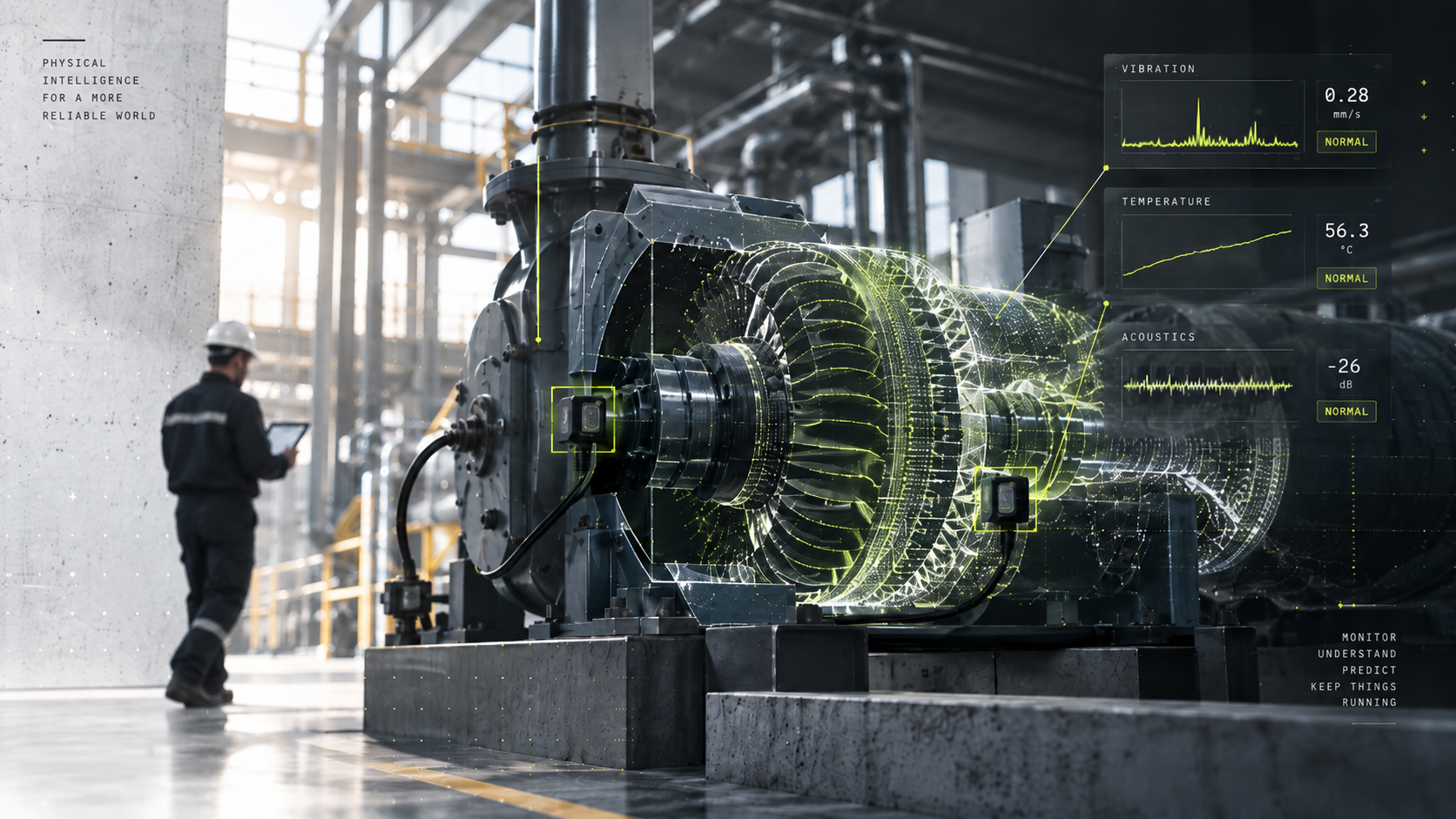
Condition monitoring is the practice of continuously measuring the physical state of operating equipment to detect faults before they cause failure. Instead of running a machine until it breaks or servicing it on a fixed calendar, you track its actual health through sensor data and act when the data says something is changing.
The stakes are concrete. Siemens' True Cost of Downtime 2024 puts the cost of unplanned downtime at $1.4 trillion a year for the world's 500 largest companies, around 11% of revenue. Condition monitoring is the discipline built to close that gap.
What Is Condition Monitoring?
At its simplest, condition monitoring answers one question on a continuous basis: is this machine behaving normally? A healthy motor, pump, or gearbox produces a characteristic signature across vibration, temperature, sound, and electrical draw. When a fault begins to develop, that signature shifts, often weeks before the machine actually fails. Condition monitoring captures those shifts and turns them into a warning.
It sits at the center of predictive maintenance. The distinction matters. Reactive maintenance fixes equipment after it breaks, which is cheap to run and expensive when it fails. Preventive maintenance services on a schedule regardless of condition, which trades unplanned failures for a lot of unnecessary work. Condition-based maintenance uses monitoring data to intervene only when the asset's real state warrants it, which is the balance most reliability programs are chasing.
The field is mature enough to be standardized. ISO 17359 serves as the umbrella standard for machinery condition monitoring, laying out a six-step cyclical process: audit the equipment and its failure modes, run a cost-benefit analysis, define the monitoring strategy, acquire data, analyze and diagnose, then take corrective action and review. That framework is a useful discipline: it forces you to start from the failure modes that actually matter rather than instrumenting everything and hoping.
What Are the Key Condition Monitoring Techniques?
No single measurement catches every fault. A mature program layers several techniques, matching each to the failure modes it detects best.
Vibration analysis is the workhorse for rotating equipment. Every bearing, gear, and shaft produces a vibration spectrum, and specific faults appear at predictable frequencies: bearing defects, imbalance, misalignment, looseness. A rising amplitude at a bearing's defect frequency is often the earliest sign of trouble in a motor or pump. Vibration is direct, fast, and well understood, which is why it anchors most condition monitoring programs.
Thermography uses infrared imaging to find heat where there should not be any. Electrical connections that are loosening, bearings starved of lubrication, and overloaded motors all run hot before they fail. A thermal camera turns that into a visible signal, and it does so without contact, which makes it valuable for scanning electrical panels and hard-to-reach assets.
Oil analysis reads the lubricant like a blood test. Wear particles, viscosity changes, and contamination reveal what is happening inside a gearbox or hydraulic system, frequently before vibration shows anything. For slow-developing wear, particle analysis can give the longest lead time of any technique, which is why ISO 17359's own guidance points to oil analysis for failure modes like gear tooth wear.
Ultrasound and acoustic emission capture high-frequency sound outside human hearing. Early-stage bearing friction, compressed air and steam leaks, and electrical arcing all emit ultrasonic signatures well before they become audible or thermal problems. Acoustic techniques are especially good at catching faults in their earliest phase.
The practical reality is that these techniques are complementary, not competing. The table below maps each to its best use.
TechniqueDetects bestTypical assetsRelative lead timeVibration analysisBearing faults, imbalance, misalignmentMotors, pumps, fans, gearboxesMedium to longThermographyOverheating, loose connectionsElectrical systems, bearingsShort to mediumOil analysisInternal wear, contaminationGearboxes, hydraulics, enginesLongUltrasoundEarly friction, leaks, arcingBearings, valves, electricalLongest for some faults
What Are the Benefits of Condition Monitoring, and Their Limits?
The benefits are well documented, but they deserve a critical read rather than a vendor's optimism.
The clearest gain is less unplanned downtime. Catching a fault early converts a catastrophic 2 a.m. failure into a planned repair during a scheduled window, which is where the cost savings concentrate.
The second benefit is longer asset life. Servicing a machine based on its actual condition, rather than running it to failure or replacing healthy parts on a calendar, extracts more useful life from the same capital.
The third is safety. Many equipment failures are also safety events. Detecting a degrading asset before it fails catastrophically removes a category of risk that never shows up cleanly on a maintenance report.
Here is the critical caveat the vendor literature tends to skip: these gains are conditional on the program being run at maturity. Lower-maturity monitoring programs frequently deliver a fraction of the benefit of fully-scaled ones, and a monitoring system with a high false-positive rate can wipe out its own savings by triggering unnecessary work and eroding technician trust in the alerts. A condition monitoring program is only as good as the signal-to-noise ratio of its alerts. That distinction, between deploying sensors and running a program that people actually act on, is where most of the value is won or lost.
How Do You Integrate Condition Monitoring Into a Maintenance Program?
Buying sensors is the easy part. Integrating them into a program that changes maintenance decisions is the hard part. A few principles separate the programs that work from the ones that gather dust.
Start from criticality, not coverage. You cannot monitor everything, and you should not try. Rank assets by the cost and safety consequence of their failure, then instrument the ones where early warning is worth the most. ISO 17359's first step, the equipment audit and failure-mode analysis, exists precisely to force this prioritization.
Match the technique to the failure mode. A gearbox with a tooth-wear failure mode wants oil analysis; a motor with bearing risk wants vibration. Instrumenting an asset with the wrong technique produces confident-looking data about the wrong thing.
Set thresholds you can defend. The alarm threshold is where a program lives or dies. Too conservative and you replace healthy components and waste the economic benefit. Too aggressive and you get the failure you were trying to prevent. Thresholds are not a one-time setup; they need calibration as you learn each asset's real behavior.
Close the loop to a work order. A reading that sits in a dashboard and never triggers action delivers nothing. The program only pays off when a deteriorating signal automatically generates a planned work order with the right parts and lead time.
The most common failure mode of condition monitoring programs is not technical. It is alert fatigue: a system that cries wolf often enough that operators stop listening. Avoiding that is less about sensor quality and more about the intelligence layer interpreting the data.
Why Does Data Analysis Make or Break Condition Monitoring?
Sensors produce signal. Value comes from interpretation, and this is the stage where most programs struggle. Raw vibration data sampled at tens of thousands of hertz is meaningless until it is processed into health indicators a person can act on: overall vibration levels, specific fault frequencies, temperature trends against a baseline, particle counts over time.
Two hard problems live here. The first is context. A reading of 85°C on a heat exchanger may be perfectly normal during full production and a red flag during a shutdown cycle. A fixed threshold cannot tell the difference; it needs to understand operating state. The second is multi-signal correlation. Most serious failures do not announce themselves in one channel. A degrading bearing might show a slight vibration rise, a small temperature increase, and a subtle change in current draw, each individually within tolerance, only alarming in combination. Detecting that pattern is exactly what multimodal anomaly detection is built for, and it is beyond what threshold-based systems can do.
This is also where the traditional machine learning approach hits a wall. Conventional models are trained one asset at a time, on labeled failure history that most sites simply do not have. Building and maintaining a separate model for every machine, then retraining as conditions drift, is the bottleneck that keeps most programs stuck at low maturity.
What Are the Future Trends in Condition Monitoring?
Three shifts are reshaping the field.
The first is the move from thresholds to learned behavior. Rather than an engineer setting fixed limits, AI-based systems learn what normal looks like for each asset under each operating condition and flag deviations in context. This directly attacks the false-positive problem that undermines threshold-based monitoring.
The second is edge deployment. When a detection window is measured in seconds and bandwidth is limited, sending everything to the cloud does not work. Inference increasingly runs where the data lives, on or near the machine.
The third, and most consequential, is the foundation model. This is a genuinely different category from both rule-based monitoring and per-asset machine learning. A foundation model trained broadly on physical sensor data generalizes across machines instead of being rebuilt for each one. Newton, Archetype's Physical AI foundation model, works this way: its out-of-the-box multimodal sensor fusion combines signals that no single channel could resolve, surfacing hidden machine states without labeled failure history or per-site model development. Physical AI platforms are the next step in condition monitoring, which is why the modeling bottleneck falls away: instead of a months-long project per asset, monitoring can begin closer to the moment sensors come online.
Frequently Asked Questions
What Is Condition Monitoring?
Condition monitoring is the continuous measurement of equipment health through sensor data, including vibration, temperature, oil condition, and acoustics, to detect faults before they cause failure. It is the foundation of condition-based and predictive maintenance.
What Are the Main Condition Monitoring Techniques?
The core techniques are vibration analysis for rotating equipment, thermography for heat-related faults, oil analysis for internal wear, and ultrasound for early friction and leaks. Mature programs combine several, matching each to the failure modes it detects best.
How Does Condition Monitoring Save Money?
By converting unplanned failures into planned repairs. Siemens estimates unplanned downtime costs the world's 500 largest companies $1.4 trillion a year, so even a modest reduction in unplanned stoppages pays for a well-run program.
What Is the Difference Between Condition Monitoring and Predictive Maintenance?
Condition monitoring is the data-gathering and analysis layer that measures asset health. Predictive maintenance is the broader strategy that uses that data to forecast failures and schedule interventions. Monitoring is the input; predictive maintenance is the decision.
How Is a Foundation Model Different From Traditional Condition Monitoring?
Traditional monitoring uses fixed thresholds or per-asset machine learning models that require labeled failure history and retraining. A foundation model like Newton is pre-trained on physical signals broadly, so it generalizes across assets and deploys without years of site-specific data.
Can Condition Monitoring Improve Safety?
Yes. Many equipment failures are also safety incidents. Detecting a degrading asset before catastrophic failure removes a class of risk, particularly for high-energy rotating equipment and electrical systems.
