
Priya Shivakumar
As AI moves into the physical world, it opens up new possibilities for manufacturing, energy, airports, logistics, and other industries. Physical AI can improve efficiency, reduce downtime and waste, extend equipment life, and help address labor shortages. But turning that potential into business results is proving difficult. Many AI programs are still built one asset and one use case at a time, producing promising results without a clear path to broader deployment.
In our conversations with operators, we hear strong interest in Physical AI, along with fundamental questions about what adoption should look like. Where should they start? What capabilities can they introduce across their operations, and in what order? How can they expand deployments while maintaining control and demonstrating business value? And how will the role of human operators change as systems become more intelligent and autonomous?
To help enterprises navigate these decisions, we developed the Physical AI Maturity Model. It provides a practical framework for assessing current capabilities, identifying opportunities, and charting a path toward greater intelligence and autonomy across their operations.
Our central argument is that intelligence and scale must advance together. Greater intelligence expands what individual systems can do. Greater scale brings those capabilities to more assets and across more of the operation. Progress on both fronts turns isolated successes into sustained business value.
Lessons from autonomous driving
When driver-assistance features first emerged, the term "self-driving" covered everything from lane assist to fully driverless vehicles. SAE International addressed this by establishing six levels of driving automation, defining what the system handles, what the driver remains responsible for, and the conditions under which it operates. This gave automakers, regulators, suppliers, and buyers a common language for describing and measuring progress.
Physical industries need a similar framework, one that accounts for the far greater variety of machines, environments, and operational demands. The Physical AI Maturity Model draws on our deployments across energy, manufacturing, and city infrastructure to provide a common way to assess progress across any platform, model, or hardware, from robots to the equipment already on the floor.
A roadmap for industrial autonomy: intelligence and scale
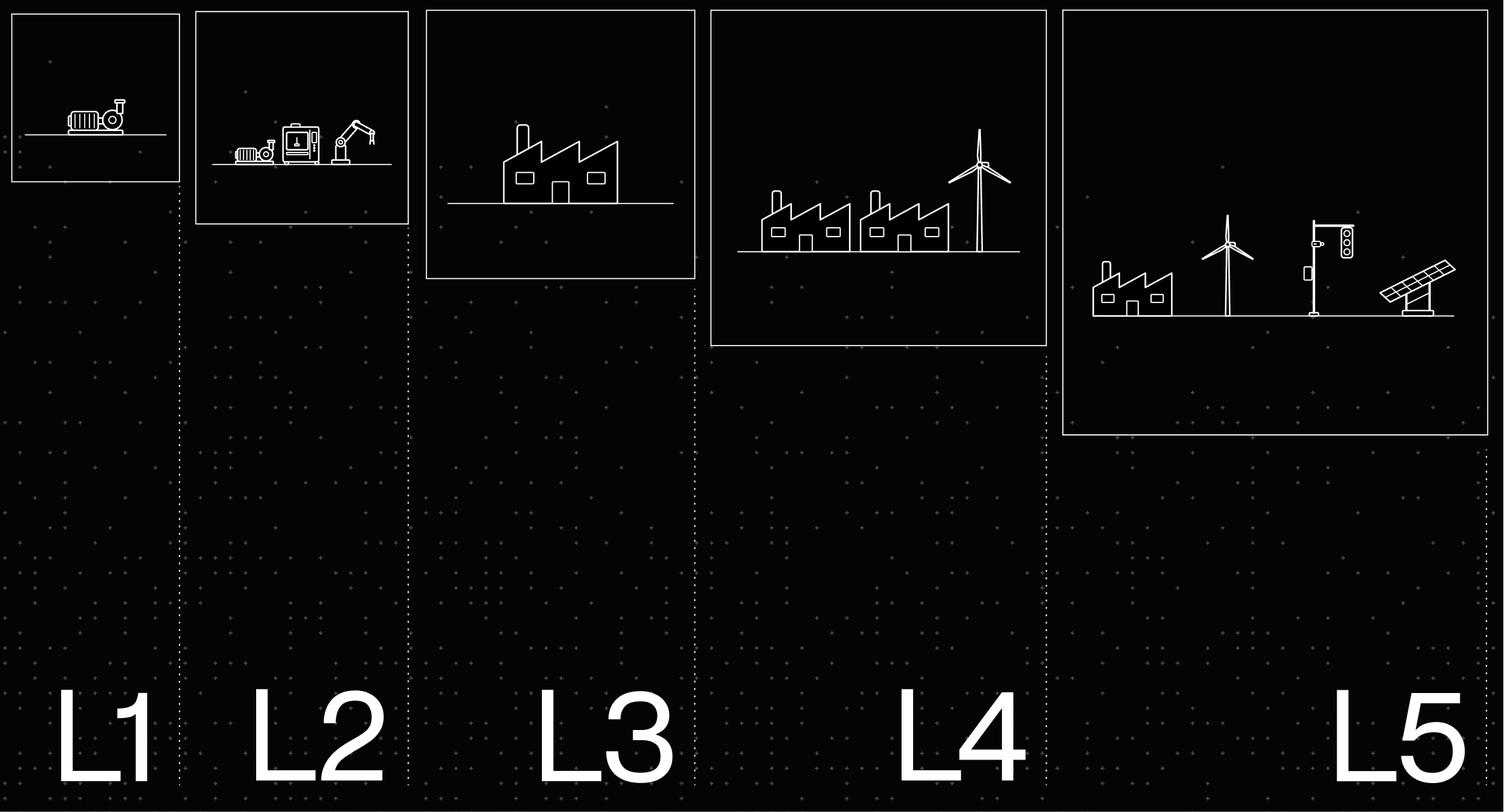
Intelligence defines how much decision-making the industrial system handles autonomously. Following a similar approach to the automotive framework discussed above, it progresses through six levels adapted to physical operations, each building on the capabilities of the one before it:
- L0—Human-guided operations: People interpret data and make decisions, providing the starting point for many enterprises.
- L1—Detection: AI identifies operating states, anomalies, and drift.
- L2—Understanding: AI explains behavior and diagnoses problems using contextual and domain knowledge.
- L3—Prediction: AI anticipates outcomes, such as equipment failure or successful task completion, so operators can act early.
- L4—Action: AI makes and executes decisions within human-defined limits, such as initiating recovery, adjusting operating parameters, or moving materials.
- L5—Orchestration: AI coordinates decisions and actions across multiple interacting autonomous systems, balancing competing priorities to achieve broader operational goals. At its fullest, L5 leads to physical superintelligence: all five capabilities working together across an entire operation.
Responsibility gradually shifts from people to the system as teams validate each capability and build confidence. People continue to define goals, set boundaries, and retain oversight.
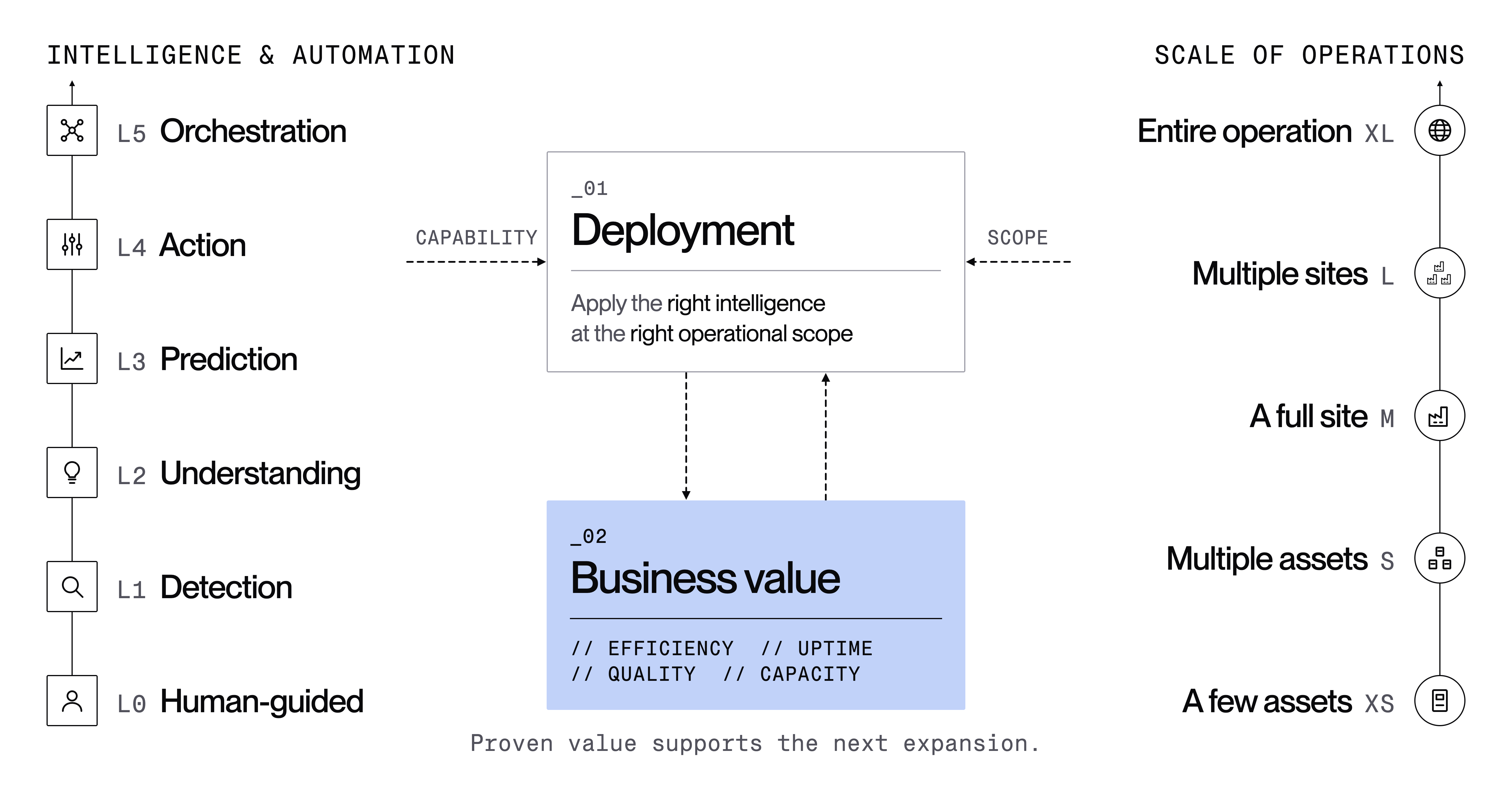
Two axes guide Physical AI deployment and value creation in real-world applications: Intelligence and Scale.
Scale measures how widely AI is deployed across an organization’s physical operations. The scope depends on the customer, but can progress from:
- XS: A few assets, such as machines, oil wells, or wind turbines.
- S: Multiple assets within a site, such as multiple machines on a production line.
- M: A full site, such as an entire production line within a factory.
- L: Multiple sites.
- XL: The entire operation, e.g., the entire factory and logistics infrastructure.
Scaling introduces a distinct challenge. In autonomous driving, the core task always remains human driving. In manufacturing, energy, and logistics, scaling brings increasingly diverse tasks, equipment, and processes even within a single facility.
Scale therefore requires adaptability across different kinds of operations, beyond repeating the same application on more assets.
The two axes reinforce each other. Broader deployment exposes the system to more data, tasks, and operating conditions, creating opportunities to improve its understanding and predictions. Greater intelligence, in turn, delivers more value at each asset and strengthens the case for further deployment.
Five stages of Physical AI maturity
Enterprise maturity in Physical AI reflects progress in intelligence and scale: the deployed Physical AI systems are making increasingly complex decisions autonomously across more operations and larger scale.
Scale also reflects time. Deployment expands gradually from assets to sites and fleets as teams integrate equipment, validate performance, adapt workflows, and build confidence. It represents accumulated experience, though time alone does not establish maturity.
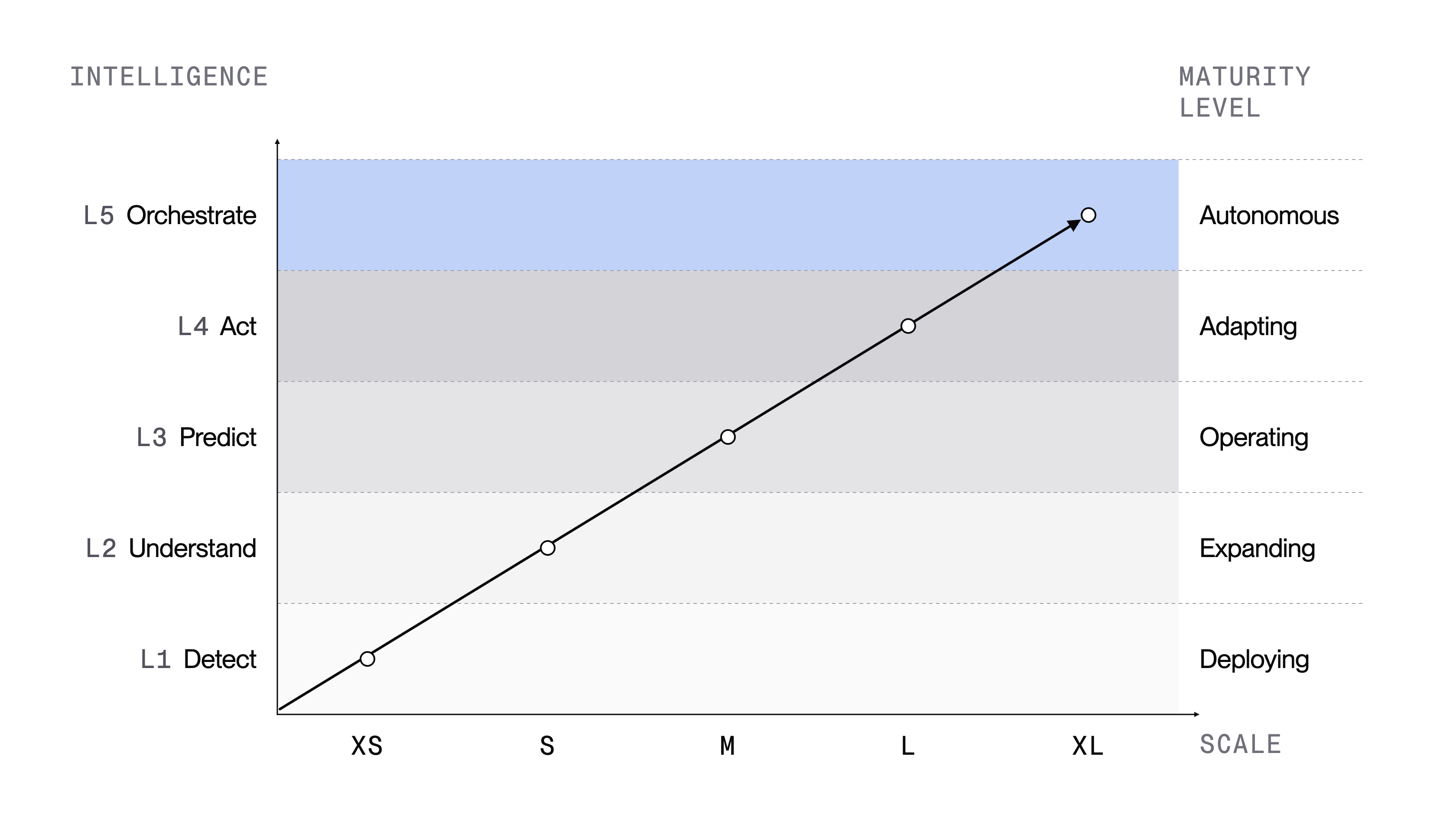
The diagonal line represents the enterprise progression across scale and intelligence, moving the enterprise through different stages of readiness for Physical AI.
The measure of progress is the value delivered, from reducing monitoring effort to improving productivity, resilience, and capacity across the enterprise:
- Deploying—prove value on a few assets. AI detects operating states, anomalies, and changes, helping operators identify problems earlier with less data review. Operators decide how to respond. Success means measurable improvements on a defined problem: fewer missed faults, faster detection, or reduced monitoring effort.
- Expanding—extend coverage and accelerate diagnosis. AI combines sensor streams with domain knowledge to explain problems across more assets within a site. Operators retain control, but spend less time investigating issues and can apply expertise more consistently. Reusing capabilities lowers deployment cost per asset and extends the reach of scarce specialists.
- Operating—prevent losses and improve performance. AI predicts outcomes, recommends interventions, and begins executing actions under supervision. Operations shift toward preventive maintenance and timely process adjustments. Business outcomes include less unplanned downtime, lower material waste, better quality, and more predictable output.
- Adapting—sustain performance as conditions change. AI adjusts routine control across diverse assets and processes without requiring approval for every action. Operators oversee performance and handle exceptions. Business outcomes include reduced manual intervention, stabilized throughput and quality, and improved energy and resource efficiency.
- Autonomous—optimize across sites and networks. AI orchestrates interacting systems, coordinating production, maintenance, energy, and logistics against shared objectives. People set priorities, limits, and oversight. The business opportunity expands to higher capacity utilization, more reliable delivery, greater resilience, and increased output without proportional growth in operating effort.
From the Operating stage onward, the economics can change more substantially as AI moves from supporting decisions to participating directly in control.
Paths to maturity—and why programs stall
Organizations can follow three broad strategies, depending on their goals, readiness, and tolerance for risk:
- Balanced: Advance intelligence and deployment scale together, following a gradual diagonal path through the maturity model. Each expansion builds on validated capabilities.
- Aggressive—intelligence first: Develop and validate greater autonomy on a small set of assets before extending it across operations, moving above the diagonal.
- Conservative—scale first: Deploy proven capabilities across more assets and sites before introducing higher intelligence and autonomous control, moving below the diagonal.
The right strategy depends on business priorities, operational complexity, available expertise, and the consequences of error. Each can deliver value, but its extremes create distinct barriers to further progress.
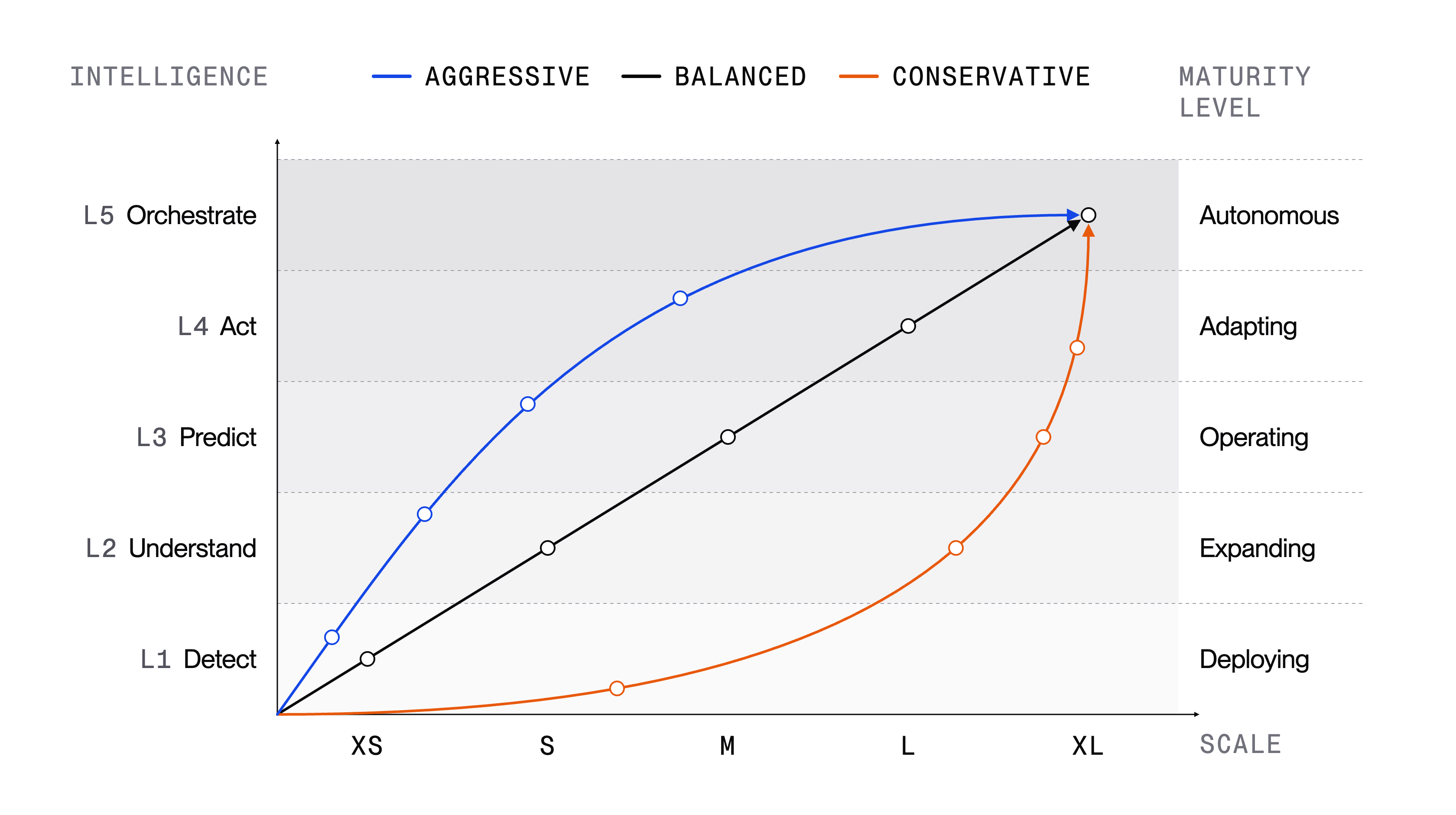
Intelligence stalls when it becomes too specialized to scale, and scaling stalls when intelligence stays low. The balanced path advances both at once.
Intelligence without scale is the risk of an aggressive strategy. A highly specialized system achieves autonomy within a narrow task but requires substantial engineering to extend beyond it. A welding robot, for example, may perform its task autonomously, yet need reprogramming or integration work for a different product, layout, or process. The deployment can be commercially successful while remaining a local solution.
Scale without intelligence is the risk of a conservative strategy. Coverage expands across operations, but capabilities remain limited to monitoring and alerts. These deployments can deliver meaningful value, yet broader coverage alone does not unlock the additional benefits of diagnosis, prediction, and autonomous action.
Organizations need both a clear destination and manageable steps that connect ambition to evidence. Each deployment delivers measurable value while building reusable capabilities for the next increase in intelligence or scale.
Technology requirements for Physical AI maturity
Advancing intelligence and scale together depends on AI that can be reused across assets, tasks, and sites. When every new deployment demands a new model and custom engineering, costs grow with every asset and programs stall before they reach scale. Five requirements separate systems that scale from those that don't, and they work as a checklist for evaluating any Physical AI platform.
- A foundation model that generalizes and adapts locally. Models should work across sensor types, equipment, and industries, and learn each asset’s behavior from its own measurements and context. This allows AI to scale efficiently across assets by removing asset-specific model development requirements.
- Sensor fusion with domain knowledge and context. Moving beyond simple alarms means connecting measurements with their meaning: combining physical signals such as vibration, current, audio, and video with specifications, manuals, and maintenance records. This not only improves accuracy but also increases the economic value of Physical AI by providing high-impact solutions, such as identifying the root causes of observed events.
- Natural language interaction. Operators and engineers should be able to ask questions, review findings, and define tasks in their own domain terms. When the people who know the operation can use the system directly, adoption scales across teams and sites without requiring data scientists and AI specialists.
- Secure edge-to-cloud deployment. Task-specific agents should run close to equipment to keep operational data on-site, preserve operator control, meet data sovereignty requirements, and reduce latency, data transfer, and cloud inference costs. They can use secure cloud resources when greater intelligence requires more compute. Standardized edge infrastructure accelerates rollout across sites.
- AI that builds and manages agents. A new application should not require a specialist development project every time. AI-assisted tools should help teams build, deploy, and manage agents for specific workflows, so proven capabilities can be reused and extended across the operation.
Together, these requirements make a practical path to maturity possible: adapt intelligence to each operation, reuse what works, and expand value without restarting the engineering at every asset.
How Newton meets these requirements
We built Newton, Archetype AI’s physical world model, and the Archetype AI platform around these requirements. Newton is a frontier model: pretrained on broad physical behavior, it brings existing knowledge to each new machine, then adapts to that asset’s characteristics and changing operating conditions. It combines sensor data with specifications, context information, and maintenance knowledge, and operators can work with it in natural language. Newton-powered agents run at the edge, keeping data on-site and costs predictable, and teams build, deploy, and manage them on one platform, so each new site starts from what the system already knows.
Bellevue’s path toward autonomy
The City of Bellevue started with the traffic cameras it already had, running at the telco edge, with no new hardware required. At the Detection level, Newton uncovered an unexpected finding: near-misses were far more common than jaywalking.
As intelligence advanced, Newton began predicting pedestrian trajectories and alerts were triggered around high-risk intersections. Now deployment is expanding toward all 220 intersections, taking the technology from an initial application toward citywide scale.
Bellevue is now working toward Action, integrating Newton with its traffic controls so the system can automatically hold vehicle traffic when pedestrians need more time to cross. The goal is to move from helping operators anticipate what will happen to autonomously responding across the city's traffic network.
Where Physical AI is heading
Physical AI is moving from experiments into everyday operations. According to Deloitte's report Physical AI: The Moment of Acceleration, only 5% of firms say Physical AI is transforming their organizations today, but 41% expect it to within three years. Gartner forecasts that the share of industrial AI providers’ agents running in production will rise from 3% to 65% by 2030, while identifying trust as a major friction point to autonomous control.
We believe this shift will reshape physical industries over the next decade. Every enterprise should assess its readiness—and define a path forward.
Our maturity model provides that path: advance intelligence and scale together, demonstrate operational value, and build trust before delegating more control. As capabilities become reusable, business value can grow faster than the investment required to deliver it. Our ultimate goal at Archetype AI is to help enterprises reach the physical superintelligence defined earlier. This maturity model is our roadmap for getting there, with AI taking on more routine tasks so people can focus their expertise where it matters most.