
Jonah Casebeer and Jaime Lien
In radio, every task typically requires its own model. One decodes messages, another locates devices, another identifies which transmitter sent a signal. Each is built and tuned for a single job, and every new task means starting over, incurring significant costs of designing, training, collecting data for, and validating a new model.
We wanted to know whether one general model could rival task-specific systems, so we tested Newton, our general physical world model, against models built specifically for radio. Newton came out ahead on 18 of 20 radio tasks. Then we tested the same model on sensor data that has nothing to do with radio, from machine vibration to earthquakes, and it came out ahead on 15 of 16 of those tasks too. Read on to learn more about the Archetype AI Research Team’s latest advancements with our physical world models.
Wireless devices are everywhere, from mice and keyboards to earbuds, Wi-Fi routers, phones, and satellites. These devices provide an incredible breadth of functionality, and commonly they all use radio waves: electromagnetic signals we cannot see, hear, or feel.
Radio waves are also complex and varied. Every radio measurement mixes information about what was sent with information about the device that transmitted it, the device that received it, and the environment it traveled through.
Different radio use cases need to extract different parts of this mixture. For your phone to decode a message, it must recover what was sent despite the effects of the environment. Radar does the opposite: it uses those exact environmental effects to understand the surrounding physical world.
Today, making sense of radio signals requires a custom model and custom engineering for each task. A model built for one radio task typically can't be reused for another. At Archetype AI, we are developing Newton, a physical world model trained on data from many kinds of physical systems. Rather than building a separate model for every asset and task, Newton learns patterns that generalize across sensor types, operating environments, and domains.
In this experiment, we trained on a broad corpus of RF data. It’s one physical modality, but with many different signal types/data containers for that modality. Radio frequencies provide a particularly demanding benchmark because of the complexity of the signals and the many sources of information contained within them. That makes radio a rigorous test of whether Newton can uncover and interpret meaningful structure in complex physical data.
Teaching Newton the dimensions of the physical world
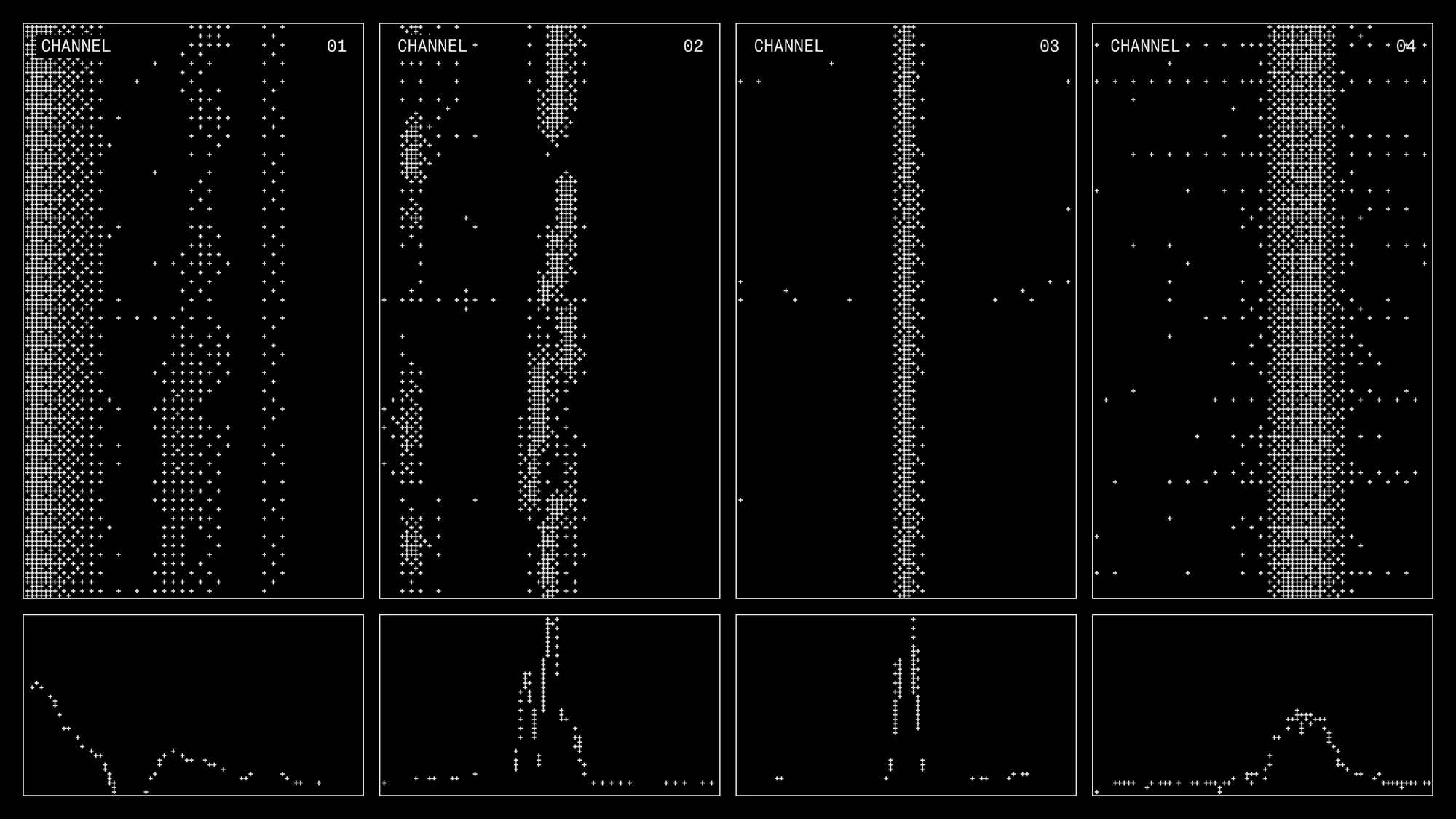
Images are fairly easy to interpret with AI — they often use the same two spatial axes (height and width), are neatly gridded, and store the same kind of value at each pixel. Most physical measurements are not as tidy. Different measurements are organized along different dimensions, and these axes change across tasks, scenarios, and devices. Radio exemplifies this. A radio waveform unfolds over time, a spectrogram shows signal changes over both time and frequency, an antenna array measures across space, and an echo measures signals across delay. Because measurements are meaningless without their axis, Newton organizes its observations around four core axis types: time, frequency, space, and antenna.
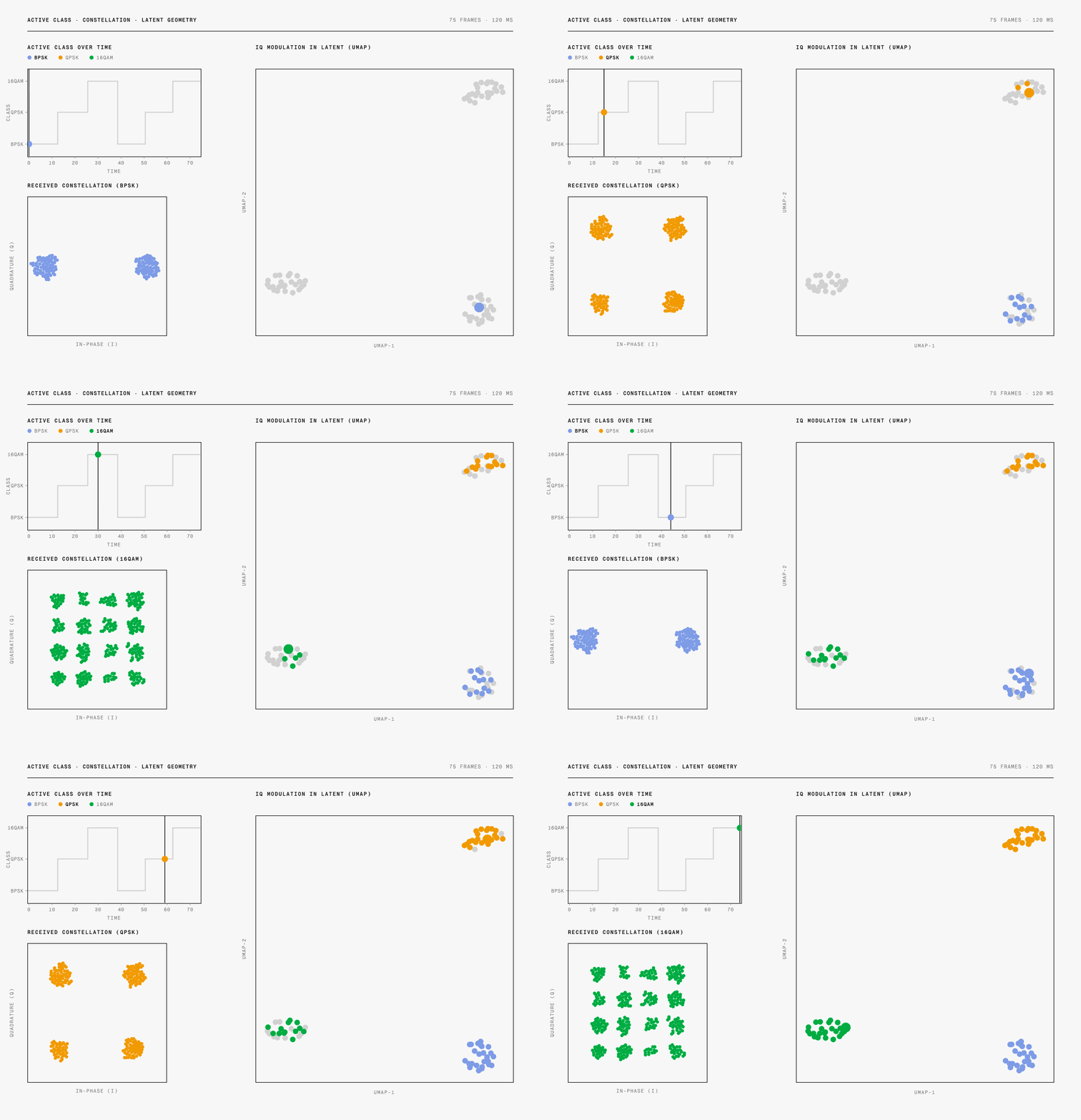
Radio transmitters can change how they encode a message into a radio wave. Newton understands the structure of different modulation schemes and maps the signal into different regions of the embedding space as the modulation changes.
Under the hood, Newton uses a transformer with relative positional encodings [1], the common building block for many foundation models, but gives each input a value and a physical context. One model can then handle different numbers and arrangements of axes, including new combinations.
Learning physical structure through masked prediction
Newton was trained by hiding parts of a measurement and asking what could be missing [2]. Filling in small regions teaches the model to learn details, and filling in larger regions teaches the model long-range reasoning. A missing region may have many plausible completions. Instead of training Newton to predict their average — which may actually correspond to no real scenario — Newton predicts a distribution of outcomes. That allows our model to represent uncertainty and distinct possibilities.

Newton learns distinct representations for radio signals that travel directly to the receiver and signals that are blocked along the way.
One general model outperforms specialized radio models
To see what Newton learned on its own, we froze the model, so none of its internal weights changed, and evaluated it on twenty fundamental radio-processing tasks [3,4]. For each task, we trained only a linear readout: one simple layer on top of Newton's output. A layer that simple can't learn much by itself, so a strong result means the information was already in Newton's representation.
The tasks span three layers of understanding. Signal tasks ask what was transmitted. Propagation tasks ask how the environment changed it. Sensing tasks directly ask about the transmitter or environment. A single Newton model handles all three categories of tasks. It can correctly determine whether a transmission was line-of-sight or not 99% of the time, and localize indoor devices to within 2 meters. Most notably, on 18 of the 20 tasks, Newton, a general-purpose physical world model, significantly outperforms specialized wireless and RF models [3,4,5,6] built for individual signal types, and it does so as a single model that also generalizes beyond radio to other modalities [7].
The chart below shows the pairwise win rate by task category. For each category, it highlights how often each model beats the others in head-to-head comparisons. The further a line reaches toward the outer ring, the more often that model wins. Newton's line, in blue, stays near the edge in every category, both radio and non-radio.

A per-task chart below provides an even more in-depth view of Newton’s performance: each row is one task, and each dot is one model's score on it. The tasks are measured in different units (accuracy, position error in meters, bit error rate, signal strength lost in dB), so every score is converted to a common scale from 0 to 1, where 1.0 means error-free. Further right is better. Newton is the solid black dot. The hollow circles are other models, and the gray circle is a baseline that works directly from the raw signal, with no pretrained model. The column on the far right lists the best result on each task in its original units, and the color of its dot shows which model achieved it.
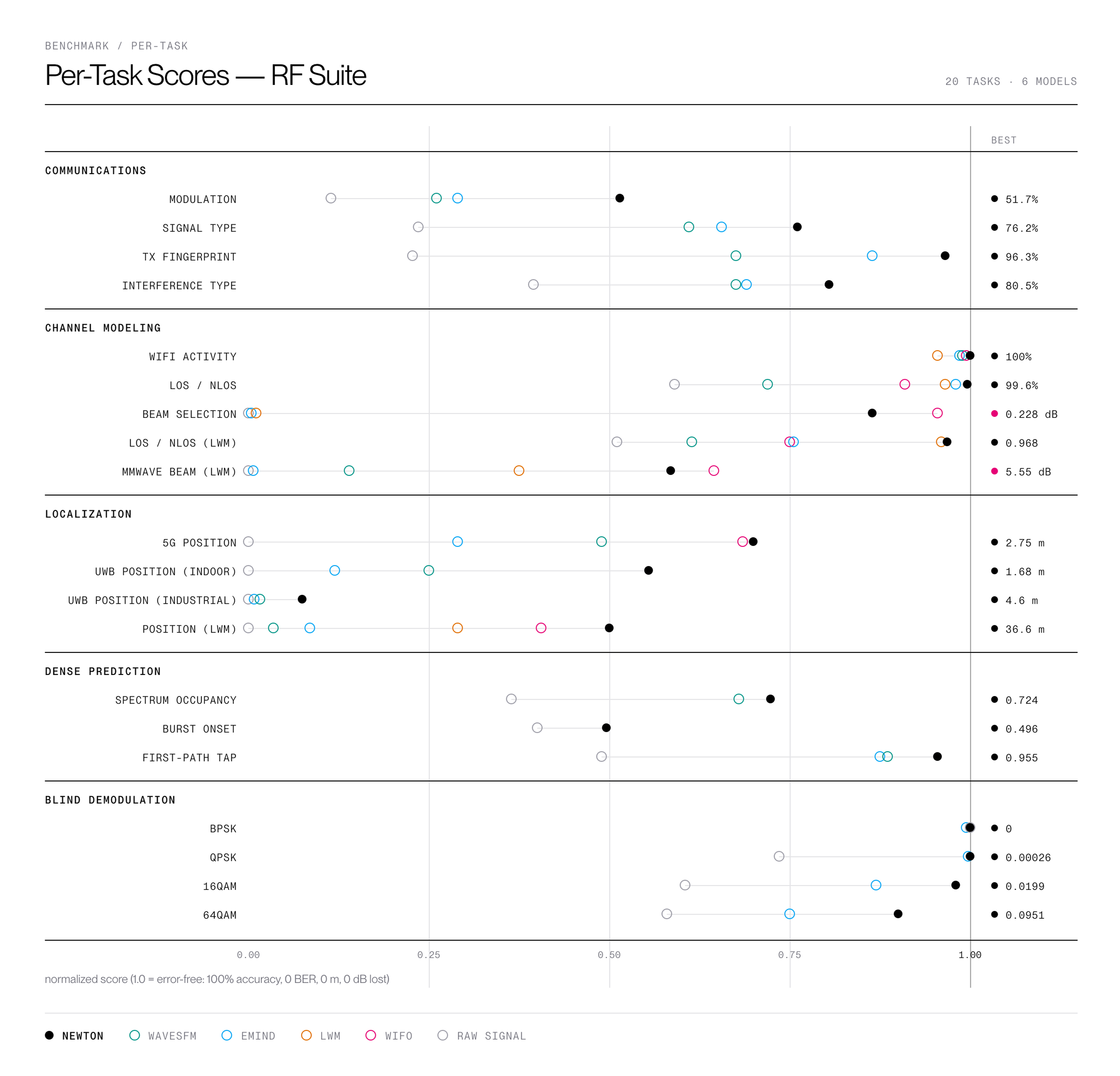
The tasks fall into five categories: communications, channel modeling, localization, dense prediction, and blind demodulation. Newton has the top score on 18 of the 20. The two exceptions are beam-selection tasks, where WiFo, a model designed specifically for wireless channels, comes out ahead. That's the strength and limitation of a narrowly specialized model: it can be excellent at the job it was built for, but unable to perform other tasks that are just as valuable, such as blind demodulation or transmitter identification. Each model works only with the specific kind of data it was designed around, while Newton can take in many kinds of physical measurements.
Beyond radio: what else Newton learned
We also tested the same Newton model on 16 tasks from sensor data that has nothing to do with radio signals: machine vibration, audio, satellite imaging, EEG (brain activity), wearable motion sensors (IMU), and seismic and automotive signals. The chart reads the same way as the one above.
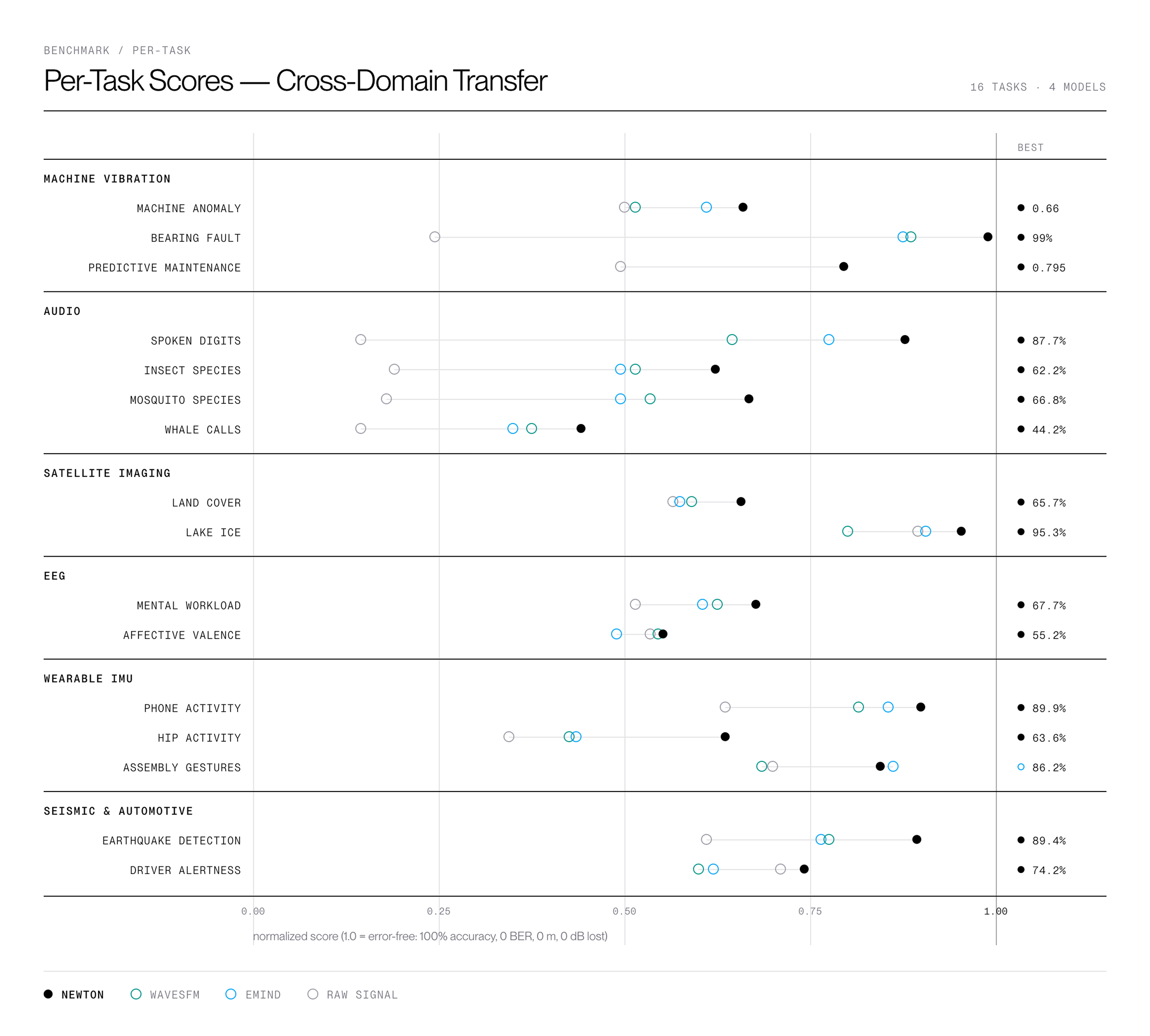
The Newton model was trained only on radio waves, but it generalizes to vibration, audio, images, IMU, and more. It has the top score on 15 of the 16 tasks, including 99% accuracy on detecting bearing faults from machine vibration and 89.4% on earthquake detection.
The one exception is recognizing assembly gestures from wearable sensors, where EMind scores slightly ahead of Newton. Only three models appear on this chart. All the non-Newton models above are radio-specific, and each accepts only certain kinds of input. LWM and WiFo, for example, can only take in data structured like wireless channel information, so they couldn't be tested here. Note that the tasks tested here are not meant to benchmark Newton against the best models specialized for those tasks. Here we test transfer: do models that perform well on radio tasks also generalize to other physical domains? In this comparison, Newton does; the specialized radio models do not. Comparing against other specialized models and baselines is future work.
Radio waves are just the start
Time, frequency, space, and sensor are the fundamental atoms for audio, seismic, electromagnetic, inertial, and other measurements — the vital signs of the physical world. A vibration sensor on a pump, an acoustic sensor on a gearbox, and an accelerometer on a robot arm produce data organized along the same kinds of axes as a radio receiver.
That shared structure is why a model trained on radio can carry over to other kinds of sensor data. Newton isn't memorizing what a radio signal is supposed to look like. It is learning how to find repeated, common structures in physical measurements, regardless of the system that produced them. If those structures transfer across sensing modalities, they provide a window into the underlying structure of the physical world itself.
This matters well beyond radio signals. Engineers typically build a separate model for each physical system; they choose the right measurements, formulate equations, estimate parameters, and then repeat much of that work when the system or its sensors change.
Our ambition is to encode the entire world in a single model that can read any physical measurement, understand the signal, and reveal the processes that shaped it. It starts with a basic human need: to understand the physical world around us. Today, Newton is transforming industries by making physical systems understandable without specialized scientific expertise or a custom engineering project for every machine, site, or sensor. We are expanding Newton to understand any physical system, so it is easier to detect and solve problems, make better decisions, and improve what matters most. What excites us most is that Newton can reveal things we don’t yet know. It points toward a future where AI helps us discover what we cannot see, and makes that understanding available to everyone.
Learn more about Newton:
Build your first Newton Agent on your own data with a free 14-day trial.