
Archetype AI Team
Most world models predict what a 3D environment will look like one frame from now. That's useful for robotics simulation. It's not what an oil and gas drilling rig needs at 3 a.m. when something is drifting out of normal range.
In our recent webinar, Archetype AI's Co-Founder and Chief Scientist Jaime Lien introduced adaptive world models, a new approacj that lets Newton help machines learn their own operational behavior directly from sensor data, with no per-site engineering and no pre-labeled history. In addition to that, Archetype AI's Creative technologist Marta Soto walked through a live demo on HVAC unit data. This post recaps the core ideas. The full recording is linked at the end.
The gap adaptive world models close
Physical AI industries like manufacturing, energy, construction, and logistics run on machines whose complexity is growing while the expert workforce that understands them is shrinking. For over half a century, the field has tried to close that gap with systems theory, control theory, statistical process control and fault detection, data-driven models, and physics-informed modeling. Every one of those approaches requires humans to specify the structure of the machine in advance. The model only captures what engineers already understood.
That ceiling is why classical techniques cannot scale across the diversity of real physical systems. Each deployment needs its own engineering effort. The result is what we call the 100-models-by-50-plants problem.
Modern AI has converged on world models as a paradigm, but most of that work is aimed at a different question: predicting how a 3D environment evolves over time for robotics simulation or synthetic data generation. Newton answers a different question: what state is this machine in, how did it get there, and what comes next?
Why Physical AI requires more than just text
Language is comparatively stationary. The physical world is not. Two machines with the same nominal design behave differently because of small hardware variations, deployment environment, load conditions, ambient conditions, and wear over time. Critical events, including novel failure states and irregular transitions, often never appear in any training corpus at all.
The data exists. After a decade of IoT, almost every modern machine is continuously monitoring its internal state and local environment. The gap is architectural. World models need to adapt to local observations in a self-supervised way, without humans hand-engineering each deployment.
What an adaptive world model actually does
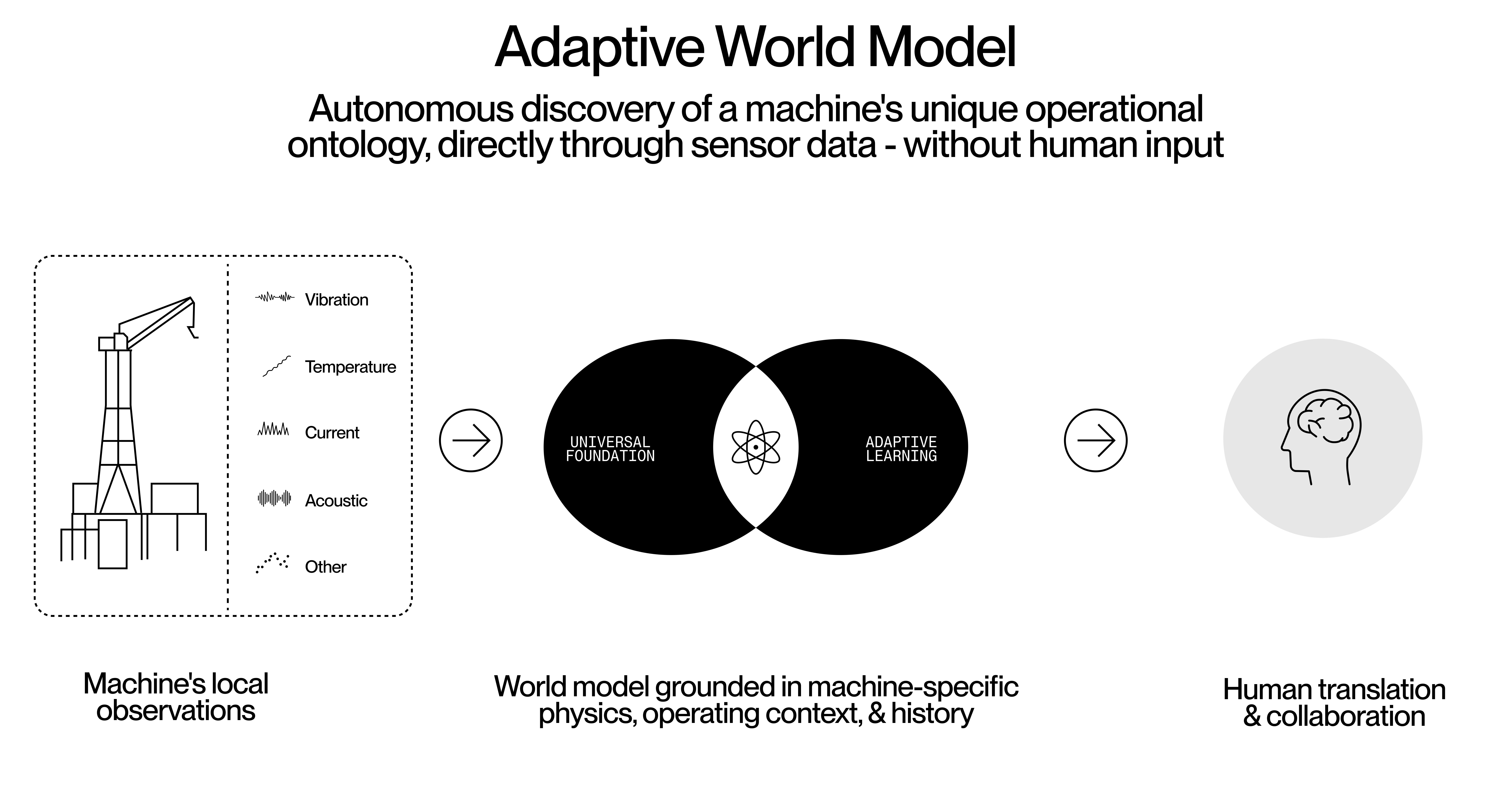
Adaptive world models autonomously discover each machine's operational ontology, meaning its operating regimes, the transitions between them, and its overall dynamics, directly from sensor observations. Three components make this work:
1. A universal foundation model provides the representational substrate. It takes diverse multimodal sensor streams and maps them into a common mathematical latent space that retains structure across sensors, systems, and domains.
2. An adaptive learning layer grounds that representation in the specific machine's physics, operating context, and history. This is where the machine-native understanding forms.
3. A natural language interface translates the machine's discovered states into terms a human operator can read, query, and act on.
From raw sensor data to operating regimes
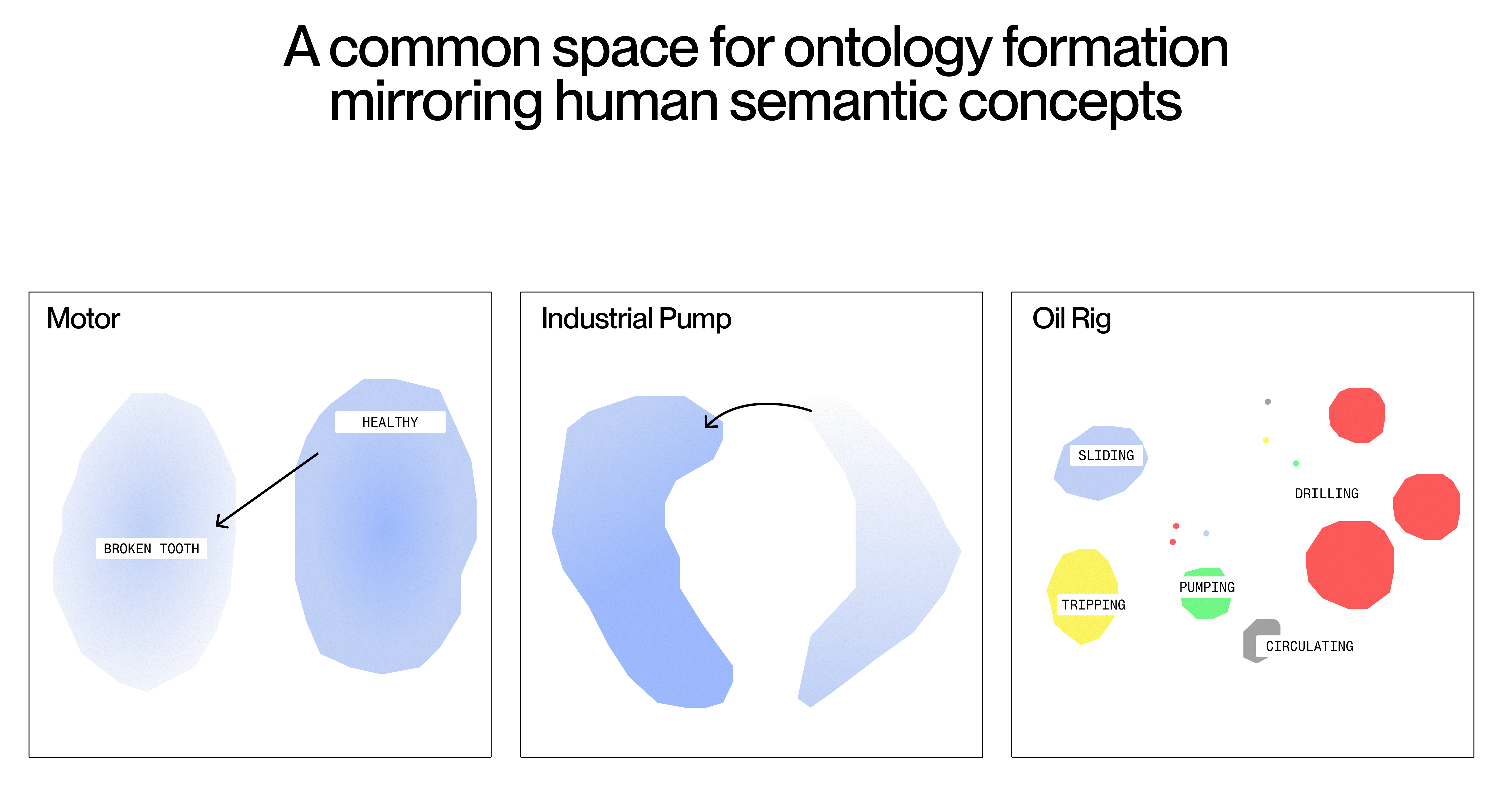
When Newton's pre-trained encoder is applied to three very different physical systems, including a motor gearbox, an industrial pump, and an oil and gas drilling rig, emergent structure appears in the latent space without being told what to look for. The gearbox measurements cluster by whether the gearbox is healthy or has a broken tooth. The pump traces show a trajectory from normal state to blocked-intake state. The drilling rig produces distinct clusters corresponding to operational states an experienced driller would name: circulating, drilling, rotating, slipping.
These groupings form a discrete vocabulary of how each machine behaves, discovered from data, not specified in advance.
A Physical AI Agent built with Newton can ingest two months of HVAC unit data with no labels. The latent space resolves into distinct clusters representing distinct regimes. A handful of labeled examples then anchor human-readable names like "normal" and "cool valve stack" to clusters Newton had already discovered. New sensor streams could then be classified in real time.
Why this matters for industrial deployment
Adaptive world models give Archetype Platform users four properties that classical approaches cannot.
The understanding is discrete and referenceable. You can point to a specific state, name it, and refer to the sequence of states the machine moved through to get there. That makes downstream reasoning, alerting, and operator handoff tractable.
The model represents epistemic uncertainty. It can express confidence about its current state classification and flag observations that fall outside any state it has seen, a precondition for catching novel failure modes.
It is scalable. Because adaptation rides on top of a shared foundation model, deployment to a new asset or site does not require per-machine ML engineering. The same architecture works across diverse hardware configurations and terrains.
It is continuous. As machines wear, environmental conditions shift, or new operating regimes emerge, the model adapts. No retraining cycle, no labeled drift dataset.
A concrete example: oil and gas drilling rigs
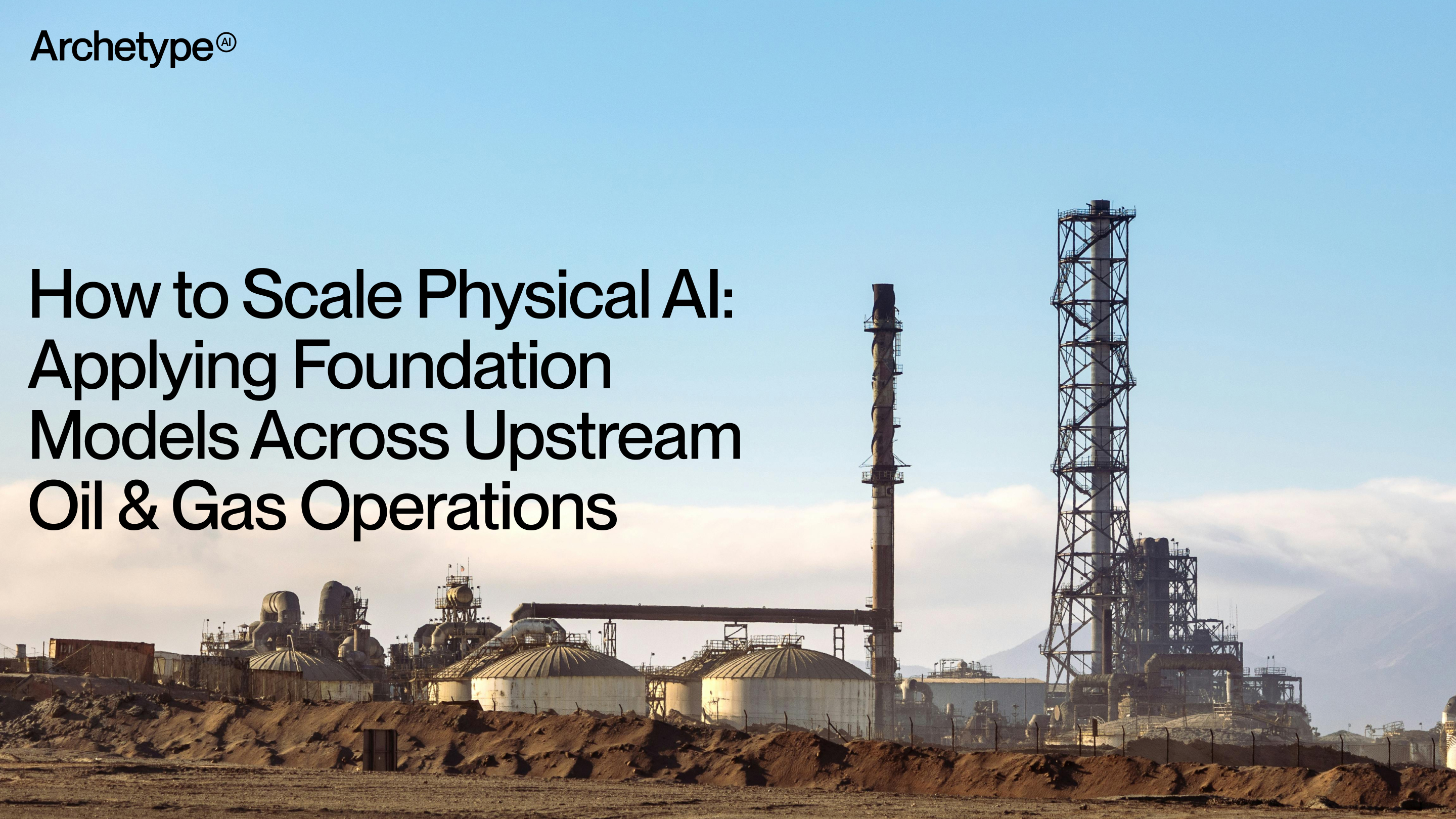
Each drilling rig behaves slightly differently depending on hardware, terrain, and configuration. Operators want continuous visibility into rig state without site-specific model development for every deployment. Applied to raw surface and downhole sensor data, Newton groups observations into clusters corresponding to operational regimes. A few labeled examples then map those clusters to operator vocabulary like drilling, tripping, and circulating, and streaming data is classified live.
About this webinar
This post is based on insights shared during “The Future of Physical AI: Introducing Adaptive World Models”, featuring Jaime Lien, Marta Soto, and Aristo Chang.
To explore the Archetype AI Platform and adaptive world models, visit Archetype AI or connect on LinkedIn and X (@PhysicalAI).
Frequently Asked Questions
What is an adaptive world model?
An adaptive world model is a world model that learns each machine's operating regimes, transitions, and dynamics directly from its sensor data, without requiring humans to specify the machine's structure in advance. It adapts continuously as the machine and its environment change.
How is an adaptive world model different from a world model used in robotics
Most world models in robotics predict how a 3D environment will look in the future, mostly for simulation or synthetic data. Adaptive world models answer a different question: what state is this specific machine in now, how did it get there, and what is likely to happen next.
Does Newton need labeled training data to work on a new machine?
No. Newton's foundation model discovers a machine's operating regimes from unlabeled sensor data. A small number of labeled examples can then anchor human-readable names to the discovered clusters, but years of labeled history are not required.