Manufacturing is entering a new phase of AI adoption. What used to be experimental is now operational and Physical AI is no longer stuck in labs. It's actively being deployed on factory floors, helping teams detect issues earlier, automate workflows, and improve safety in real time.
In the recent virtual session with NTT Data — a $30 billion IT services company within a $100 billion full-stack technology firm investing over $3.6 billion in R&D annually — and Archetype AI, we break down what is actually changing in 2026 and where the real value is coming from.
What Is Physical AI in Manufacturing?
Physical AI refers to systems that can understand and act on real-world data — not just digital inputs. Unlike traditional analytics or machine learning models, Physical AI combines sensor data, video, and environmental inputs, interprets signals in real time, adapts across machines, sites, and conditions, and moves beyond predictions into actions.

We started sensing the physical world decades ago with thermometers and thermocouples, which led to control systems like thermostats. As sensor technology advanced and data volumes grew, we moved into the era of big data and traditional ML: building highly optimized models that could solve a specific problem on a narrow set of sensors. That was transformational, but it hit a ceiling. Each use case required its own model, its own labeled dataset, and its own deployment cycle.
Foundation models change this equation the same way GPT changed natural language processing: by consuming a world of physical sensor data and learning to generalize across systems, sensors, and conditions. Newton, Archetype's proprietary physical AI model, has effectively learned to understand physics statistically (without a single physics equation baked into the model) by training on nearly 600 million real-world sensor measurements.
The key difference from traditional ML is simple. Traditional ML tells you what happened. Physical AI tells you what is happening and what to do next. That shift is what allows manufacturers to move from dashboards to operational intelligence that actually drives decisions.
Why Physical AI Matters Now
For years, manufacturers have been collecting massive amounts of sensor data. For years, the problem was turning it into something useful. Most AI systems failed because they were:
- Too slow to deploy
- Too dependent on labeled data
- Too narrow to scale across environments
Now that is changing. Foundation models can generalize across different machines and conditions, which means faster deployment, lower setup cost, and higher reliability in real-world environments. In practice, Newton works out of the box — teams have connected it to machinery on the factory floor and immediately identified issues without months of custom work or model training. This is why Physical AI is finally moving from pilots to production.
Key Physical AI Trends in 2026
Manufacturers are changing how they approach AI, and a few clear trends are emerging.
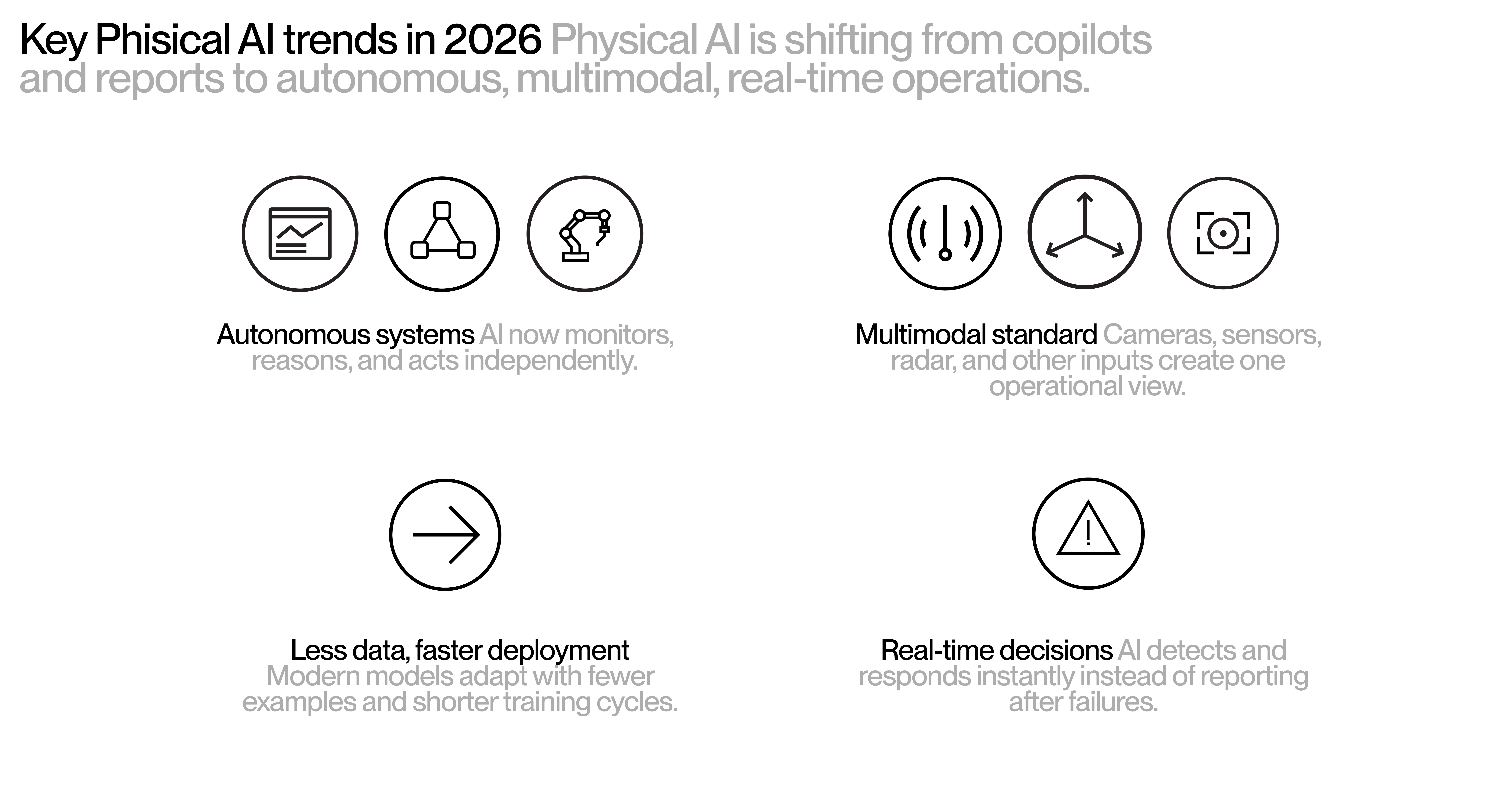
From copilots to autonomous systems
Teams are no longer experimenting with AI assistants. They are deploying systems that can monitor, reason, and act independently. As Raleigh Murch, Managing Director of Physical AI at NTT Data, describes it: the honeymoon phase of "let's find places to put AI" is over. The question has shifted from "can we do AI?" to "where is AI paying back?"
Multimodal data is becoming the standard
AI models are combining data from cameras, sensors, radar, and other inputs to create a unified view of operations. This is critical because most failures are not visible in a single data stream. They appear when multiple signals are analyzed together. Newton fuses these modalities into a single embedding space, which means teams can detect patterns that siloed, single-sensor approaches would miss entirely.
Reopening failed computer vision projects
Many manufacturers invested in computer vision over the past several years and hit a wall because ofbrittle model pipelines, constant drift, and an inability to scale across changing manufacturing environments. The new generation of vision-language models and physical AI foundations has fundamentally changed what's solvable, creating an opportunity to revisit those failed initiatives with capabilities that simply didn't exist before.
Faster deployment with less data
Modern foundation models can adapt with very few examples, reducing the need for long training cycles. Archetype's approach uses what they call n-shot examples — providing a handful of representative samples from a specific environment or operating condition so Newton can calibrate without retraining.
Real-time decision-making replaces reporting
Instead of analyzing data after something breaks, AI is now used to detect and respond instantly. The shift from reactive monitoring to predictive intelligence happens through forecasting and prescriptive layers that turn raw signals into prioritized actions.
Where Manufacturers Are Actually Seeing ROI
Not every AI use case gets approved. The ones that do are tied directly to business impact and the path to budget approval is more tactical than most teams realize. As Raleigh Murch puts it: "Stop selling AI and start with a business objective. Find a P&L line item you can gravitate towards." Pitching innovation puts you in a line with everyone else. Tying AI to a specific cost reduction target is what gets you to a purchase order.
The high-impact use cases that consistently get funded include predictive maintenance to prevent downtime, anomaly detection across equipment, process optimization to improve output and efficiency, quality control with real-time monitoring, and safety tracking to detect risks early. What these have in common: they are measurable, they reduce cost, increase uptime, or improve productivity. That is why they get budget.
One area gaining particular traction is work method validation and SOP modernization. Teams are using Physical AI to verify that standard operating procedures are being followed correctly; when they detect deviation, it's not always a problem. Sometimes the drift represents optimization developed through years of field experience, which becomes an opportunity to modernize the SOPs themselves rather than enforce outdated procedures.
What Makes a Strong Physical AI Use Case
Most teams fail because they start in the wrong place.
A strong use case usually has:
- Clear financial impact
- Existing sensor data available
- Repeatable patterns across machines or sites
- A decision that can be automated or assisted
The practical filter is straightforward: can you tie this to a line item on a P&L? Can you measure the outcome in dollars saved, incidents avoided, or throughput gained? If you can, and you already have the sensor data to support it, you have a use case worth pursuing.
Real Challenges in Scaling AI in Manufacturing
Despite the progress, most teams still struggle with persistent challenges: long development cycles requiring large labeled datasets, poor performance in real-world conditions, fragmented tools and vendors, and massive volumes of data with limited actionable insights.
But a recent MIT study on LLM deployments in industrial settings found that the majority of implementations are failing — and not because the models themselves fail. The implementations fail. The technology works, but the organizational adoption doesn't. Raleigh shared a telling example: his team has had cameras on factory floors sabotaged because workers didn't understand the objective. It wasn't malice; it was a lack of AI literacy. The teams that succeed invest in education and change management alongside the technology, building understanding from the C-suite down to the line workers doing assembly.
The deeper technical issue is fragmentation. Each sensor, machine, or use case often requires its own model, and that doesn't scale. Physical AI solves this by creating a single intelligence layer that works across multiple systems and environments without rebuilding from scratch each time.
How Physical AI Works in Practice
The Archetype Platform is built around three core components that work together as a continuous loop.
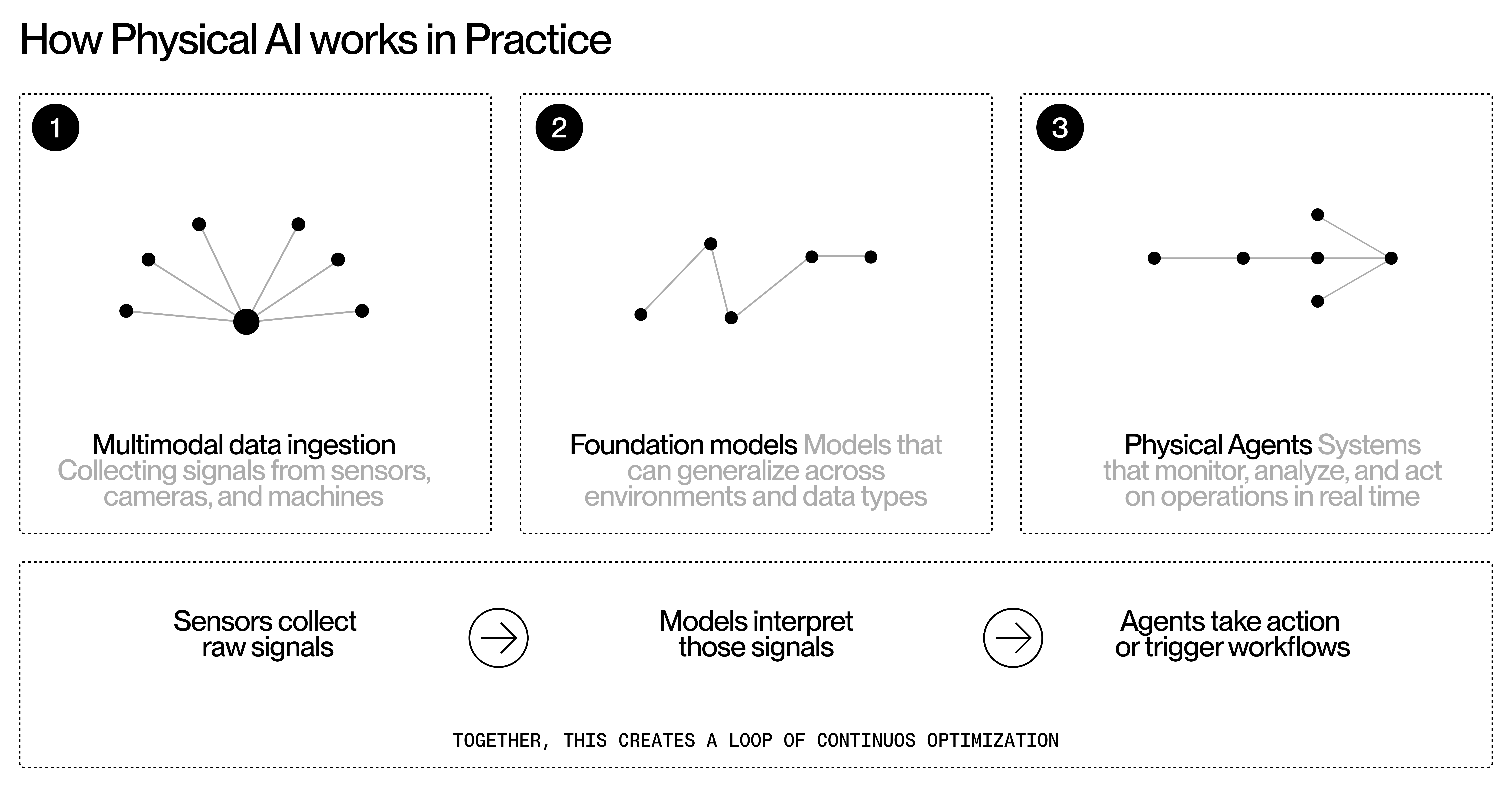
Multimodal data ingestion
Newton ingests signals from any combination of sensors, cameras, and machines. It understands sensor data natively — vibration, current, temperature, pressure — alongside video and text, fusing them into a unified representation. This multimodal capability is what allows it to catch patterns that single-sensor systems miss.
Foundation model intelligence
Newton generalizes across environments and data types without retraining. For different operating conditions — a motor running in a cold climate versus a warm one, equipment interacting with different terrain — the platform uses n-shot examples to calibrate in context. For more specialized needs, fine-tuning is available. And for edge deployment, distillation compresses the 7-billion-parameter model down to 1 billion or even under 100 million parameters, depending on the hardware and throughput requirements.
Physical agents
These are what customers build on the platform — systems that monitor, analyze, and act on operations in real time. The Archetype Platform provides three prebuilt agent templates for the most common use cases: continuous process monitoring for detecting anomalies and predicting failures across equipment, task verification for validating that SOPs and procedures are followed correctly, and safety monitoring for flagging hazards and unsafe conditions. Each can be deployed in the cloud, on-premises, or at the edge.
Real-World Impact Examples
Companies are already seeing measurable results:
- Detecting equipment failures across different machines without retraining
- Discovering new failure patterns by combining multiple sensor inputs
- Analyzing thousands of operational videos to improve scheduling
- Reducing downtime costs by millions annually
These are not edge cases; they are early indicators of what scaled Physical AI will look like across manufacturing.
Common Pitfalls to Avoid
Most Physical AI projects fail for predictable reasons: starting with low-impact use cases, underestimating data complexity, treating AI as a one-off experiment instead of infrastructure, and lack of alignment between technical and operational teams.
But the pitfall that gets the least attention is organizational readiness. Having lots of data does not mean having AI-ready data: a historian full of sensor logs is not the same as a pipeline a model can actively consume. And even when the technology works, adoption can stall if the workforce doesn't understand why it's there. Transitioning to Physical AI is a mindset shift that has to be supported from the CEO down to line workers.
How to Get Started with Physical AI
If you are exploring Physical AI, the most effective approach is to keep it simple and stay practical. Start with a high-value, measurable use case — one that ties to a specific cost or performance metric your organization already tracks. Use existing sensor data before investing in new infrastructure. Focus on real-time outcomes, not just reporting. And build toward a system, not isolated pilots.
The companies investing in Physical AI infrastructure now will have a durable advantage. They'll own the operational data, the deployment patterns, and the organizational muscle to scale. The goal is not to prove AI works, it's to prove it delivers value.
Final Thoughts
Physical AI is shifting manufacturing from reactive to proactive. The real change is the ability to turn raw sensor data into real-time decisions and actions, across any machine, any site, and any operating condition. That is where the value is.
About This Webinar
This post is based on insights shared during “From Sensors to Insights: How Physical AI Is Transforming Manufacturing”, a live webinar with Raleigh Murch, Managing Director of Physical AI at NTT Data, and Sisinio Baldis, Head of Solutions Engineering at Archetype AI.
To explore the Archetype AI platform and the Newton Foundation Model, visit Archetype AI or connect on LinkedIn and X (@PhysicalAI).
FAQ: Physical AI in Manufacturing
What is Physical AI in manufacturing?
Physical AI refers to systems that analyze and act on real-world data from sensors, machines, and environments in real time. Unlike traditional analytics, which operate on historical data and narrow models, Physical AI uses foundation models like Newton to generalize across different equipment types, sensor modalities, and operating conditions — turning raw signals into operational intelligence without requiring custom models for each use case.
How is Physical AI different from traditional ML?
Traditional ML focuses on building specialized models from historical, labeled data to make predictions about specific problems. Physical AI takes a foundation model approach — training once on diverse physical data and generalizing across systems, sensors, and conditions. This means faster deployment, less dependency on labeled datasets, and the ability to work across real-world variance that would break narrow models. Traditional ML tells you what happened; Physical AI tells you what is happening and what to do next.
What industries benefit from Physical AI?
Manufacturing is the primary application today, but Physical AI applies to any environment with complex physical operations: logistics, energy, construction, telecom, and smart infrastructure. The common thread is abundant sensor data and high economic stakes around equipment failures, safety incidents, or operational inefficiency.
What are the main use cases of Physical AI?
The most common use cases are predictive maintenance, anomaly detection, process optimization, quality monitoring, and safety tracking. The Archetype Platform organizes these into three solution packages — continuous process monitoring, task verification in discrete operations, and safety — each with prebuilt agent templates that customers can deploy and tailor to their specific assets and workflows.
Is Physical AI expensive to implement?
Costs vary, but the foundation model approach significantly reduces the traditional barriers. Because Newton generalizes across systems, you don't need custom models, large labeled datasets, or long training cycles for each use case. N-shot examples allow the model to adapt to new conditions with just a handful of representative samples. And distillation lets you run Newton on edge hardware — from standard NVIDIA GPUs down to devices with under 100 million parameters — so you can match compute costs to your deployment requirements.
What is the first step to adopting Physical AI?
Start with a clear, high-impact use case where you already have sensor data and can measure results quickly — ideally one tied to a specific P&L line item like downtime cost, rework rates, or incident frequency. Avoid starting with broad, exploratory projects. The companies seeing the fastest ROI are those that pick a focused problem, prove value, and then expand from there with the infrastructure already in place.