AI has already transformed the digital world. From writing code to summarizing research, large language models have changed how we work with information. But there is one major area that has not been fully transformed yet: the physical world. Factories, warehouses, power plants, and infrastructure systems still operate largely without true AI intelligence, and that is starting to change.
Why LLMs Fall Short in the Physical World
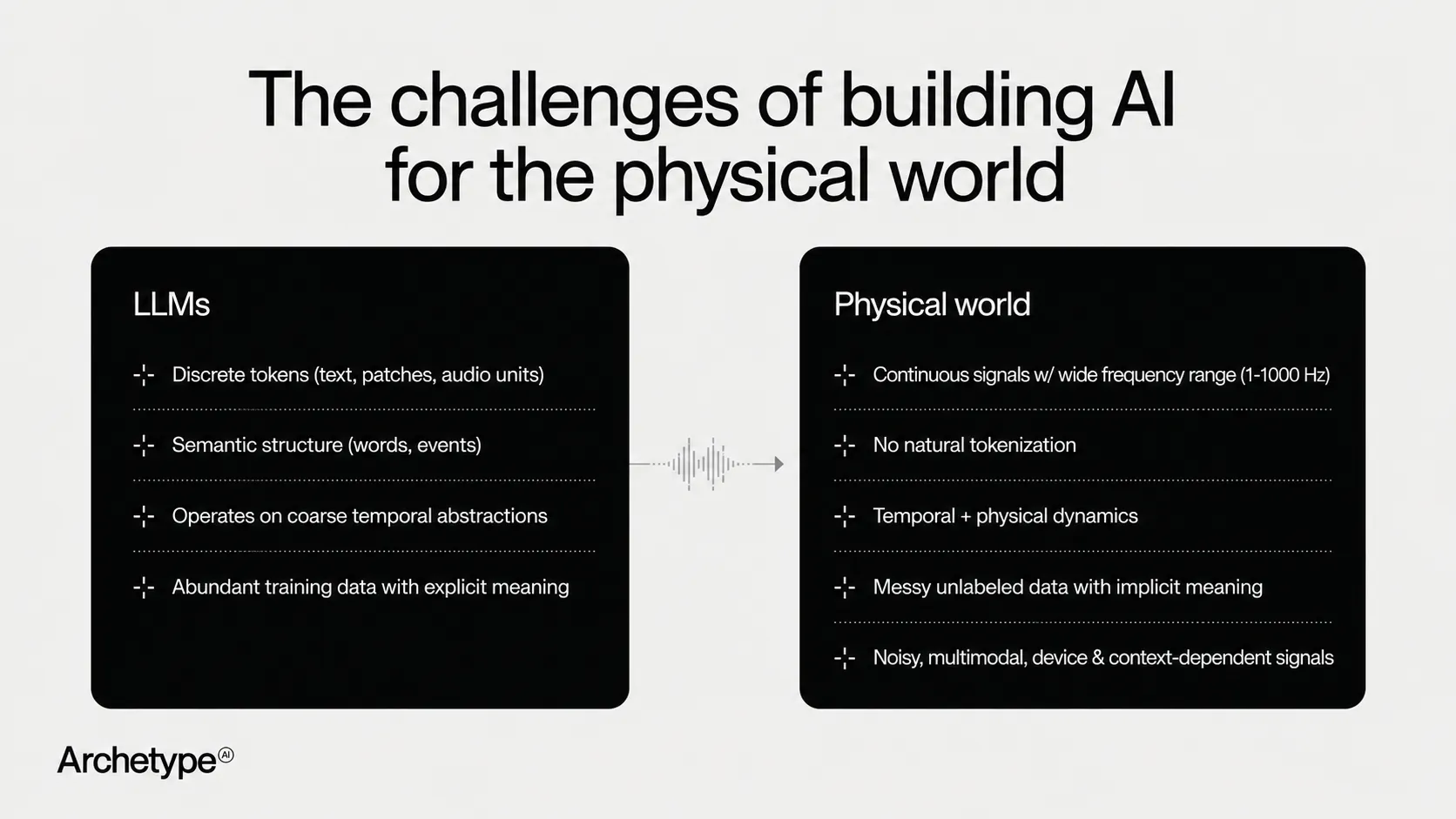
LLMs are powerful, but they were never designed for physical systems. They operate on discrete tokens (words, image patches, audio units) that carry natural semantic meaning and structure. Language, as it turns out, is one of the most structured and well-curated datasets in history, and LLMs are built to leverage that structure.
The physical world is completely different. It communicates in torque, pressure, electrical current, and vibration: continuous signals spanning frequency ranges from fractions of a Hertz to several thousand Hertz. There are no clean boundaries or natural units of meaning the way a sentence breaks into words. Trying to tokenize these signals the same way you'd tokenize a sentence leads to loss of information, because the temporal dynamics that matter in physical systems unfold at millisecond scales, far finer than the coarse temporal abstractions that language models rely on.
Beyond structure, there's a data problem. LLMs were trained on the internet. Physical data is also abundant, but it tends to be noisy, unlabeled, and device-dependent. The data assumptions baked into LLMs simply do not transfer well to the physical world. If we want AI that understands physics, we have to start from different first principles.
The Case for Physical AI
Physical AI is built specifically for real-world systems. Instead of working with text, it learns directly from sensor data and physical signals, with the goal of understanding the physical world the same way LLMs understand language.
This means learning patterns from raw signals, generalizing across machines and environments, operating in real time, and producing actionable insights. The core idea mirrors what made LLMs transformative: instead of building narrow bespoke models for every modality or system, you train a single foundation model on diverse physical data so it can develop a general understanding of how the physical world behaves.
The challenge with existing approaches is that they fall into two camps. On one hand, bespoke models require deep domain expertise and long deployment cycles, and still only work for one system. On the other, LLMs, despite their impressive capabilities, were not designed to handle the continuous, noisy physical quantities that define real-world operations. What's needed is a foundation model that bridges the gap.
Introducing the Newton Foundation Model
To enable Physical AI at scale, Archetype AI built Newton — the proprietary physical AI model at the heart of the Archetype Platform. Newton is designed to learn from physical signals instead of text, trained on a diverse cross-modal dataset of nearly 600 million real-world sensor measurements in a fully self-supervised way. No human labels, no domain-specific preconceptions — just the model learning the underlying structure of physical behavior directly from data.
Newton powers the Archetype Platform, a full-stack Physical AI platform that provides everything teams need to build, tune, deploy, and manage physical AI agents. The platform includes domain-specific solution tools for continuous process monitoring, task verification, and safety, along with agent templates, automation tools, and flexible deployment across hyperscaler cloud, private VPC, on-premises, or edge infrastructure.
How Newton Understands the Physical World
Every physical system — whether it's a motor, a pipeline, or an electrical grid — produces time-varying signals: temperature changes, electrical current, pressure levels, vibration patterns. Newton processes these signals through a transformer-based encoder that compresses them into a compact latent representation of the underlying physical process.
The closest equivalent to text tokenization in this context is what happens at the input stage: continuous time-series signals are segmented into patches — small portions of a longer signal — which are then mapped into the latent space. But unlike word tokens, these patches don't carry inherent semantic meaning; the model has to learn what matters from the physics itself.
This latent representation turns out to be remarkably versatile. It can be used for:
- Anomaly detection
- Classification
- Forecasting
- Pattern discovery
What makes it powerful is that the model was trained across such a diverse range of physical signals that it was forced to learn the underlying structure of physical behavior itself — and the resulting representations encode phenomena that organize into semantically meaningful clusters, even without any human labels.
Why Foundation Models Matter for Physical Systems
Before foundation models, AI in manufacturing looked like this:
- One model per machine
- One model per use case
- Long deployment cycles
- High dependency on experts
That approach does not scale.
Foundation models change this by learning general patterns that apply across systems. This allows:
- Faster deployment
- Lower development cost
- Cross-domain generalization
- Better performance with less data
In practice, this means that 90 to 95 percent of customer use cases with Newton require no fine-tuning at all — the model works out of the box. Fine-tuning is only recommended when capturing a very specific, complex behavior.
Real Capabilities of Physical AI Models
Newton demonstrates several capabilities that traditional models struggle with.
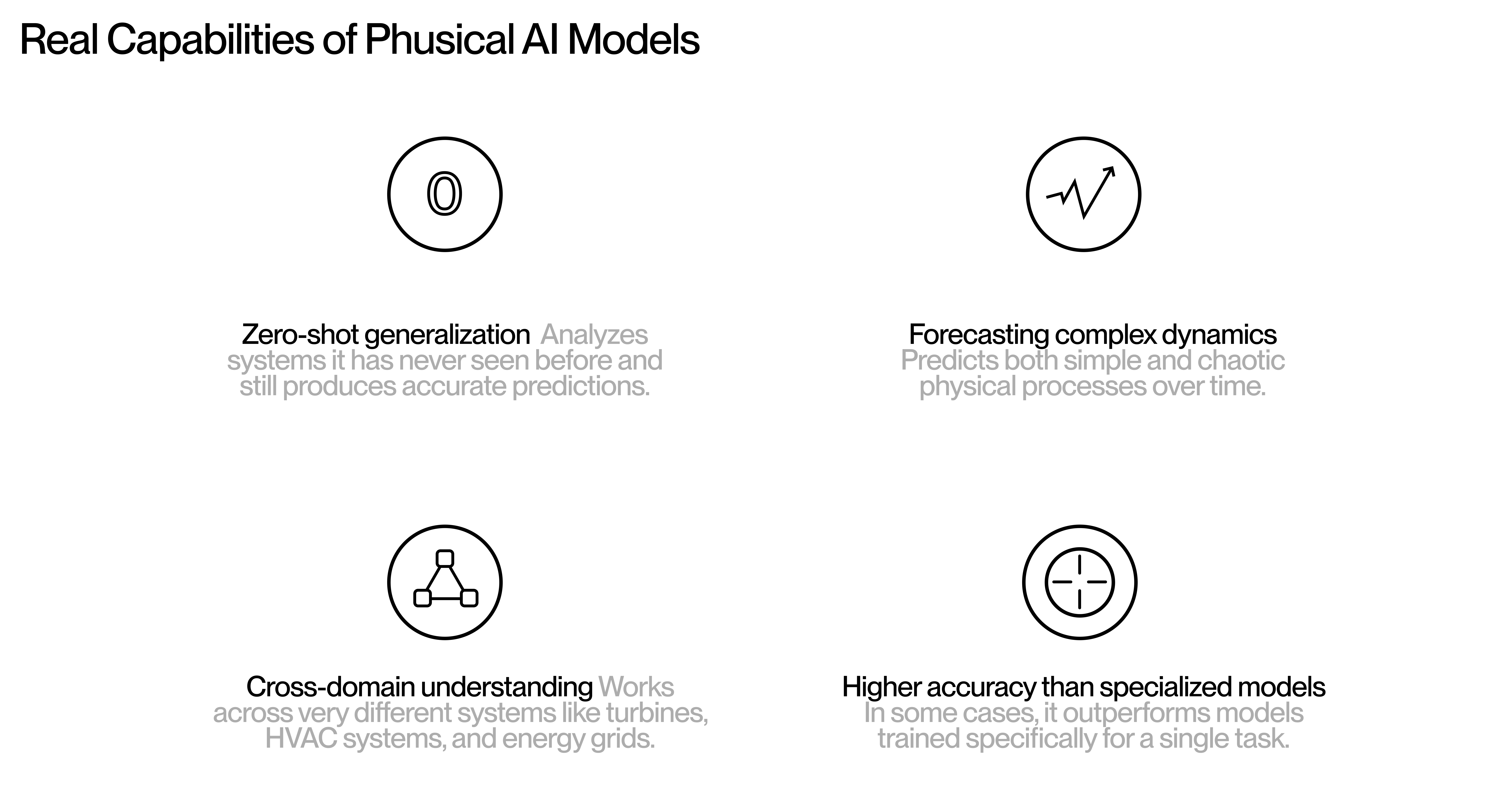
Zero-shot generalization
Newton can analyze systems it has never seen before and still produce accurate predictions. In controlled experiments, it successfully forecast the trajectory of physical systems — from simple oscillations to the chaotic behavior of an elastic pendulum — using only its pre-trained weights, with no exposure to the target data during training. It even outperformed specialized models that were trained specifically on that data, demonstrating that broad physical pretraining can induce better understanding than narrow, task-specific training.
Real-world anomaly discovery
In one deployment, Newton's process monitoring agent analyzed data from more than 40 sensors on complex wind turbines and discovered nine previously unknown failure patterns — patterns that even industry experts were not aware of, with more than $50 million in estimated annual downtime impact.
Outperforming specialized software
When benchmarked against software specifically designed for HVAC anomaly detection — a well-researched domain with mature tools — out-of-the-box Newton outperformed those specialized systems, demonstrating the power of general physical representations over narrow solutions.
Cross-domain understanding
The same model, with no weight changes, works across completely different systems — turbines, HVAC systems, energy grids, transformers, even country-wide electricity consumption forecasting.
From Signals to Meaning: Combining Physical AI with Language
One of the most powerful ideas in this approach is combining a physical world model with a semantic language model. The physical model understands signals; the language model translates them into human-readable insights. Both components share a unified embedding space, which means you can interact with Newton through natural language to steer it toward the insights you need.
For example, you can ask Newton whether a package was mishandled based on accelerometer data, and it will generate a clear answer by integrating motion signatures with the natural language prompt — no manual rules or pre-programming required. You can then ask a completely different question about the same data ("Is the package in transit? Is it stationary?") and get equally useful answers, because the model is reasoning across modalities rather than following hard-coded logic.
Multimodal Intelligence in Action
Physical AI is not limited to one type of data.
It combines multiple inputs such as:
- Radar
- Audio
- Video
- Sensor signals
For example, in a fire safety scenario, Newton can combine radar data with audio to recognize that an alarm is going off while someone ios present in the room, and then provide actionable recommendations.
In a data center environment, it fuses temperature readings with video footage and reasons that a sudden temperature drop was caused by a person opening a door — context that a single-sensor system would completely miss. These multimodal capabilities are where most real-world value comes from, because single data streams rarely tell the full story.
Bringing Physical AI to Production
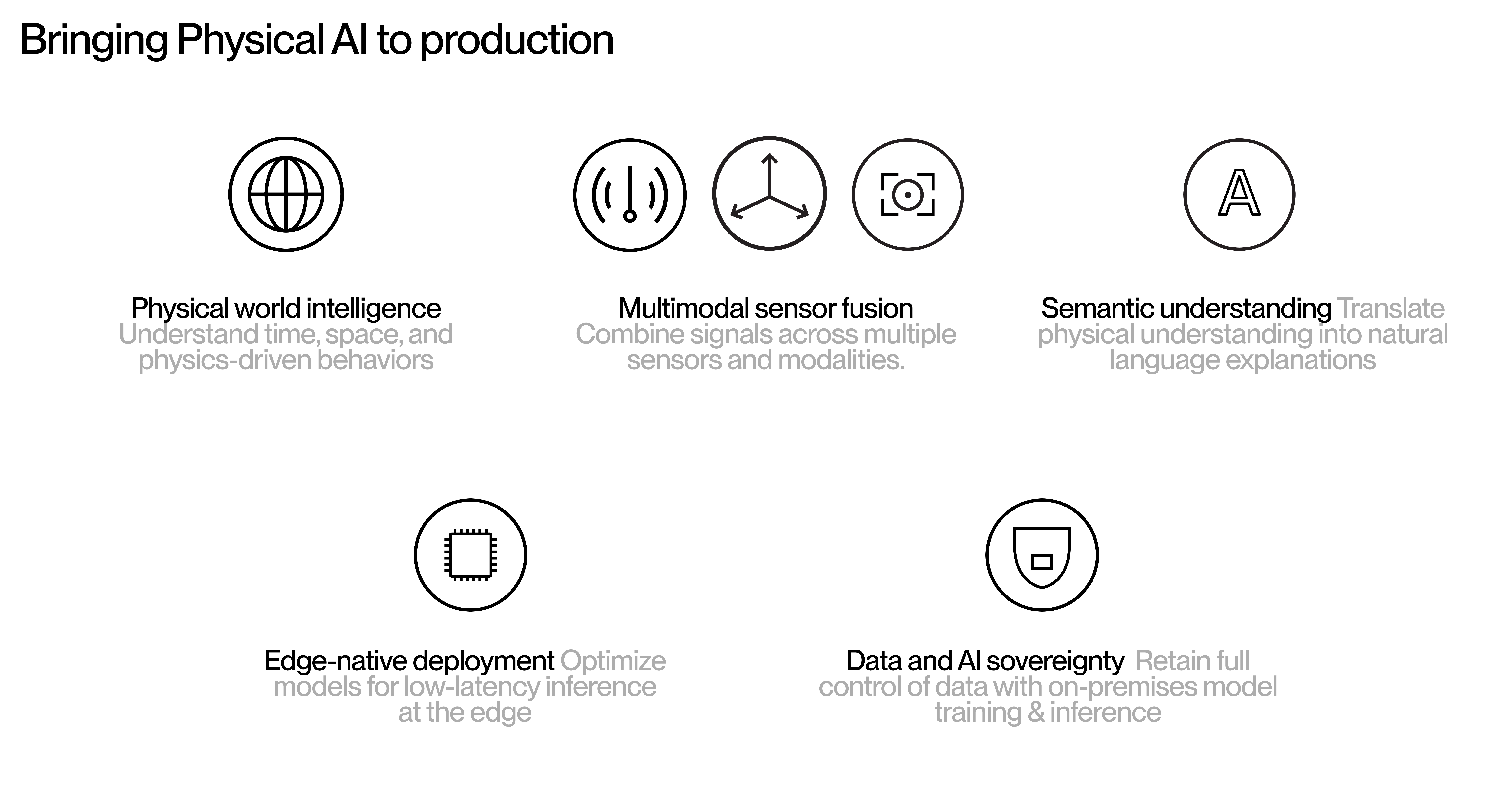
TTo move from research to real deployment, the Archetype Platform is built around five core pillars: physical world intelligence, multimodal sensor fusion, and semantic understanding (which Newton handles directly), plus edge-native deployment and data sovereignty (which ensure the system is practical in production environments).
Edge deployment is critical for latency and privacy. In one pedestrian safety monitoring deployment, Newton was distilled from a seven-billion-parameter model down to one billion parameters — a 7x reduction — with inference running 48 to 60 percent faster and no measurable impact on performance. The distilled model ran on a single GPU with just two gigabytes of RAM, demonstrating that Physical AI can operate wherever the data is generated.
Real-World Applications of Physical AI
Physical AI is already being used in production environments.
Examples include:
- HVAC systems are achieving efficiency improvements of over 20 percent through continuous anomaly detection
- Task verification agents are monitoring assembly lines and flagging deviations from standard procedures in real time
- Safety agents are analyzing multimodal feeds (cameras, radar, traffic signals)_ to identify hazards and near-miss incidents
These use cases map to the Archetype Platform's three solution packages: continuous process monitoring, task verification in discrete operations, and safety. Each comes with prebuilt agent templates that customers tailor to their specific assets and workflows, with agents deployable in the cloud, on-premises, or at the edge.
Why This Matters for the Future of AI
AI has already transformed digital workflows. The next transformation will happen in physical systems, and it matters because physical industries power the global economy — failures have immediate real-world consequences and efficiency gains translate directly into cost savings. The physical world generates trillions of sensor signals that AI has barely touched, and platforms like Archetype are building the infrastructure to unlock intelligence over those signals.
Physical AI is not just another AI trend. It is the next layer of intelligence that bridges the gap between what AI can do with language and what it needs to do with the real world.
Final Thoughts
LLMs changed how we interact with information. Physical AI will change how we interact with the real world. The key difference is the ability to understand, predict, and act on physical systems in real time, across any sensor, any environment, and any deployment model.
About This Webinar
This post is based on insights shared during a live session with Laura Galindez Olascoaga and Lucas Giannini at Archetype AI. To explore the Archetype AI platform and the Newton Foundation Model, visit Archetype AI or connect on LinkedIn and X (@PhysicalAI).
FAQ: Physical AI vs LLMs
What is the difference between Physical AI and LLMs?
LLMs work with text and structured data, operating on discrete tokens that carry natural semantic meaning. Physical AI works with real-world signals like sensor data (continuous, high-frequency, and noisy)_ and focuses on understanding physical systems through their behavior over time rather than through language.
Can LLMs be used for manufacturing AI?
They can help with reporting, documentation, and operator interfaces, but they are not designed to analyze raw physical signals effectively. The temporal dynamics and data characteristics of physical systems require models built from different first principles, which is why combining LLM capabilities with a physical foundation model like Newton produces the best results.
What is the Newton Foundation Model?
Newton is Archetype's proprietary Physical AI model, trained on nearly 600 million real-world sensor measurements in a fully self-supervised way. It is designed to understand physical systems by learning directly from sensor data across multiple domains and sensor types, and it powers the Archetype Platform alongside domain-specific solution tools.
What are the main use cases of Physical AI?
Anomaly detection, predictive maintenance, forecasting, safety monitoring, task verification, and process optimization. The Archetype Platform organizes these into Agents — for example, for continuous process monitoring, task verification, and safety.
Why is Physical AI important now?
Recent advances in foundation models allow a single model to generalize across physical systems, dramatically reducing the cost and time to deploy. In practice, 90 to 95 percent of customer use cases work with Newton out of the box, without any fine-tuning — something that was impossible with the one-model-per-machine approach of traditional ML.