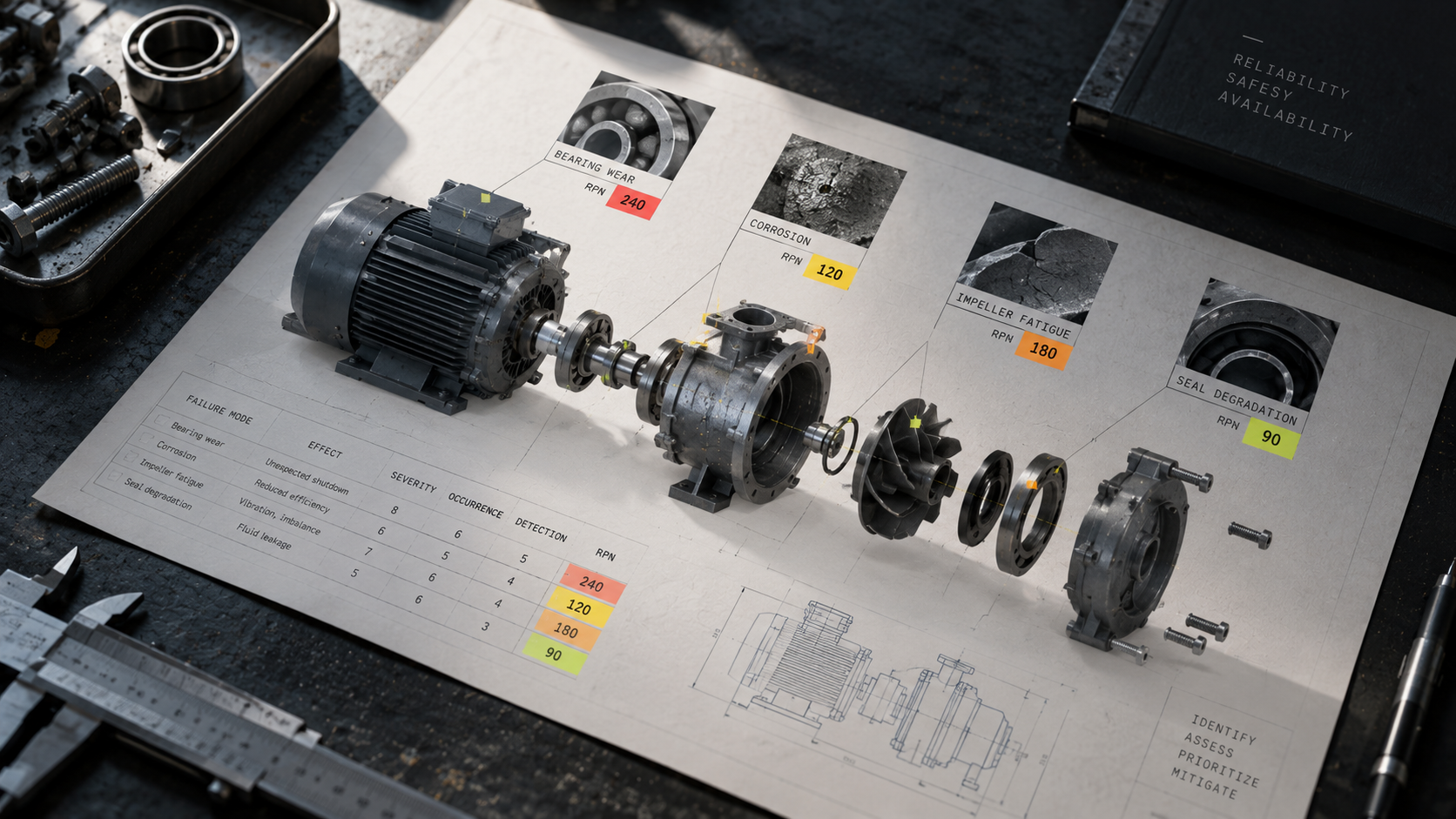
Failure Mode and Effects Analysis (FMEA) is a structured method for finding how a product, process, or system could fail, judging how much each failure would matter, and deciding which failures to act on first. It has been in continuous use for more than seventy years, from spacecraft to surgical devices, and its governing standards have changed more recently than most practitioners realize. This guide covers where FMEA came from, how to run one under the current standard, the main types and when to use each, the benefits and the real limitations, and how FMEA sits alongside Six Sigma and Lean.
Where Did FMEA Come From, and How Has It Evolved?
FMEA began in the United States military. The original procedure, MIL-P-1629, titled "Procedures for Performing a Failure Mode, Effects and Criticality Analysis," was published in 1949 as a reliability technique for classifying failures by their effect on mission success and safety. A common claim that FMEA dates to a 1974 standard is off by a quarter century: 1974 is when MIL-STD-1629 (SHIPS) appeared, and the method itself is 1949.
Aerospace picked it up next. By the early 1960s, NASA contractors were using variants of the technique, and NASA released a formal procedure for the Apollo program in 1966. The Society of Automotive Engineers published the first civil treatment in 1967. The military consolidated its guidance in MIL-STD-1629A in 1980, which was formally canceled in 1998 but is still widely referenced in defense and space work.
The military method was technically FMECA, which adds a criticality analysis to rank each failure by how serious and how likely it is. In commercial practice the criticality step was often dropped and the name shortened to FMEA, though the two terms are still used interchangeably in many industries.
The move into commercial industry came through automotive. Ford adopted FMEA in the 1970s following the Pinto fuel-system problems and extended it from designs to manufacturing processes, which is where Process FMEA originates. International standards followed: the International Electrotechnical Commission published the first edition of what is now IEC 60812 in the mid-1980s, and the Automotive Industry Action Group and Germany's Verband der Automobilindustrie each maintained their own automotive methods for decades.
The most consequential recent change is the 2019 AIAG and VDA FMEA Handbook, which merged the two automotive traditions into a single global reference, introduced a structured seven-step process, and replaced the long-standing Risk Priority Number with a new prioritization scheme. Any guide that still presents FMEA purely in terms of the old scoring math is describing a superseded method.
How Do You Perform an FMEA?
Under the current AIAG-VDA approach, an FMEA is built in seven steps: planning and preparation, structure analysis, function analysis, failure analysis, risk analysis, optimization, and results documentation. The point of the front-loaded steps is to force a team to understand the system and its functions before anyone starts filling in a form, which is where earlier, worksheet-first FMEAs tended to go wrong.
The work is done by a cross-functional team rather than a single engineer. A design or reliability lead brings the system knowledge, but manufacturing, quality, service, and often suppliers each see failure modes the others miss. For every function, the team asks how it could fail (the failure mode), what would happen if it did (the effect), and why it might happen (the cause).
Each failure mode is then rated on three scales from 1 to 10: severity of the effect, likelihood of occurrence, and the chance it goes undetected before reaching the customer. For most of FMEA's history, teams multiplied these into a Risk Priority Number, or RPN, from 1 to 1,000, and chased anything above an arbitrary threshold such as 100.
The 2019 handbook retired RPN as the primary metric and replaced it with Action Priority. Instead of one multiplied score, Action Priority reads the actual combination of severity, occurrence, and detection from a fixed table and returns High, Medium, or Low, weighting severity most heavily. This closes a real hole in the old math: a rare but catastrophic failure could produce a low RPN and slip down the list, whereas Action Priority keeps a high-severity failure near the top regardless of how often it happens. RPN survives, if a team wants it, only as a secondary tiebreaker within a priority band.
The current standard also separates two kinds of control that the older worksheet tended to blur: prevention controls, which lower how often a cause occurs, and detection controls, which catch a failure before it reaches the customer. Rating them apart tells a team whether to design the cause out or to strengthen the check, which is often the difference between a real fix and a heavier inspection burden.
The last step is the one most often skipped. An FMEA is meant to be a living record, revisited when the design changes, when a new failure mode appears in the field, or when the original ratings prove wrong. Treated as a one-time document filed after launch, it stops reflecting the system it was built to protect.
Which Types of FMEA Are There, and When Do You Use Each?
The type of FMEA follows the object under analysis and the phase of the lifecycle. Three are in common use, and the automotive handbook adds a fourth.
TypeWhat it analyzesWhen it is usedOwns the questionDesign FMEA (DFMEA)A product, component, or subsystem designDuring design, before tooling is committedHow could this design fail to perform its function?Process FMEA (PFMEA)A manufacturing or assembly processDuring process planning and before productionHow could this process build the part wrong?System FMEAInteractions between subsystems in a larger systemEarly architecture, before designs are fixedHow could the parts fail as they work together?FMEA-MSRFailures that occur in customer operation and how the system detects and respondsFor safety-relevant systems under the 2019 handbookWill the system notice and react safely in the field?
Design FMEA targets weaknesses that live in the design itself, such as a material that fatigues or a tolerance stack that binds. Process FMEA assumes the design is sound and asks where the line could produce a defective part, from a missed torque spec to a mislabeled batch. System FMEA sits above both and looks at interfaces, where a component that works on its own fails in combination with others.
FMEA-MSR, for Monitoring and System Response, was formalized in the 2019 handbook for systems that must stay safe during operation. It analyzes whether onboard diagnostics will detect a fault and bring the system to a safe state, which matters for anything from a braking system to a medical infusion pump. Choosing the right type, or running several in sequence, is usually more important than any single rating decision.
What Are the Benefits of FMEA?
The core benefit is timing. FMEA moves the discovery of failures to the design and planning stages, where a change costs a drawing revision rather than a recall, a line stoppage, or an incident. The economics of getting this wrong are well documented: Deloitte estimates unplanned downtime costs industrial manufacturers around $50 billion a year, and that poor maintenance and reliability practices can cut a plant's productive capacity by 5 to 20 percent. A failure mode caught in an FMEA is a failure mode that never reaches that ledger.
Safety and compliance are the second driver. FMEA is not optional in much of manufacturing: IATF 16949 mandates it across the automotive supply chain, aerospace and defense programs expect it, and medical device makers fold it into risk management under ISO 14971. For regulated products, a defensible FMEA is part of the evidence that a company took foreseeable failures seriously.
There is also an organizational benefit that rarely shows up on a balance sheet. A well-maintained FMEA is institutional memory. It records why a design choice was made and which failure a control was put in place to prevent, so that knowledge does not walk out the door when an experienced engineer retires. Finally, the prioritization discipline itself is valuable: Action Priority gives a team a shared, defensible way to argue that this failure gets fixed now and that one can wait.
What Makes FMEA Hard to Get Right?
For all its value, FMEA has well-known weaknesses, and honest guidance names them. Research on the method describes it as labor-intensive, dependent on significant expert input, and prone to subjectivity and analyst bias because failure modes and their ratings are generated largely through team brainstorming. Two people can score the same occurrence rating three points apart, and neither can fully defend the number.
The deeper limit is structural. A traditional FMEA can only evaluate failure modes the team is able to imagine in a workshop. Failures that nobody anticipated, especially ones that emerge from combinations of conditions rather than a single cause, do not appear on the worksheet and therefore never get a rating. Occurrence and detection ratings compound the problem, since both are usually estimates rather than measurements from how the equipment actually behaves.
The practical failure mode of FMEA is that it goes stale. Teams treat it as a launch deliverable, file it, and never return to it, so it stops matching the system in the field. Resistance to the process and thin training make this worse, turning a risk-analysis tool into a form-filling exercise.
Physical AI platforms are the next step in closing these gaps, which is why they are worth understanding alongside the method. Newton, Archetype AI's physical world model, learns directly from the sensor data that machines produce, rather than from a team's recollection of what has gone wrong before. Because it learns the underlying physics that governs how equipment behaves rather than one machine's failure history, it can read situations it was never explicitly trained on. That maps onto two of FMEA's blind spots. Its Anomaly Discovery agent surfaces emerging and previously unknown failure modes from observed behavior; in one wind-energy deployment, Newton found nine failure patterns that had not been identified before. Its Rare Anomaly Detection agent catches high-impact faults from only a handful of examples, exactly the rare, high-severity cases that FMEA teams struggle to rate. Observed frequency across a fleet can also ground occurrence ratings in data instead of estimation.
None of this replaces the FMEA itself. Severity is a judgment about consequences to people and the business, the cross-functional workshop is where system understanding lives, and a design analysis still has to be done by engineers. What a physical world model changes is that the analysis can stay current and can be informed by what the equipment is actually doing, so the FMEA becomes a living document instead of a filed one. Because Newton runs from cloud to edge on existing infrastructure, that feedback can happen where the machines are.
How Does FMEA Fit With Six Sigma and Lean?
FMEA is rarely used alone. It fits most naturally into the Analyze and Improve phases of Six Sigma's DMAIC cycle, where a team has measured a problem and needs to reason about how a process fails before changing it. The Action Priority ranking gives DMAIC a defensible way to choose which failure modes to attack, and the improvements a Six Sigma project makes feed back into the FMEA as revised occurrence and detection ratings.
In Lean manufacturing, FMEA pairs with mistake-proofing, or poka-yoke. A Process FMEA identifies where an operator could build a part wrong, and Lean answers with a physical or procedural control that makes the error impossible or immediately visible. The detection rating in the FMEA is a direct measure of how well those controls are working.
FMEA also sits within a family of reliability and quality tools that answer adjacent questions. Fault tree analysis works top-down from an undesired event to its possible causes, while FMEA works bottom-up from a component failure to its effects, so the two are often used together on safety-critical systems. Cause-and-effect diagrams help a team enumerate the causes that feed the failure-analysis step, and a control plan turns the FMEA's conclusions into the checks that run in production.
The through-line is that FMEA supplies the structured risk picture these methods act on. That is also why keeping it current matters so much: a Six Sigma project, a Lean control, or a maintenance program is only as good as the failure analysis underneath it. Continuously grounding that analysis in operational sensor data, rather than revisiting it once a year in a conference room, is what turns FMEA from a static artifact into a working part of a reliability program. For the operational side of that loop, the same principles carry into AI-based predictive maintenance, which monitors in real time for the failure modes an FMEA identifies.
Frequently Asked Questions
What is FMEA?
Failure Mode and Effects Analysis is a structured method for identifying how a product, process, or system could fail, assessing the effect and likelihood of each failure, and prioritizing which failures to address. It was developed by the US military in 1949 and is now used across automotive, aerospace, healthcare, electronics, and heavy industry.
How is FMEA performed?
Under the current AIAG-VDA standard, a cross-functional team works through seven steps: planning, structure analysis, function analysis, failure analysis, risk analysis, optimization, and documentation. For each failure mode the team rates severity, occurrence, and detection, then uses those ratings to prioritize corrective action.
What is the difference between RPN and Action Priority?
The Risk Priority Number multiplied severity, occurrence, and detection into a single score from 1 to 1,000, which let a high-severity failure hide behind a low number. The 2019 AIAG-VDA handbook replaced it with Action Priority, which reads the combination of the three ratings from a fixed table and returns High, Medium, or Low, weighting severity first.
What are the main types of FMEA?
The common types are Design FMEA for product designs, Process FMEA for manufacturing and assembly processes, and System FMEA for interactions between subsystems. The 2019 handbook adds FMEA-MSR for how a system detects and responds to failures during customer operation.
Which industries use FMEA?
FMEA is used wherever failure is costly or dangerous. It is mandated in automotive through IATF 16949, expected in aerospace and defense, and built into medical device risk management under ISO 14971, and it is widely applied in electronics, energy, and general manufacturing.
