
Archetype AI Team
From prebuilt agents to intelligence adapted for your operation.
Building Physical AI for a new operational problem shouldn’t mean starting from scratch. That’s why we introduced Newton Agents: prebuilt agents for common physical-world problems, from understanding changing operating states to detecting anomalies and verifying physical work.
Built on the Newton physical world model, each agent starts with an understanding of physical sensor data and can be adapted to the machines, processes, and environments unique to your operation.
Now, let’s take a look at what it means to put one to work.
Start with the problem you need to solve
Every operation has questions its data should be answering, but isn’t.
Is this machine running the way it should? Is process behavior changing in ways existing thresholds aren’t catching? Was that task completed correctly?
The first step isn’t choosing a model. It’s defining the question you need answered.
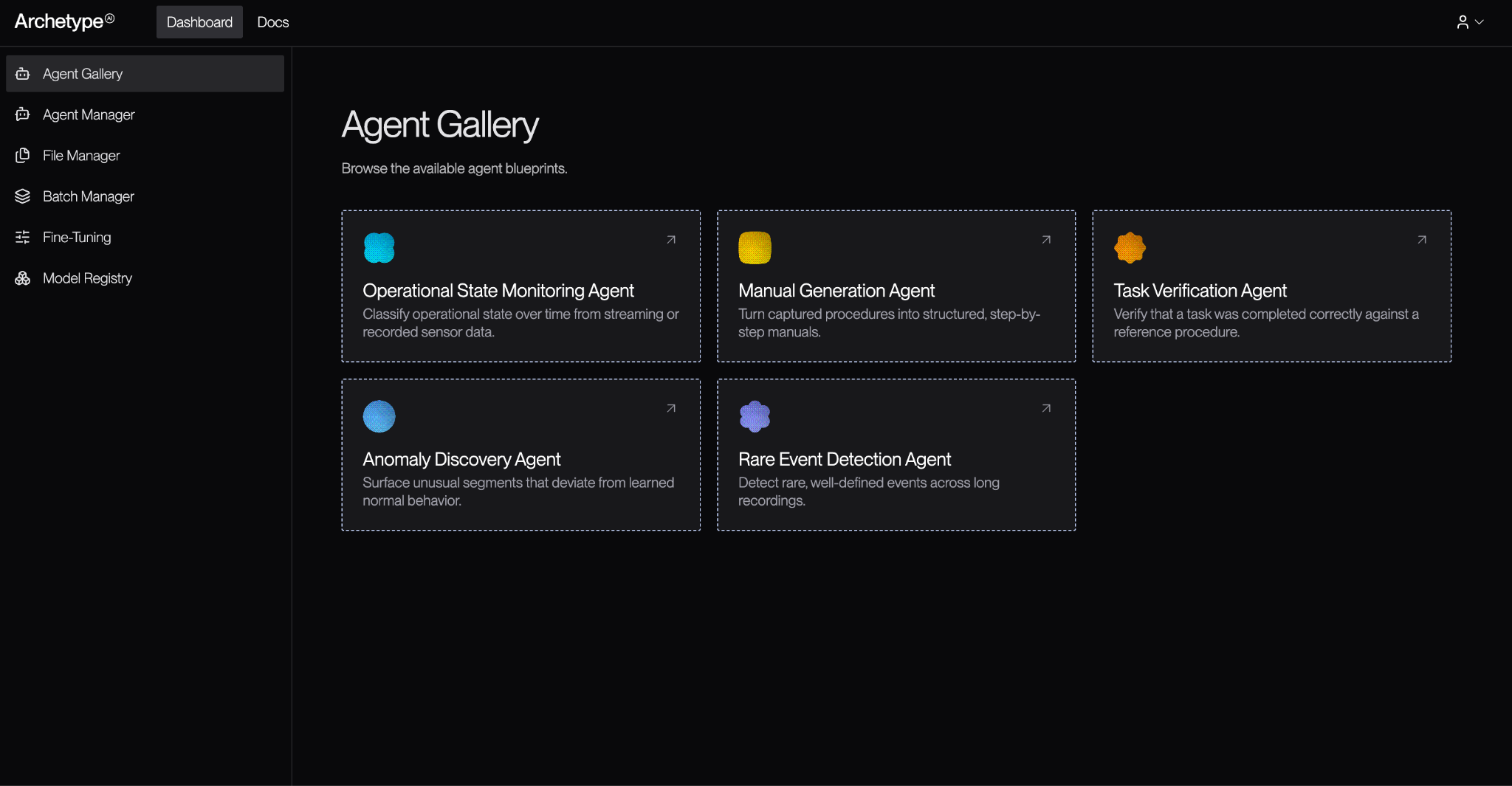
We designed Newton Agents around five common classes of physical-world problems:
- Operational State Monitoring — Understand the changing operating conditions and behaviors of machines and processes.
- Anomaly Discovery — Find unexpected behavior and problems you didn’t know to look for.
- Rare Event Detection — Detect critical events and failures from just a handful of examples.
- Task Verification — Verify that physical work is performed correctly.
- Manual Generation — Turn expert demonstrations into step-by-step instructions.
Each agent packages a common job into a reusable capability. And because every agent is powered by the Newton physical world model, you don't have to build the underlying intelligence from scratch for each new problem.
Instead of creating a new data pipeline, collecting thousands of labeled examples, and training a specialized model for every application, you start with pretrained physical understanding and an agent already designed for the job.
Adapt Newton to your operation
The question every industrial team asks about anything prebuilt: how does this work on my equipment, my sensors, my data?
Newton Agents are built around classes of problems, not a single machine, dataset, or application. Take Rare Event Detection. The agent isn’t designed to recognize one predetermined fault on one particular machine. Its job is to learn the physical patterns associated with an event from a small number of examples and recognize when those patterns occur again — on one machine, a line, or across an entire fleet.
The same principle applies across the catalog. Operational State Monitoring can identify the operating conditions that matter for different machines and processes. Anomaly Discovery can surface unexpected behavior across different combinations of sensor signals. Task Verification can be applied to different physical workflows.
This ability to carry the same underlying intelligence from one physical context to another is what makes Newton different. Because Newton is pretrained to understand patterns across physical signals, it can generalize to machines, environments, and operating conditions it wasn’t specifically trained on—instead of requiring a new model for every asset or application.
Putting an agent to work then starts with the physical context of your operation: your sensor data, equipment, processes, and operating conditions. Newton can work with live streams or historical data across vibration, temperature, pressure, current, acoustics, video, and other physical signals.
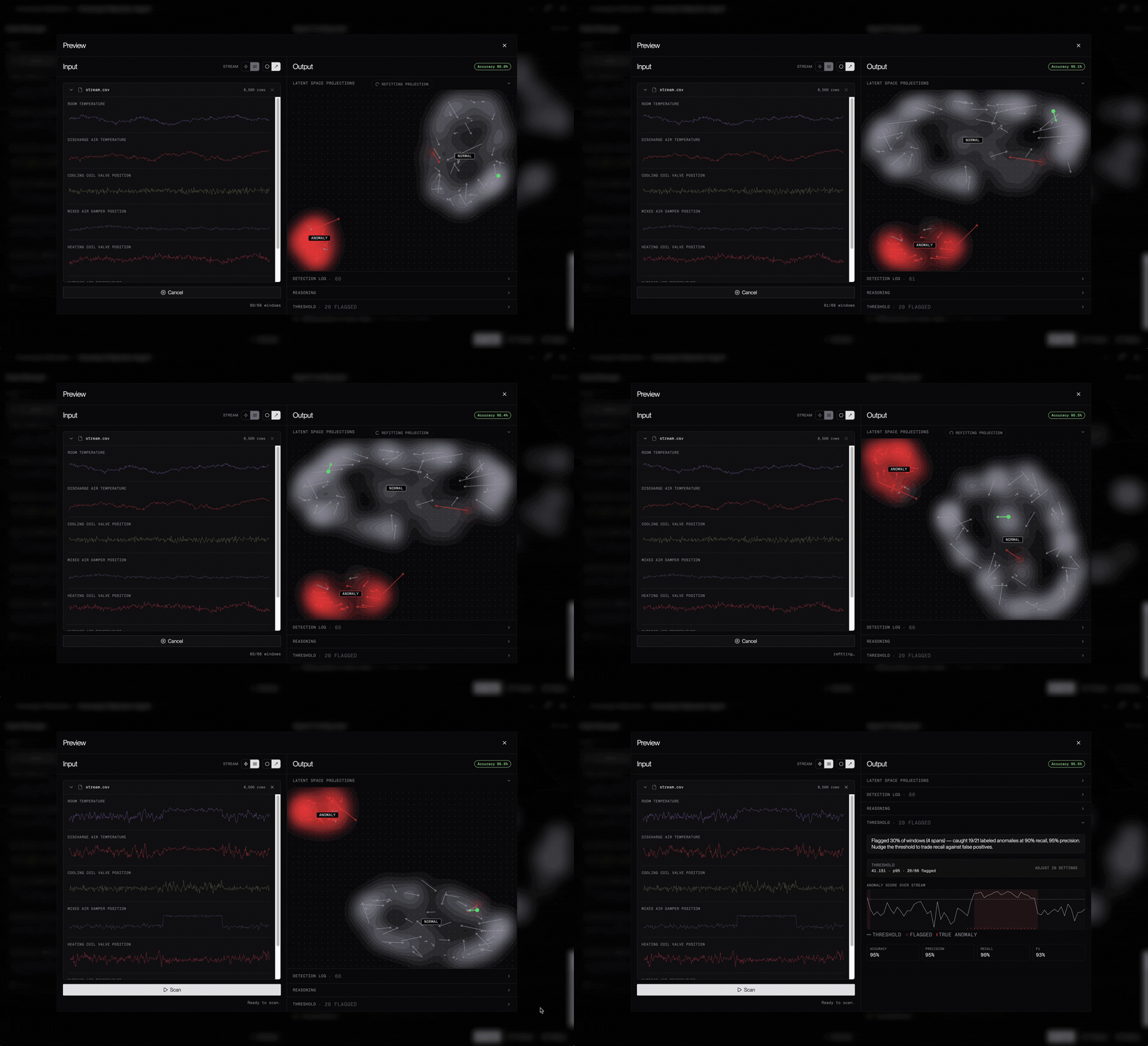
When more context is needed, a small number of examples can help the agent understand the behaviors that matter with more precision. And when deeper specialization is required, Newton can be fine-tuned on proprietary data within your own environment.
Then, prove that it works. Define what success means for the application and evaluate the agent against ground truth. Can it distinguish the states that matter? Catch the events you care about? Avoid costly false alarms? Use tools to automate data preparation, parameter tuning, and evaluation, to meet your bar before deployment.
The result is not a generic agent applied the same way everywhere. It’s a ready-to-deploy agent adapted to the realities of your operation.
Deploy where your operation happens
Getting an agent to understand your data is only part of the job. Physical AI ultimately has to run where physical operations happen.
For some applications, that might be in the cloud or a private VPC. For others, intelligence needs to run on-premises or directly at the edge, close to the equipment and sensor data it is interpreting.
Newton Agents can be deployed across cloud, VPC, on-premises, and edge environments based on the requirements of the application. Newton is available in multiple model sizes and can be optimized for industrial edge hardware, bringing intelligence closer to the physical systems it needs to understand.
That matters in environments where latency, connectivity, security, and data sovereignty aren't abstract infrastructure considerations—they determine whether AI can operate at all.
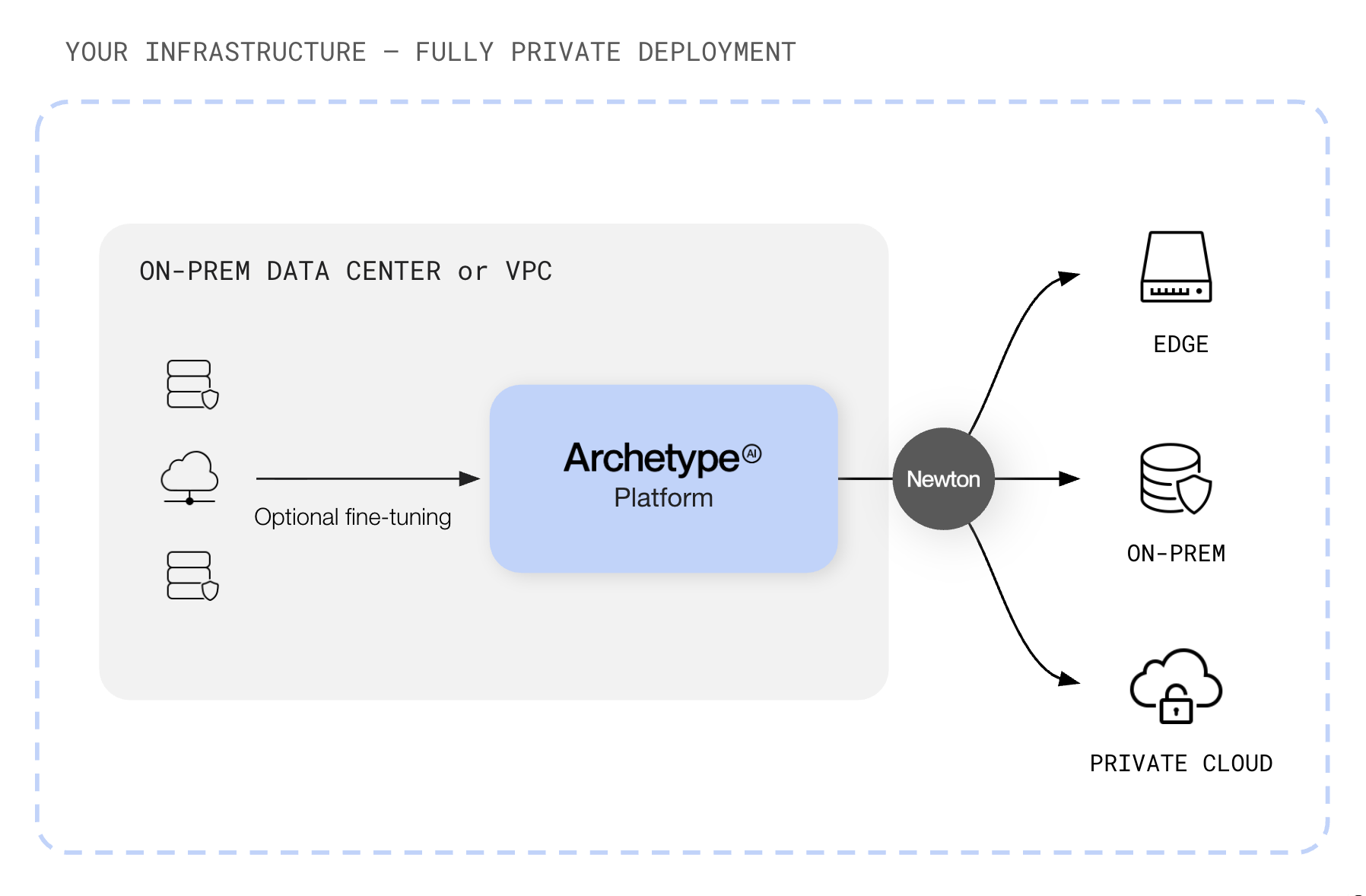
The goal is not simply to get an agent working on a dataset. It’s to put intelligence where the data is generated and where people and systems can act on what it understands.
Five agents are just the starting point
Operational State Monitoring, Anomaly Discovery, Rare Event Detection, Task Verification, and Manual Generation represent common problems we see across physical operations. But they don't define the limits of what you can do with Newton. When your problem doesn't fit one of these starting points, the same Newton physical world model, platform, and developer tools can be used to build custom Newton Agents for the problems unique to your organization.
And if you want to see what it looks like to put Newton Agents to work on your own data — join us at the Newton Meetup September 15. It's a hands-on session with the Archetype team: bring your data and your physical-world problem, and we'll run Newton Agents on it together.
Already have a physical-world problem you want to solve? Connect with our team to see how Newton Agents can help.