Choosing AI condition monitoring software is less about finding the tool with the longest feature list and more about avoiding the one that becomes expensive shelfware. Most platforms can detect a fault in a lab demo. Far fewer keep detecting reliably, at low false-positive rates, across your actual assets, a year after deployment. This guide is a critical buyer's framework: what these tools actually do, the categories they fall into, the tradeoffs vendors tend to skip, and how to select one that earns its keep.
For the underlying techniques and definitions, our guide to condition monitoring techniques and benefits covers the fundamentals. This page focuses on the software decision.
What Does AI Condition Monitoring Software Actually Do?
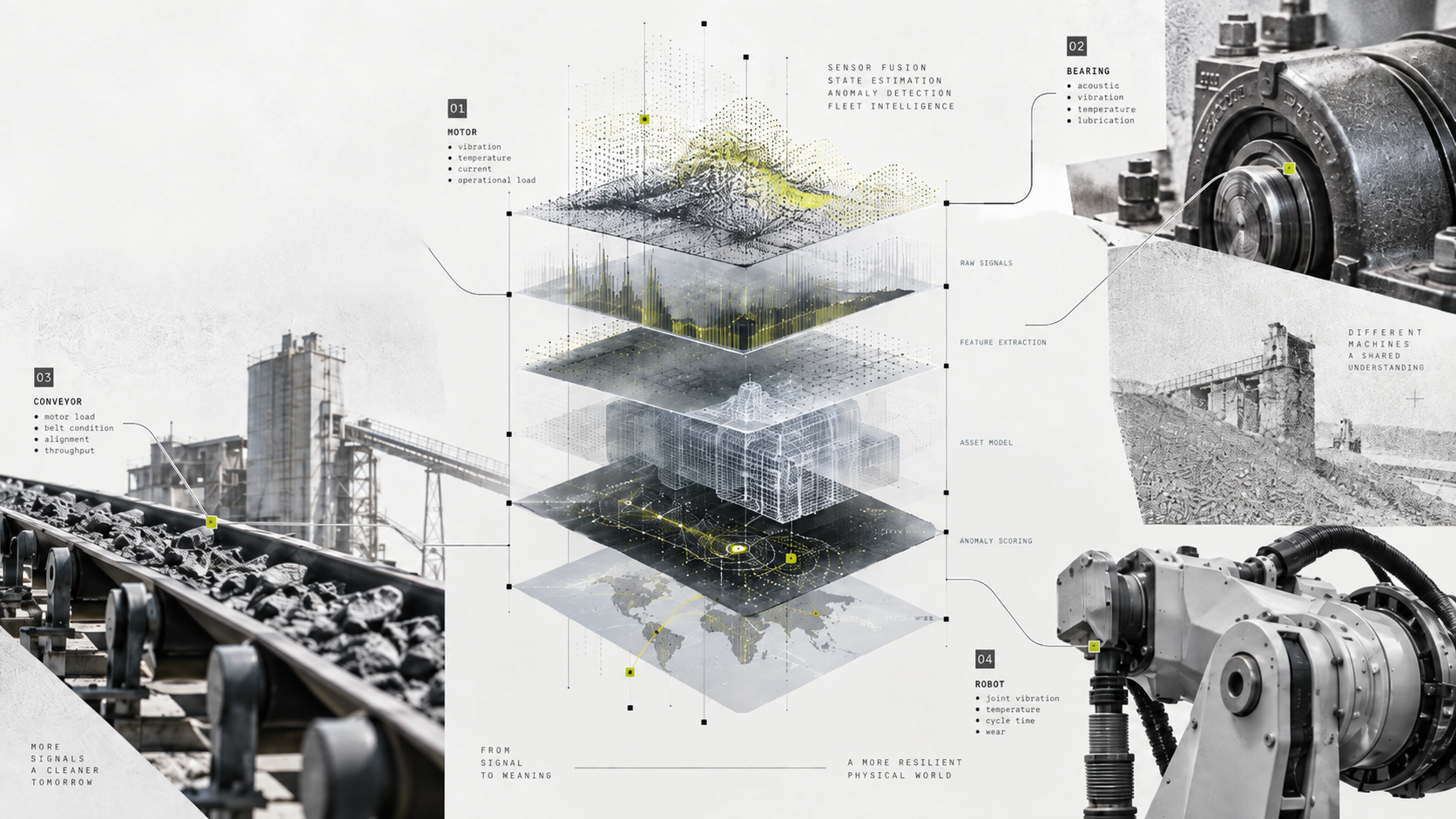
AI condition monitoring software ingests sensor data from operating equipment (vibration, temperature, current, acoustics, pressure) and applies machine learning to distinguish normal behavior from developing faults. The promise over older systems is specific: instead of firing an alert only when a value crosses a fixed threshold, it learns each asset's normal pattern and flags deviations in context.
That distinction is the entire value proposition, and it is worth stating plainly why it matters. A fixed threshold cannot tell that 85°C is normal at full production but alarming during a shutdown cycle. It cannot see that a slight vibration rise, a small temperature increase, and a subtle current change together signal a bearing failing, even when each reading individually looks fine. Catching context and correlation is what separates AI-based monitoring from rule-based systems, and it is the reason the category exists.
What Are the Three Categories of AI Condition Monitoring Software?
Marketing language flattens every product into "AI-powered." The useful distinction is architectural, because it determines what the software costs you in data, setup, and ongoing maintenance.
Rule-based and hybrid systems. The oldest category, often marketed with an AI layer bolted on. These rely primarily on thresholds and expert-defined rules. They are cheap, transparent, and adequate for simple, well-understood failure modes. Their weakness is the one above: they miss gradual, multi-signal degradation, and they generate false alarms when operating conditions shift.
Per-asset machine learning. The mainstream of what is sold as "AI condition monitoring." These systems train a model on a specific machine's historical data, learning its normal signature. They are genuinely more capable than thresholds. But they carry a hidden cost that rarely appears in a sales deck: each asset, or asset class, needs its own model, trained on enough labeled failure history to be reliable, and retrained as conditions drift. On a multi-site operation with thousands of assets, that becomes a permanent modeling and MLOps burden.
Foundation models. The newest category, and a genuinely different architecture. A foundation model is pre-trained broadly on physical sensor data, so it generalizes across machines rather than being rebuilt for each one. This removes the per-asset training bottleneck. Newton, Archetype's Physical AI foundation model, works this way: pre-trained broadly on physical signals, it generalizes across machines and deploys without labeled failure history or per-site model development. For an operation weighing the total cost of monitoring at scale, this is the axis that matters most, and the one most feature comparisons ignore.
Which Benefits Hold Up to Scrutiny?
The benefits of AI condition monitoring are real, but the numbers attached to them in vendor material deserve scrutiny.
The genuine wins are well documented at the strategy level. Siemens' True Cost of Downtime 2024 puts the cost of the problem being solved, unplanned downtime, at $1.4 trillion a year for the world's 500 largest companies, around 11% of revenue. Cutting even a slice of that is the prize a well-run program is chasing.
Be more careful with the accuracy claims. You will see "92% accuracy" or "90% prediction accuracy" quoted widely, but accuracy is meaningless without context. A model trained on imbalanced data can hit 99% accuracy by simply predicting "no failure" every time, and be useless. What matters is precision and recall on the failures that actually occur, on your assets, under your operating conditions. Treat any single headline accuracy number as a marketing artifact until you have seen it validated on a test on your own data.
The benefit that survives scrutiny best is the shift in maintenance economics: converting unplanned failures into planned interventions, extending asset life by servicing on condition rather than calendar, and removing a class of safety risk by catching degradation before catastrophic failure. Those hold regardless of which vendor's accuracy chart you believe.
What Challenges Do Vendors Skip?
A critical buyer's guide has to name the failure modes, because most struggling deployments fail for the same reasons.
Data quality and coverage. Every AI monitoring system is only as good as its inputs. Sensor dropout, calibration drift, poor sensor placement, and gaps in historical data all corrupt the signal. If your data foundation is weak, no algorithm rescues it.
The labeled-data problem. Per-asset machine learning needs run-to-failure examples to learn from, and most sites do not have them, especially for rare, high-consequence failures. This is the single most common reason pilots stall before scaling. It is also the specific problem foundation models are built to sidestep.
False positives and alert fatigue. This is the quiet killer. A system that flags problems that turn out to be nothing, even 8 times out of 10, trains operators to ignore it, and the eleventh alert, the real one, gets dismissed too. A false-positive rate as low as 10% can wipe out a program's savings entirely, the unnecessary work it triggers costing more than the failures it prevents. A tool's false-positive rate on your assets matters more than its peak accuracy in a demo.
Total cost of ownership. The license fee is rarely the real cost. Sensors, integration, the internal labor to review alerts, and, for per-asset systems, the ongoing modeling and retraining work, dominate the true budget. Ask where the recurring effort lives before you buy.
How Do You Choose AI Condition Monitoring Software?
Rather than a branded vendor ranking, which goes stale in months and rarely fits your assets, evaluate against criteria that actually predict success.
Start from your critical assets. Rank equipment by the cost and safety consequence of failure. The right software is the one that monitors those assets well, not the one with the most features overall. ISO 17359, the umbrella standard for condition monitoring, opens with exactly this step for a reason.
Insist on a test with your own data. The single most useful evaluation is running a candidate system on your historical or live sensor data and checking whether it catches known past failures without drowning you in false alarms. Any serious vendor will support this. It is also the fastest way to separate real capability from a polished demo.
Weigh the deployment cost honestly. Ask how many models the system needs, how much labeled history each requires, and who maintains them over time. A tool that deploys zero-shot or few-shot has a fundamentally different cost curve than one requiring a model per asset.
Check where inference runs. For real-time detection and data-sovereignty reasons, many operations need inference to run at the edge, on or near the machine, not exclusively in the cloud. Confirm the deployment model matches your latency and security constraints.
Evaluate interpretability. An alert a reliability engineer cannot understand or act on is noise. Favor systems that explain why they flagged something, in terms tied to the asset, over black-box scores.
Where Is the Category Heading?
Three shifts are worth factoring into a multi-year software decision.
The first is the move from per-asset models to generalizing models. The MLOps burden of maintaining thousands of individual models is the main thing keeping monitoring programs stuck at low maturity, and foundation models are the direct answer to it.
The second is multimodal fusion. Rather than watching each sensor stream in isolation, next-generation systems fuse vibration, temperature, acoustics, and more into a single representation, which is how the subtle multi-signal failures actually get caught. Newton's sensor fusion works this way, combining signals that no single stream could resolve to surface machine states a threshold system would miss.
The third is edge-native intelligence, as real-time inference moves closer to the data to meet the latency and privacy demands that cloud-only architectures cannot.
The Bottom Line
The best AI condition monitoring software is not the one with the most impressive accuracy figure in a slide. It is the one that reliably catches the failures that matter on your critical assets, keeps its false-positive rate low enough that your team trusts it, and does not saddle you with a modeling burden that grows with every asset you add. Evaluate against your own data, count the total cost of ownership honestly, and pay particular attention to how the underlying architecture scales. That last question, whether the tool learns one machine at a time or generalizes across them, increasingly separates programs that stay live from programs that quietly get switched off.
Frequently Asked Questions
What Is AI Condition Monitoring Software?
It is software that applies machine learning to equipment sensor data to detect developing faults before failure. Unlike threshold-based systems, it learns each asset's normal behavior and flags deviations in context, catching gradual and multi-signal degradation that fixed limits miss.
How Accurate Is AI Condition Monitoring?
Accuracy varies widely by asset, data quality, and method, and any single headline number should be treated skeptically. What matters is precision and recall on real failures on your equipment. The most reliable way to judge a tool is a validation test on your own data.
What Is the Difference Between Per-Asset ML and a Foundation Model?
Per-asset machine learning trains a separate model for each machine, requiring labeled failure history and ongoing retraining. A foundation model like Newton is pre-trained broadly on physical signals, so it generalizes across assets and deploys without years of site-specific data.
What Are the Biggest Challenges in Adopting AI Condition Monitoring?
Poor data quality, lack of labeled failure history, false-positive rates that cause alert fatigue, and underestimated total cost of ownership. Most stalled deployments fail on these rather than on raw algorithm capability.
How Do I Choose the Right Software?
Start from your critical assets, insist on a validation test with your own data, count the full deployment and maintenance cost, confirm the inference model fits your latency and security needs, and favor systems whose alerts are interpretable and whose architecture scales without a model per asset.
Is AI Condition Monitoring Suitable for Smaller Operations?
It can be, but the economics depend heavily on architecture. Tools requiring extensive per-asset training and data science support are harder for small teams; approaches that deploy with minimal labeled data lower that barrier considerably.
