
AI is moving beyond screens.
For years, generative AI has been about words, images, code, and conversations. But the next shift is happening in the physical world: machines, sensors, factories, buildings, vehicles, and infrastructure. That is where Physical AI comes in.
This post breaks down the difference between Physical AI, generative AI, and agentic AI, and explains how they work together to turn real-world signals into smarter decisions, safer operations, and systems that can actually understand what is happening around them.
What Is Physical AI?
How Do Practitioners Define It?
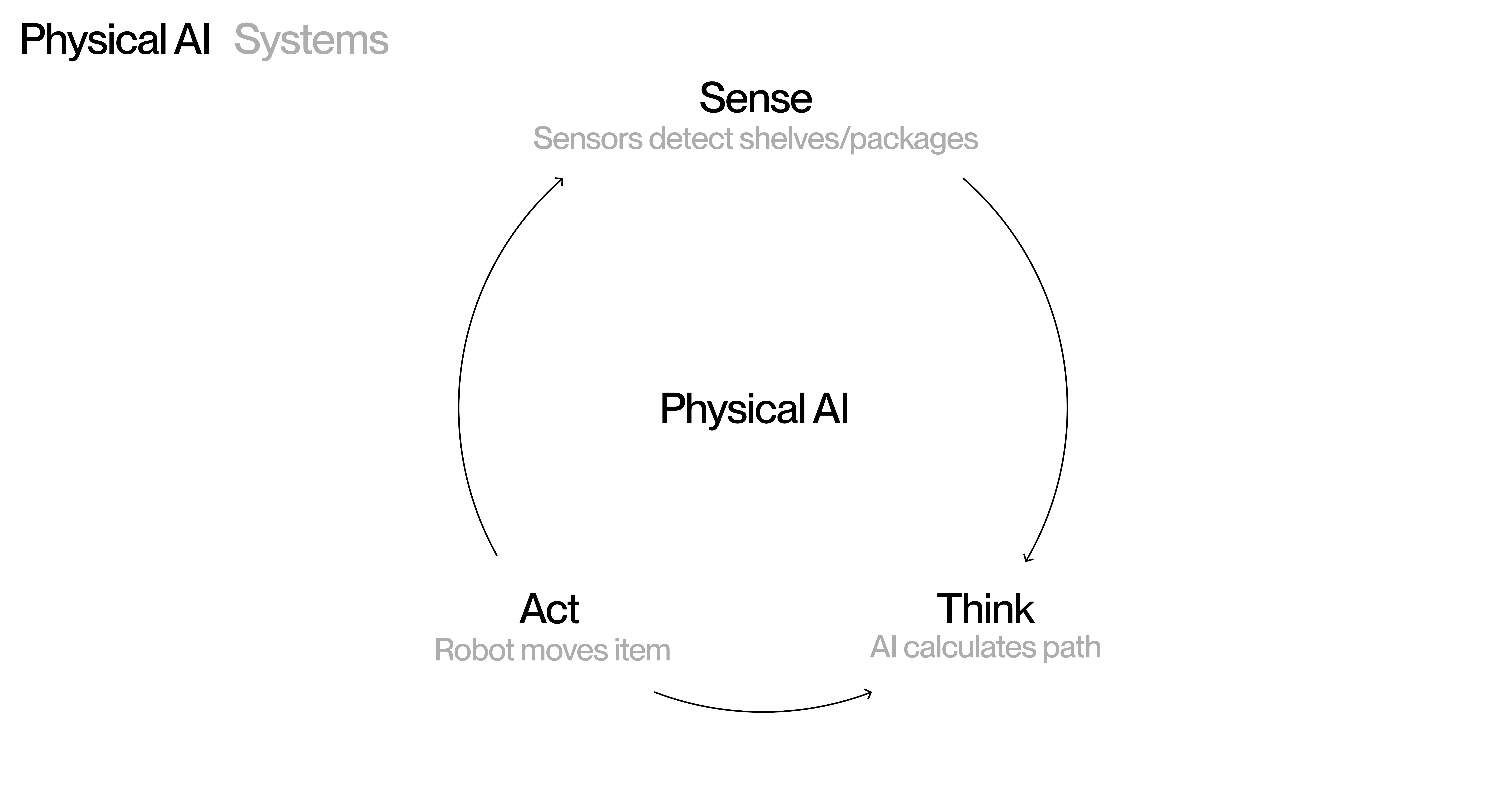
Physical AI is AI that understands, predicts, and acts on continuous signals from the physical world. Practitioners see it as a stack that combines sensing, dynamics modeling, decision making, and actuation or control.
Unlike models that only reason over text or images, Physical AI reasons about forces, timing, wear, and system behavior over time. The physical world generates trillions of sensor signals that AI has barely touched, and Physical AI is the approach that unlocks intelligence over those signals.
What Are Core Components And Capabilities of Physical AI systems?
Core components of Physical AI systems include sensors, a foundation model for physical signals, a real-time inference layer, and a control or recommendation layer that connects to operational systems.
Capabilities span anomaly detection, predictive maintenance, safety monitoring, task verification, and many more.
Foundation models for physical signals, like Newton, Archetype's proprietary Physical AI model, let teams build domain-specific applications without training from scratch. The Archetype Platform — a full-stack Physical AI platform — provides Newton alongside domain-specific solution tools for continuous process monitoring, task verification, and safety, so teams can rapidly build and deploy Physical AI agents instead of rebuilding every time.
Newton is trained self-supervised on hundreds of millions of real-world sensor measurements, so it generalizes across machines, sensor types, and domains without task-specific labels.
How Does It Operate In The Real World?
Physical AI systems ingest continuous, multimodal streams from edge sensors — radar, cameras, accelerometers, vibration, temperature, current — then tokenize and embed them into a shared representation a foundation model can reason over. Predictions and policies run at the edge or in the cloud depending on latency needs, producing alerts, optimized setpoints, automated actions, or operator insights. Newton, Archetype's Physical AI foundation model, uses Universal Tokens to fuse sensor data with natural language, so operators can query the physical world in plain English while the model reasons directly over raw signals.
Deployments mix human-in-the-loop checks, models that learn from feedback, and integration with operational systems. The Archetype Platform is built for that loop — agents run in the cloud, in a private VPC, on-premises, or directly on edge hardware, so teams meet latency and data-residency requirements without rebuilding the stack.
The shift from reactive monitoring to predictive physical intelligence happens through forecasting and prescriptive layers that turn signals into prioritized actions — failure forecasts, setpoint recommendations, ranked maintenance tickets — closing the loop between perception and operational decisions.
How Is It Different From Embodied AI?
Embodied AI usually refers to agents with a body, most often robots that perceive and act in a localized environment.
Physical AI includes embodied systems but is broader, covering static infrastructure, industrial equipment, and distributed networks where no single agent "moves." Embodied work emphasizes control, manipulation, and navigation.
Physical AI adds forecasting, system-level optimization, and long-horizon monitoring across assets that may never be mobile.
What Is Generative AI?
How Do Generative Models Work?
Generative models learn patterns in their training data and produce new outputs that fit them. Most are transformers, which use an "attention" mechanism to weigh how every part of an input relates to every other — that's what gives them long-range context. Text models predict the next token (a word or word piece) across billions of examples; diffusion models learn images by removing noise from corrupted inputs.
Pretraining yields broad pattern recognition; fine-tuning and prompting then steer the model toward specific tasks without retraining from scratch. In short: generative AI predicts plausible continuations of patterns it has seen.
What Capabilities Do They Offer?
They produce text, images, code, audio, and structured outputs — drafting reports, translating manuals, generating boilerplate code, summarizing tickets, or turning a sketch into a UI mockup.
They excel at pattern completion, creative assistance, and knowledge work where the domain is symbolic, textual, or visual. LLMs unlocked intelligence over text, changing how organizations automate anything language-centric.
What Data And Compute Do They Require?
Pretraining a frontier model takes massive, diverse datasets and large compute budgets — clusters of GPUs, weeks to months of training, and serious storage. Performance scales predictably with more data, parameters, and compute.
After pretraining, fine-tuning and prompt-based methods cut the cost of adapting a model to new tasks, but inference at scale still costs compute and adds latency. Data quality is decisive: noisy or biased data produces noisy or biased models.
What Limitations Should You Expect?
One common limitation of LLMs is hallucinations, i.e. outputs that sound right but aren't. The cause is structural: the model's job is to predict the next plausible token, so guessing is the default when it doesn't know.
Generative models also lack grounding in physical causality, time, and uncertainty — they reason over text and pixels, not forces, dynamics, or sensor signals. For physical tasks, you need external grounding from sensor data and control layers that enforce safety and worst-case guarantees.
This gap — between symbolic reasoning and physical reality — is the problem Physical AI is built to solve.
How Do They Differ?
What Are The Key Technical Differences?
Inputs and outputs differ: Physical AI ingests continuous, high-frequency, multimodal sensor streams with strong temporal correlations. Generative AI ingests discrete tokens or images and outputs symbolic or pixel-based artifacts.
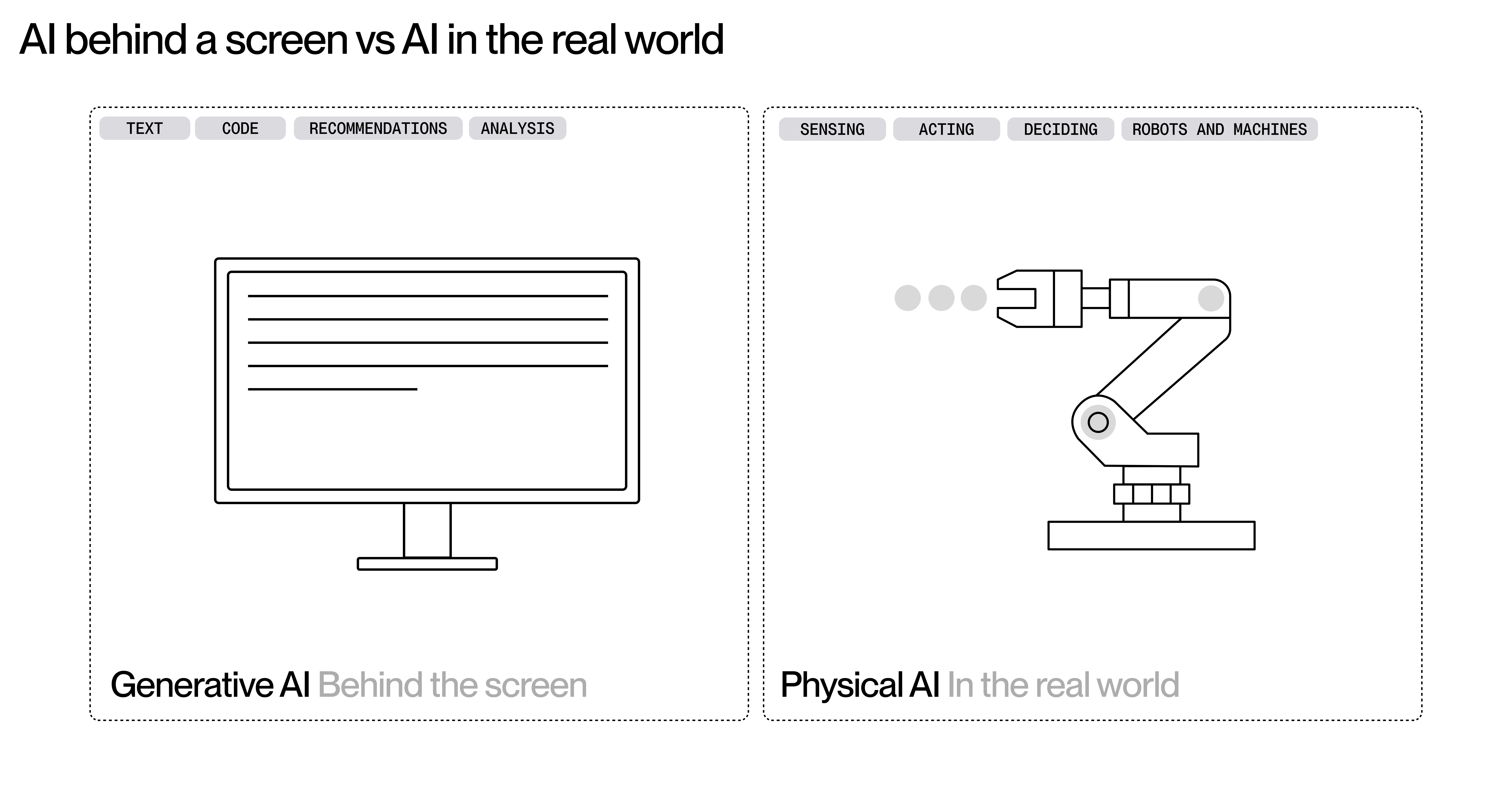
Physical systems demand real-time constraints and physics-aware priors. Generative systems emphasize large-scale pattern learning and sampling. Training data regimes differ too, with physical models relying on structured telemetry and experiments while generative models rely on massive unstructured corpora. Put plainly: LLMs were built for language, Physical AI is built for real-world processes.
How Do Use Cases Contrast?
Generative AI is used for content creation, coding, and conversational automation. Physical AI is used for predictive maintenance, process optimization, safety monitoring, and much more.
Platforms like Archetype organize these capabilities into solution packages — continuous process monitoring, task verification in discrete operations, and safety — each with prebuilt agent templates that customers tailor to their specific assets and workflows. Industries like construction, manufacturing, energy, telecom, and smart cities are early movers for Physical AI, but any real-world environment can be transformed by Physical AI Agents.
How Do Evaluation Metrics Differ?
Generative models are often judged by human quality measures, perplexity, or FID for images. Physical AI is evaluated by operational metrics: time-to-detect faults, false negative rates, control stability, uptime, and business impact like cost saved or incidents avoided. Physical metrics are operational, safety oriented, and tied to downstream performance.
Where Does Agentic AI Fit?

What Is Agentic AI In Practice?
Agentic AI describes systems that pursue goals by sensing, planning, and acting across tools and environments. Mechanically, most agents today use an LLM as the planning and reasoning engine, then call out to tools — search, calculators, APIs, sensor queries, control systems — to actually take action. The LLM proposes; the tool layer (with any safety gates in front of it) executes.
The most familiar agents today are LLM-based and live in the digital world. Coding agents like Claude Code or Cursor read a codebase, run tests, propose patches, and apply them — turning a natural-language instruction into multi-step engineering work. Productivity agents schedule meetings, draft emails, search documents, and chain those steps together so a single request can move through ten tool calls without human handholding.
Physical AI agents work the same way, but they reason about sensor signals, machinery, and physical context. A manufacturing safety agent built on Archetype's Newton, for instance, can fuse camera, microphone, and equipment-control streams to monitor a factory floor in real time, distinguish standard activity from a worker entering a hazardous transit area, and trigger safety protocols — alerts, warning lights, or equipment shutdown — when risk is detected. The reasoning happens over physical signals; the actions land in the physical world.
How Does It Bridge Generative And Physical Systems?
Agentic systems use generative models for high-level reasoning and language tasks, and Physical AI models for perception, dynamics prediction, and control.
For example, an agent might use an LLM to draft a troubleshooting plan and a physical foundation model to predict outcomes. That composition lets teams leverage the strengths of both worlds.
When Should You Use Agentic Control?
Use agentic control when tasks require long-horizon planning, cross-modal reasoning, and adaptive decision-making across systems. It's ideal for orchestration, diagnostics, scheduling, and semi-autonomous operations where human oversight exists.
Avoid full agentic autonomy for latency-critical or safety-critical loops without formal validation and redundant fail-safes. Teams building agentic layers on top of Physical AI infrastructure can gain outsized advantages as deployments scale.
When To Use Each Approach?
Which Problems Require Physical Intelligence?
Use Physical AI when the problem is about continuous dynamics, cause and effect, timing, or safety. If you avoid false positives, increase uptime, or forecast system states from high-frequency sensors, generative models alone won't cut it.
Problems that must run closed-loop at the edge, maintain stability, or meet worst-case guarantees require physical priors, physics-aware models, and time-series foundation models. Industries like construction, telecom, manufacturing, energy, and smart cities are early movers because they livestream trillions of sensor signals that traditional AI has barely touched. Teams that build this infrastructure now will own the data and operational edge for the next decade.
Which Problems Benefit From Generative Models?
Generative models excel where the medium is symbolic, textual, or visual and where pattern completion, synthesis, or creative reasoning matters. Use them for incident summarization, runbook generation, operator assistance, design ideation, and conversational interfaces that let humans interact with complex systems.
LLMs unlocked intelligence over text, so tasks that require natural language understanding, planning at a high level, or synthesizing disparate records belong to generative AI. They’re great when grounding in precise physics is not required for the immediate decision.
When Is a Hybrid Solution Best?
Go hybrid when you need both grounding in physical reality and flexible, high-level reasoning. Examples include factory-floor safety agents that fuse camera and equipment telemetry to detect hazards as they emerge plus an LLM to summarize incidents and brief the next shift, or predictive maintenance that uses a physical foundation model to forecast failure and an LLM to suggest remediation steps that operators understand.

Hybrid solutions shine when you must move from reactive monitoring to predictive, prescriptive actions while keeping human workflows natural and auditable. In practice you isolate low-latency control loops to Physical AI and place planning, explanation, and orchestration on generative models, then stitch them together with explicit grounding and safety gates.
What Are Real World Examples?
Which Physical AI Applications Lead Today?
Predictive maintenance on industrial equipment leads to an ability to forecast failures and schedule repairs.
Smart buildings and energy grids apply continuous forecasting to trim energy use and avoid brownouts. Construction fleets and heavy machinery monitoring are early adopters, because sensor data there is abundant and the ROI on downtime is obvious.
These applications rely on time-series foundation models that generalize across assets and accelerate deployment. Full-stack platforms like Archetype deploy on the customer's chosen infrastructure — hyperscaler cloud, private VPC, or on-premises — with agents running in the cloud, on dedicated hardware, or directly at the edge.
Which Generative AI Applications Lead Today?
Customer support automation, code generation, content creation, and conversational agents are among the many generative use cases. In operations, LLMs are used to translate sensor findings into standard operating procedures, draft change requests that engineers can review, and more.
Generative models reduce cognitive load and speed decision cycles when the work is language-centric and does not require millisecond-accurate control.
Where Does NVIDIA And Other Vendors Fit?
Hardware and systems vendors provide the compute infrastructure, optimized libraries, and edge platforms that make hybrid deployments practical. NVIDIA supplies GPUs and edge accelerators for model training and inference, plus software stacks that accelerate multimodal models and sensor fusion.
Cloud providers and chip makers enable scalable training of foundation models for both signals and language. Industrial automation vendors supply hardened sensors, gateways, and control interfaces you must integrate with.
Where possible, teams build on open standards to avoid lock-in to any single vendor’s stack.
How To Design Hybrid Systems?
How Should You Orchestrate Perception And Language?
Keep perception loops local and deterministic, let language layers act as planners, explainers, and human interfaces.
A common approach is to translate between physical embeddings and tokenized prompts through adapters, retrieval mechanisms, or lightweight encoders so the LLM always has grounded context. Archetype takes a more integrated approach with TimeFusion, where sensor signals and natural language are encoded into a single shared token vocabulary so the model reasons over both directly in one unified architecture.
Use the language model to propose actions, but gate execution through the physical control layer and a safety policy. Make human review a first-class mode: let operators accept, modify, or override LLM suggestions with traceable audit trails.
Combining a physical world model with a language model creates a unified workflow: sensor data becomes legible to operators, insights are queryable in plain English, and decisions stay grounded in what the machines are actually doing.
How Do You Manage Latency And Bandwidth?
Put control-critical inference on-device and run heavier forecasts or generative workloads in the cloud. Use quantization and distillation to fit models on edge hardware, and reduce telemetry bandwidth by sending deltas, downsampled streams, or event summaries instead of raw signals.
Implement adaptive telemetry that increases fidelity only on anomalies. Measure end-to-end latency budgets and enforce them with tiered service levels: local for safety, edge for fast analytics, cloud for heavy reasoning.
How To Simulate And Test End To End?
Build digital twins for simulation and replay engines for recorded traces. Use both to validate perceptual and control behavior against realistic sensor noise, known failure modes, and edge-case scenarios.
Use hardware-in-the-loop tests for safety-critical actuations and run shadow mode in production where the system proposes actions without executing them. Continuously inject edge cases and monitor for drift, then update your test corpus so regression tests reflect real-world variation.
Common Mistakes And Remedies
What Implementation Errors Are Most Common?
The most common — and most expensive — implementation error is treating Physical AI like classical ML: building a bespoke model for every machine, sensor type, or use case. That path takes 12+ months and 5+ ML engineers per application, which is one reason an estimated 70-90% of industrial sensor data still goes unused. Instead, start from a Physical AI foundation model that already understands physical signals and can fuse multimodal data out of the box, then build use-case-specific agents on top of it instead of retraining from scratch.
A close second is over-investing in labeling and per-asset feature engineering before testing what a generalist model can already do. Newton is trained self-supervised on hundreds of millions of real-world sensor measurements, so it generalizes across machines and modalities without per-asset labels — work that used to take months of annotation can be configured in days through natural-language prompts on the Archetype platform.
MLOps hygiene still matters underneath all of this. Under-specified time alignment and metadata make any model brittle across assets, inconsistent root-cause labeling muddies whatever labels you do collect, and skipping shadow mode before granting control authority causes avoidable incidents. Enforce timestamp discipline, version data and features, and run extended shadow deployments and hardware-in-the-loop tests before you let any model touch an actuator.
How To Avoid Overreliance On One Model Type?
Don’t ask an LLM to do physical work on its own, and don’t fall back to hand-built single-purpose models for every asset either. Both extremes break for predictable reasons: LLMs lose information when forced onto continuous sensor signals, and bespoke per-asset pipelines don’t scale across machines, sites, or modalities.
The pattern that holds up is two complementary layers. A Physical AI foundation model — like Newton — handles perception, sensor fusion, and anomaly detection across many sensor types and use cases without retraining from scratch. A language model sits above it for high-level reasoning, planning, and operator communication. Keep clean interfaces between the two so either can be swapped, and gate any LLM output that could trigger an actuator through the physical model and a safety policy.
How To Build For Robustness From Day One?
Plan for deployment topology. Cloud-only architectures introduce latency and data-residency exposure that physical environments often can't tolerate. Run inference where the data lives — at the edge, on-prem, or in a private VPC — with the cloud reserved for heavy retraining and analytics, so a network interruption degrades gracefully rather than taking the system offline.
What Organizational Missteps To Prevent?
Avoid treating Physical AI as a pure R&D play or a vendor-led bolt-on. Siloed teams, unclear ownership of data, and missing operator involvement kill adoption. Here is how to solve this problem: form cross-functional product teams with operations, controls, and data science in the same loop. Define measurable KPIs tied to business outcomes. Invest in operator training and change management because trust, not raw model accuracy, determines whether systems get used.
Build Physical AI to augment human expertise, not replace it. Fully autonomous "lights-out" operations are rare in practice — most successful deployments make operators faster, safer, and better-informed. Scoping the project as a human productivity tool, not a labor-replacement project, is often what gets it adopted at all.
FAQs
What Is Physical AI?
Physical AI is AI that reasons about continuous, time-dependent signals from the real world and converts those signals into predictions, recommendations, or actions. It combines sensing, time-series modeling, real-time inference, and control or prescriptive layers so systems can go beyond monitoring to forecasting and closed-loop intervention. The physical world generates trillions of sensor signals that AI has barely touched, and Physical AI is the approach that unlocks intelligence over those signals.
How Is Physical AI Different From Generative AI?
Generative AI predicts plausible continuations of symbols or pixels, Physical AI predicts system states and outcomes governed by physics and time. Generative models excel at language, images, and synthesis. Physical models must handle high-frequency telemetry, causal dynamics, latency budgets, and safety guarantees. One produces text or images, the other produces state estimates, failure forecasts, and control setpoints. Use generative models when you need flexible reasoning or narration, use Physical AI when you need reliable, time-aware answers about machines, infrastructure, or environments.
Physical AI vs Generative AI vs Agentic AI?
Think of them as complementary layers, not competitors. Generative AI provides broad reasoning, explanation, and natural-language interfaces. Physical AI provides grounded perception, sensor fusion, and dynamics forecasting. Agentic AI is the pattern that ties them together — pursuing goals, sequencing actions, and interacting with tools and humans. A typical Physical AI agent uses a foundation model like Newton to interpret sensor signals and an LLM to reason about plans and communicate with operators. Combine them when tasks need long-horizon reasoning plus physics-aware decisions.
What Are Physical AI Examples?
Predictive maintenance, manufacturing safety agents that fuse video and equipment streams to flag hazards in real time, smart-building energy forecasting, and grid stability forecasting. Each example turns continuous telemetry into insights suggesting that teams schedule a repair, halt a hazardous operation, adjust an antenna, change setpoints, or route pedestrians. These are the kinds of Physical AI agents that teams build on platforms like Archetype, using prebuilt templates for process monitoring, task verification, and safety as a starting point. These early-mover industries have lots of sensors and clear economic upside, but any instrumented environment can benefit.
What Is The Difference Between Physical AI And Embodied AI?
Embodied AI focuses on agents with a body, most often robots that perceive and act locally, emphasizing navigation and manipulation. Physical AI is broader, covering static and distributed infrastructure as well as mobile agents. It emphasizes forecasting, system-level optimization, and long-horizon monitoring across fleets or networks, not just a single embodied agent.
Can Generative Models Control Physical Systems?
Not directly, and not safely on their own. Generative models can propose plans, explain rationale, or draft runbooks, but acting on physical systems requires grounded perception, uncertainty estimates, and a control layer that enforces safety limits, timing constraints, and fail-safes. The pattern that works: pair a Physical AI foundation model that understands sensor signals with an LLM that handles language and orchestration, and gate any LLM-suggested action through the physical model and a safety policy before it executes.
How Does NVIDIA Support Physical AI?
NVIDIA supplies the compute and software building blocks many teams use to train and deploy large models and run inference. GPUs speed up pretraining and fine-tuning for time-series and multimodal workloads, while accelerated libraries and edge compute (including chips like the NVIDIA L4) help meet low-latency and throughput requirements at the edge. Their optimized stacks for sensor fusion and multimodal workloads lower integration friction when you stitch perception, forecasting, and language together — which matters as soon as you're running foundation models across fleets.
How Should Teams Combine These Technologies?
Use two complementary layers, not many. A Physical AI foundation model — built for continuous, multimodal sensor data — handles perception, sensor fusion, and anomaly detection across machines and modalities. An LLM sits on top for high-level reasoning, planning, and operator communication, with adapters or embeddings letting it query recent physical context. Gate any LLM-suggested action through the physical model and a safety policy before it executes, run long shadow deployments, and instrument for drift. Full-stack Physical AI platforms like Archetype provide the foundation model, development tools, and deployment flexibility to accelerate this investment — the teams that own operational data and the Physical AI infrastructure will have an unfair advantage over the next decade.
