
Archetype AI Team
Point a vision-language model at a camera on a production line and it will describe the scene well: a forklift near a pallet, an operator at a workstation, boxes moving down a conveyor. Operations teams need answers to different questions. Did the operator finish step four before starting step five? Is the part that slipped behind the guard still moving? Does the vibration on this motor match what the camera shows?
VLMs were built to describe images. Newton, Archetype AI's physical world model, was built to understand how physical systems behave, and it runs where those systems operate.
Why the difference starts with training
VLMs learn from internet-scale text, images, and video, so they are strong at captioning a frame, answering a question about a photo, and summarizing a clip. That training gives them little exposure to how machines, materials, and people behave over time. The PhysBench study presented at ICLR 2025 tested 75 models and found that while they excel in common-sense reasoning, they struggle with understanding the physical world.
Newton is pretrained on billions of real-world sensor and video measurements, including footage of tasks in industrial settings. It compresses sensor data, video, and language into one shared representation of what is happening in space, time, and physical state. The same model supports many tasks, from activity recognition and event sequencing to next-action prediction.
| VLMs | Newton | |
|---|---|---|
| Learns from | Internet text, images, and video | Real-world sensor data and video over time |
| Built to | Describe what a scene looks like | Understand how a physical system behaves |
| Inputs | Images, video, and text | Video, audio, text, and any type of time-series sensor data |
| Cameras | One view at a time | Multiple camera views at once |
| Output | Text, generated one token at a time | Real-time detections and predictions, with text explanations |
See the difference
Tracking in real time
We gave Newton's 1B-parameter physical reasoning model and a 4B-parameter open-source VLM the same video and asked both where the ball was. Newton returned a detection every frame at 30 Hz, or every 33 milliseconds. The VLM took about 1,100 ms to answer for a single frame, so the ball had moved by the time it responded. Newton's physical reasoning model produces its full output in one pass rather than one token at a time, which makes it more than 30x faster than a VLM on real-time vision tasks.
Why it matters: In physical operations, an insight is only useful if it arrives in time to act on. Real-time understanding lets a system step in while the outcome can still change. It can flag a hand entering a restricted zone, catch a missed assembly step before a defective unit moves down the line, or spot a conveyor backing up before throughput drops. A model that answers seconds late can only describe what already happened, and anything that happens between detections goes unseen.
Hyster-Yale Materials Handling runs this kind of real-time check today. Working with NTT DATA, we deployed Newton into a critical assembly workflow at Hyster-Yale's lift-truck plant in Berea, Kentucky, where it confirms each part is installed and each stage is completed, flagging deviations before a truck moves down the line. Newton also caught intentional deviations where operators had found a better way to perform a step, and those improvements feed back into the standard operating procedure.
"Our confidence in physical AI continues to grow, and we're starting to see the countless benefits that AI can bring to our global manufacturing operations. Working with NTT Data allows us to leverage how physical AI can help our production teams maintain high-quality standards and deliver the most reliable products to our clients." Barbara Binda, Director of Global Manufacturing Innovation, Hyster-Yale Materials Handling
Knowing what it can't see
When the ball rolls behind a book, Newton keeps tracking it. Having seen every frame leading up to that moment, it knows the ball’s speed and direction. Its training on billions of real-world examples tells it how that motion will continue until the ball reappears. The VLM, catching only one frame every second or so, loses the ball before it even reaches the book.
Why it matters: Real sites are cluttered. Workers walk behind racks, parts pass under guards, and vehicles move out of a camera's view. A system that loses track whenever something is blocked leaves gaps in the record and raises false alarms that operators learn to ignore. Continuous tracking of people, parts, and equipment is what safety monitoring, task verification, and throughput analysis depend on.
Reading sensors, not pictures of sensors
Most operational data never appears on camera. Vibration, temperature, current, and pressure are what confirm whether a machine is healthy or a step was done right. An LLM reads that data as text, and a VLM reads it as a picture of a chart. Both formats lose the timing and cross-sensor relationships that carry the meaning. In Beyond Plausible: Building Trustworthy AI to Explain the Physical World, our recent post with Encord, general-purpose models were given a chart and the correct finding and still explained it with the wrong reasoning, from miscounted heartbeats on an ECG to misjudged airflow in an HVAC unit.
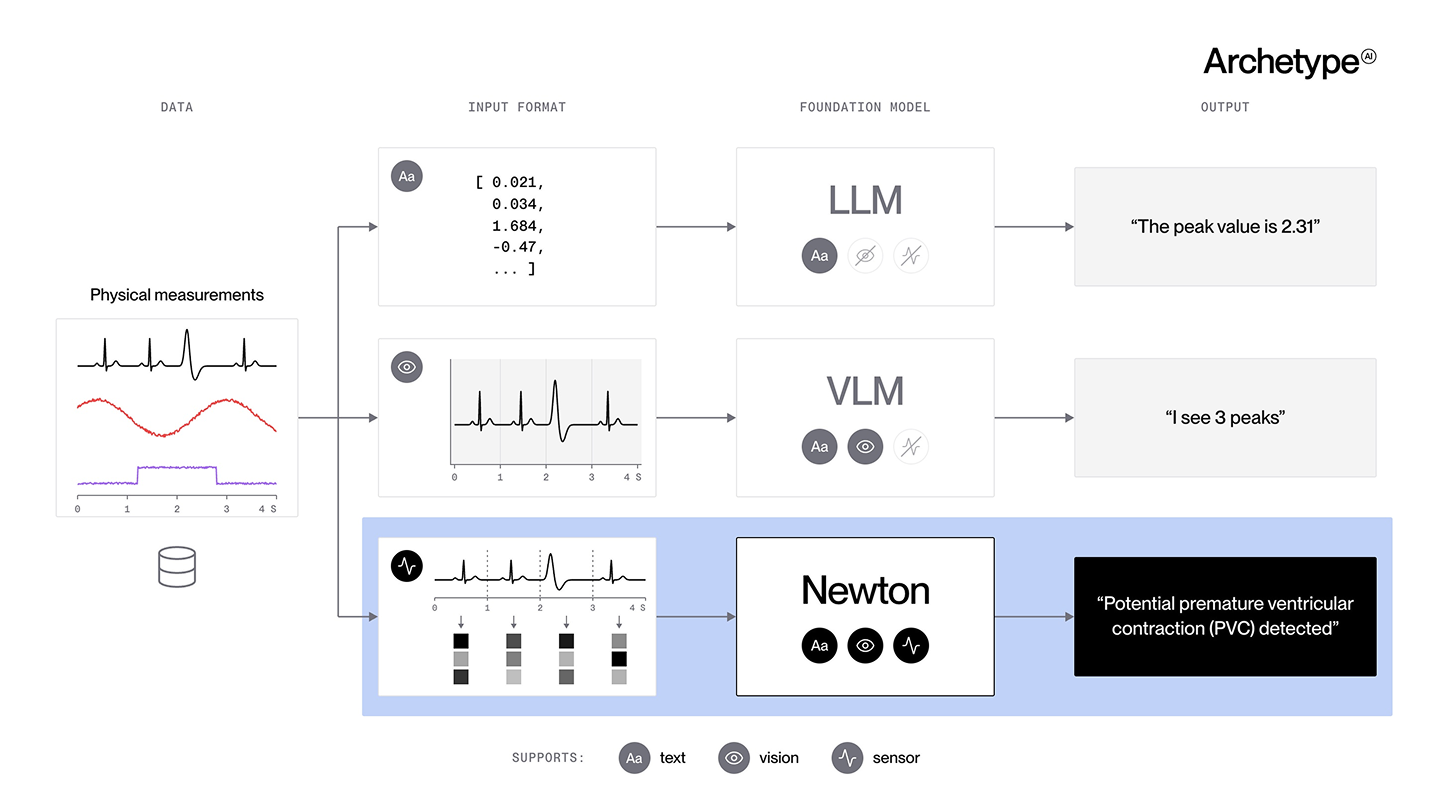
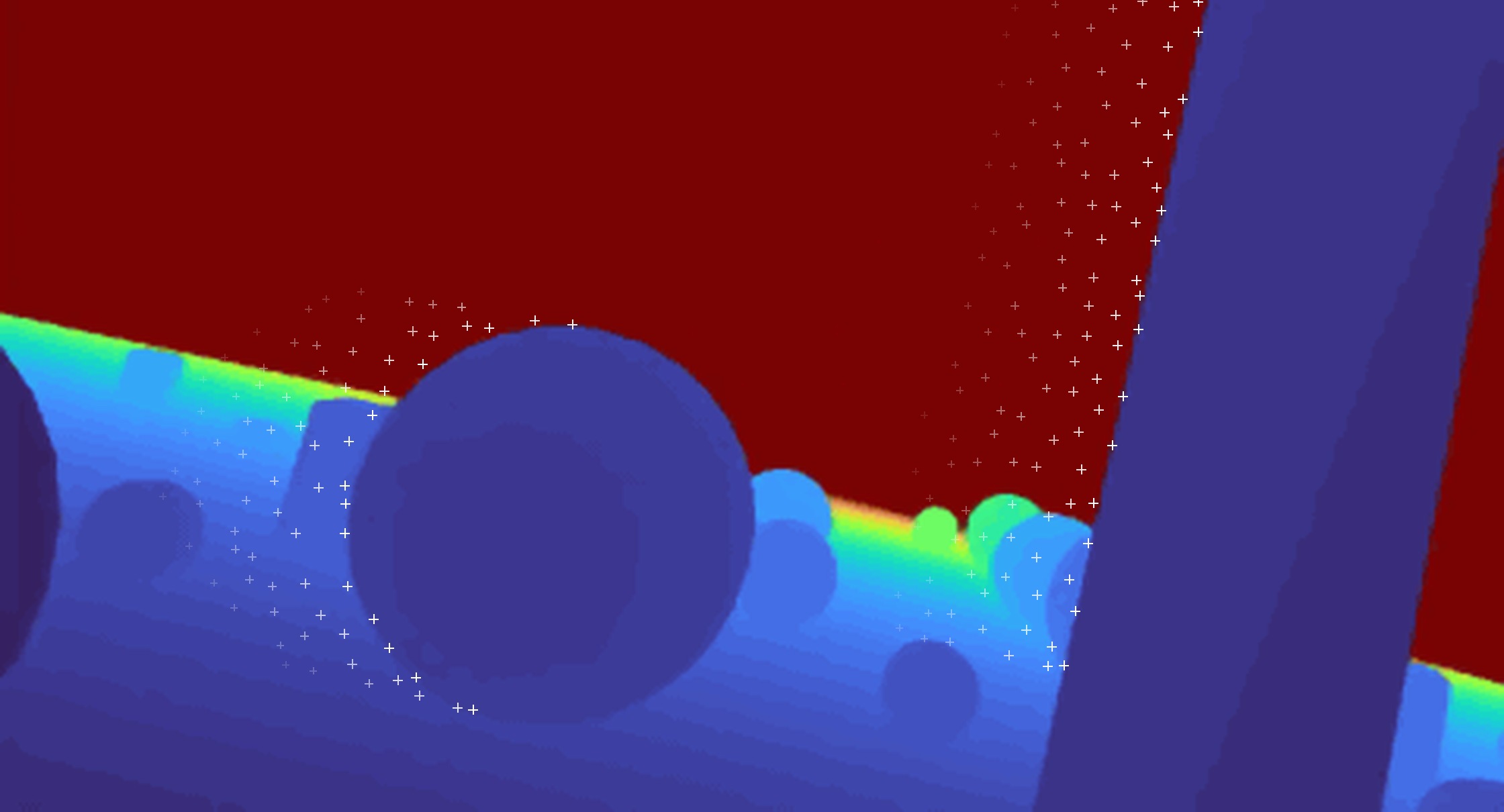
Newton reads sensor measurements natively and fuses them with video in the same model. In one demonstration, Newton took in data from a drone’s motion sensors, control commands, an RGB camera, and a depth camera at once, combining them into a single view of the drone’s flight.
Why it matters: Many costly failures show up in sensor data before they show up on camera. A bearing runs hotter, a motor draws more current, or vibration shifts ahead of a breakdown. A model that reads those signals directly can flag the problem early, and pairing them with video confirms what’s actually happening on the floor. Because its findings can be traced back to specific measurements, an engineer can verify the alert before committing to a shutdown or a repair.
What it takes to run in production
A model that performs well in a demo still has to run inside a real operation. Three questions decide whether it can: where the model runs, what it costs at scale, and how long it takes to reach production.
| Cloud VLMs | Open-source VLMs | Newton | |
|---|---|---|---|
| Video and sensor fusion | Video or images only | Video or images only | Camera and sensor data together |
| Multiple cameras | Single view | Single view | Multiple views at once |
| Real-time inference | Limited, through a cloud API | Possible with custom serving & optimization | Built-in, streaming |
| Edge deployment | Cloud only | Small models, with custom optimization and deployment | Range of model sizes, distilled to edge hardware |
| Where data lives | Vendor's cloud | Your infrastructure, with custom stack | Your infrastructure, out of the box |
| Pricing | Per token | Compute | Compute |
| Time to production | Full solution build | 6 to 12 months of model and solution build | Prebuilt agents and pipelines |
Edge and private. Newton deploys to edge CPUs and GPUs, on-premises data centers, or a customer VPC. Models range in size, including a distilled 1B-parameter version that runs on a GPU with about 2 GB of memory, and down to 80M parameters for constrained hardware. Data never leaves customer infrastructure, which keeps response times low and clears the way for teams that cannot send production data off-site. At Hyster-Yale, Newton runs on edge hardware beside the assembly line, and all production data stays on-site.
Predictable cost. Per-token pricing grows with every frame. One camera at 30 frames per second produces about 2.6 million frames a day, and a site may run dozens of cameras around the clock. Newton runs on compute the customer controls, with no token-based or per-inference charges, so the economics of a pilot hold up when it expands to every line and site. At the City of Bellevue, Newton running at the edge eliminates per-token charges and an estimated $1M a year in data transfer costs to the cloud.
Production-ready. Downloading open-source weights is the easy part. In our experience, turning them into a production industrial system takes 6 to 12 months and four to six specialists across ML, inference optimization, computer vision, and infrastructure, with three to six months of hiring lead time per role. Newton comes with that platform in place, so engineering time goes to the product rather than model infrastructure. Teams configure Physical AI agents with Newton in less than a day, with no model training, and reach 90%+ accuracy out of the box. At Hyster-Yale, AI deployment went from months to weeks.

When to use which
A VLM fits scene description, ad hoc questions about images, and reviewing footage after the fact. Newton fits work that has to happen on-site and in real time, across cameras and sensors, with data kept private and cost predictable across a fleet. Many products will use both, with Newton handling physical understanding and a language model handling the conversation with the user.
Why we built Newton
Physical operations depend on machines, sensors, and people moving through space in real time, often in places where data has to stay on-site. We built Newton to understand that world directly and to run where the work happens. Four capabilities make it fit for real-world operations:
- Fuse vision and sensor data. Corroborate what cameras see with sensor readings, so actions are verified beyond vision alone.
- Real-time AI at the edge. Frontier intelligence that runs in real time without the cloud. Select a model size or distill one to your hardware.
- Data and AI sovereignty. Keep full control of proprietary data for model training and inference, without it leaving your infrastructure.
- Cost-efficient scaling. Scale across production lines and sites with predictable compute costs, not token-based fees.
Describing a scene is only the start. Running a physical operation calls for AI that follows motion as it happens, reads the signals machines produce, and keeps working on the hardware and the budget a real site has. That’s the job Newton was built for, in manufacturing and automotive plants, semiconductor fabs, and city infrastructure, and across energy, materials and process industries, construction, and logistics.
Try Newton free or request a demo to see it on your own video and sensor data.
Build your first Newton Agent on your own data with a free 14-day trial.