
Archetype AI Team
How to Scale Physical AI Across Upstream Oil and Gas Operations
A model trained on a well stops describing that same well a few months later. The pressure characteristic has changed, the fluid mix has shifted, the drill string is longer, and the formation underneath is not what it was at spud. Nothing broke. The well simply moved, and the model did not move with it. That single fact is why most Physical AI efforts in upstream oil and gas stall before they leave the pilot stage.
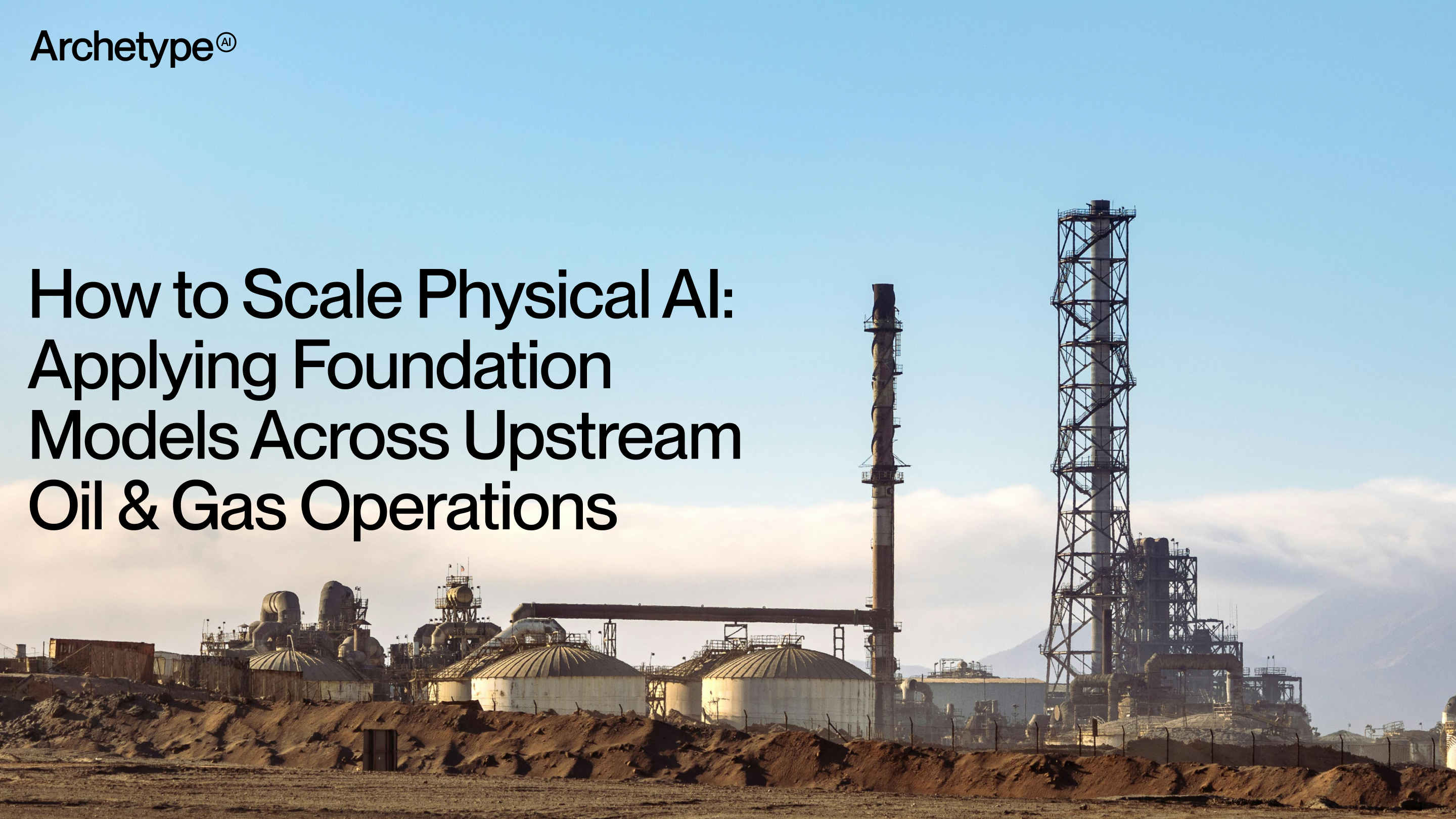
In our recent webinar, "How to Scale Physical AI: Applying Foundation Models Across Upstream Oil & Gas Operations," Sisinio Baldis, Head of Solutions Engineering at Archetype AI, and Lucas Gianini, AI Solutions Specialist, walked through what changes when a single foundation model adapts to each well instead of a new model being built for every one. The session closed with a live demo: building a rig-state identification agent on drilling data, start to finish, with no model training. This post recaps the core ideas. The full recording is linked at the end.
Why oil and gas breaks traditional industrial AI
Large language models compressed digital knowledge work from days into hours, and they did it because a foundation model trained on enough text starts to generalize across tasks it was never explicitly built for. The physical world never got that moment. LLMs were built for text and code. They were never designed for torque, pressure, voltage, and vibration, and the physical world speaks only in those terms.
Upstream operations make the mismatch sharp. A well sits on a geologic formation with its own porosity, permeability, and fluid mix. On top sits the rig, with its own pumps, compressors, configurations, and sensor packages, and the drill string changes as it goes down. Then the conditions themselves move: pressures and fluid composition shift as the well produces and depletes. The signal is local, and it is always drifting.
Traditional industrial AI answers that variability the only way it can: one bespoke model per sensor package, per use case, per narrow operating range. You collect data, label it, engineer features, train, evaluate, deploy, and then retrain every few months as conditions drift out from under the model. It is expensive to stand up and expensive to keep alive, and it does not scale from one well to a field.
There is an operational catch on top of the modeling one. Text tools assume a steady cloud connection and move a few sentences at a time. In the field you may not have reliable connectivity, and physical signals carry enormous volume. Data gravity means moving that data is slow and costly, so where you run inference matters. Often it has to run on the edge, on a small box next to the asset.
What a foundation model does differently
Newton is Archetype's foundation model, pre-trained on billions of physical measurements across many domains and modalities. Because it learns the structure of physical signals rather than one machine's labeled history, it treats the physical world as what it is statistically: a superposition of sine waves. That is why the common question, "does it work with my brand of sensor," usually has a simple answer. If the sensor measures a real physical phenomenon, Newton already speaks that language.
Around the model sits the Archetype platform, which manages the AI lifecycle: running inference, fine-tuning where a domain needs it, and distilling the model down to run on cloud, on a rack in the field, or directly on the asset. Two points mattered most to the operators in the room. First, the platform runs entirely inside your own security perimeter. Your data never comes to Archetype, and any model you fine-tune or distill stays in your own library, never folded back into the foundation model your competitors use. Second, it deploys from cloud to edge, so inference can live right next to the data instead of fighting data gravity to reach a distant cloud.
The result is a universal model with the ability to adapt locally: deploy faster, then keep pace with drift as the formation, the equipment age, the sensor fleet, and the production stage all change underneath you. The unlock is not a better version of the old bespoke model. It is a different capability.
Inside the demo: building a rig-state agent with no training
Lucas built an agent live and called it Rig State Identification. The workflow had none of the classical pipeline in it.
He pointed the agent at an operation file, ordinary time-series data from an oil rig, and hit Adapt. Newton mapped windows of that raw signal into its embedding space, the high-dimensional representation where physically similar behavior lands in the same region. Reduced to two dimensions on screen, the data fell into three clean clusters on its own. Newton had separated the operating states with no labels at all. It knew the windows behaved differently from one another. It did not yet know what any of them meant, so it called them State A, B, and C.
Then came the labels. From historical data, Lucas fed in a short set of examples of a known drilling state and hit Adapt again. The drilling examples landed squarely on State C, confirming what that cluster was. He repeated it for trip/slips, which matched State A, and for off-bottom, which matched its own cluster. Roughly ten labeled examples per state is the rule of thumb, and there was no feature engineering, no training run, and no retraining schedule. The "pipeline" was a few parameters: window size, step size, some smoothing.
That is the sequence worth carrying out of the demo. Newton finds the states first, unsupervised. Your domain knowledge then attaches the human meaning to physical clusters that already exist, turning them into something an operator or another machine can act on.
Why this scales: N-shot examples across wells
The labels are the expensive part, and they are also the part that travels. Because every asset runs the same underlying foundation model, the labeled examples pulled from one well work on wells you have no data for. Extract N-shot examples from Well 1, 2, and 3, and you can run inference on Well 4 and Well 5 without touching them. That is what lets a single agent cover a field instead of a single rig.
It is worth being precise about the three ways to teach Newton, because they trade off differently:
- Zero-shot. No labeled data. Newton clusters operating states and flags anomalies straight out of the box. You get structure without knowing yet what each state means.
- Few-shot (N-shot). A handful of labeled examples, around ten per state, map the discovered clusters to states you care about. This is the workhorse, and it is what scales across assets.
- Fine-tuning. Only when you need Newton to learn a genuinely new and complex behavior. It changes the model's weights, needs a large labeled dataset, and carries real cost. Reach for it deliberately, not by default.
What to know before you start
On generalized versus specialized models, the sequence is the message: start with the generalized model, benchmark what it gives you out of the box, and layer in fine-tuning only where a specific domain demands accuracy the general model does not yet reach. A generalized model that covers more assets with far less upkeep usually buys more than a specialized model that needs constant care and feeding, and every specialization you add is ongoing maintenance you own.
On getting started, the pipeline is no longer a months-long build. You point the platform, inside your own infrastructure, at raw signal data for a chosen use case, tune a few parameters, provide a small set of N-shot examples, and evaluate against your own datasets. A use case that once meant collecting, labeling, and training from scratch can be stood up in a working session.
About this webinar
This post is based on "How to Scale Physical AI: Applying Foundation Models Across Upstream Oil & Gas Operations," featuring Sisinio Baldis and Lucas Gianini of Archetype AI. Watch the full recording here.
To explore the Archetype platform and Physical AI Agents, visit Archetype AI or connect on LinkedIn and X (@PhysicalAI).
Frequently asked questions
What was Newton trained on?
Newton is a foundation model pre-trained on billions of physical measurements spanning many domains and modalities. Because it learns the underlying structure of physical signals rather than one machine's labeled history, it can read sensor streams it has never encountered before.
Does Newton work with my specific sensors?
Generally yes. Newton treats physical data statistically, as a superposition of sine waves, rather than keying off a particular vendor's format. If a sensor measures a real physical phenomenon, it produces the kind of signal Newton already understands, regardless of brand or exact operating range.
How much labeled data do I need?
Often very little. In zero-shot mode Newton clusters operating states with no labels at all. To attach meaning to those clusters, few-shot learning needs only a small set of examples, with roughly ten per state as a working rule of thumb. Full fine-tuning, which requires a large labeled dataset, is reserved for teaching genuinely new and complex behavior.
How does this scale across a field of wells?
The foundation model is shared across every asset, so the N-shot examples you extract from wells you have data on can be applied to wells you do not. Label a few wells, and you can run inference on the rest without collecting or labeling data for each one.
Do I have to send my data to the cloud, or to Archetype?
No. The platform deploys inside your own security perimeter, and your data never leaves it. Models you fine-tune or distill stay in your library and are never merged back into the shared foundation model. Inference can run in the cloud, on a rack in the field, or directly on the asset, which matters when connectivity is unreliable and data volumes are high.
Should we use a generalized model or a specialized one?
Start generalized. Benchmark what Newton delivers out of the box, then introduce fine-tuning only where a specific domain requires accuracy the general model does not yet reach. A single model across many assets scales with far less maintenance, and each specialization you add is ongoing upkeep you take on deliberately.