
Archetype AI Team
When we polled attendees on how long it takes to get a working predictive maintenance model for a new asset type, most answers landed between three and twelve months. Around 30% said they had no experience building or deploying these models at all.
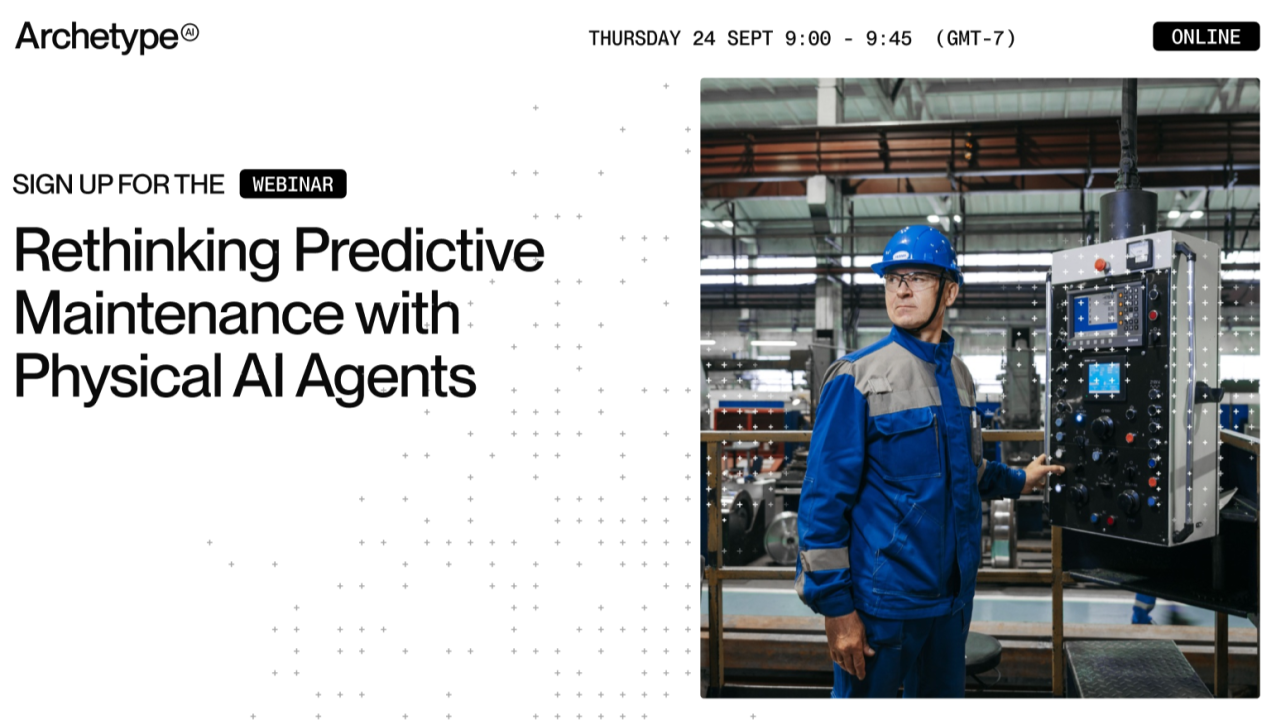
That timeline is the problem this webinar was built around. In our recent predictive maintenance webinar, "Rethinking Predictive Maintenance with Physical AI Agents," Sisinio Baldis, Head of Solutions Engineering at Archetype AI, and Lucas Gianini, AI Solutions Specialist at Archetype AI, walked through how a pretrained physical world model changes what it takes to scale predictive maintenance. Aristo Chang from Archetype's product marketing team moderated. The session covered the scaling problem, how Newton and Newton Agents work, real deployments, a live HVAC demo, and audience Q&A. This post recaps the core ideas. The full recording is available below.
Why does predictive maintenance break down at scale?
Sisinio framed predictive maintenance as predicting when maintenance is needed, with the goal of reducing unplanned failures, downtime, operational losses, and safety risks, while extending asset life and avoiding unnecessary work. The goal is simple. Scale is where it gets hard.
Plants have more machines, more variations of each machine, and more sensor types than ever, and collecting the data is no longer the bottleneck. Modeling it is. Traditional techniques need large amounts of labeled data and generalize poorly, even between similar machines, and not at all between different asset types. The signal that matters is also rare: a small event inside otherwise normal operation. Adding more sensors does not make that needle easier to find.
The build cycle compounds the problem. You collect data, engineer features, train, evaluate, and deploy, and by the time the model reaches the field, the data it learned from no longer matches what the machine produces. Sisinio compared it to a car that feels different ten years after you buy it. That gradual deviation is drift, and it varies machine by machine. The same HVAC system behaves differently on a desert rooftop than in a climate with snow and heavy rain. In oil and gas, the geology, pressures, and fluids change underground. Failures are sparse, technicians are limited, and false positives consume capacity those teams do not have.
The result is months or years of model development, followed by constant retraining, with coverage growing only as fast as a team can build and maintain each model.
How does a physical AI foundation model change predictive maintenance?
Sisinio drew a parallel to large language models. Nobody taught them grammar. Trained on enough text with the right architecture, they developed general capabilities. Archetype applies the same approach to the physical world, training a large model on sensor data such as vibration, temperature, and pressure. Without being taught Newtonian physics, the model develops a statistical understanding of how physical systems behave, so vibration becomes something it reads natively.
The practical consequence is one model instead of one model per machine. A train, an HVAC system, a drill, and a power grid all speak the language of physics, so a single model can read all of them. Newton takes in vibration, current, and temperature, along with video, text, and other context. It fuses a physical understanding of the signal with a semantic understanding that matches how a human expert would describe what is happening, then decodes that into classification, prediction, alerts, root cause explanations, triggered actions, or control loops. Sisinio said Archetype's solutions team regularly benchmarks a customer's existing approach against Newton within hours, a process that traditionally takes months or years.
Those capabilities are packaged as Newton Agents that follow the predictive maintenance lifecycle: detect, understand, predict, act.
- Detect: operational state monitoring shows what state an asset is in right now, and anomaly discovery surfaces events that matter.
- Understand: interpretation and root cause analysis put those events in context.
- Predict: failure prediction and remaining useful life estimate when maintenance is actually needed, instead of relying on a fixed calendar.
- Act: the output can dispatch a technician or trigger an automated response. Whether to close the loop autonomously or send recommendations to an expert is a business decision that depends on the use case.
On deployment, Sisinio stressed that most customers want to run this inside their own infrastructure. The Archetype platform deploys in your cloud, your data center, or at the edge, including fully air-gapped, and customer data does not flow back into Newton. Fine-tuning is available but usually not needed. When it is used, it produces a forked version of the model that lives in the customer's environment, and Archetype never sees it.
What does Newton's latent space show?
Lucas pointed out that the 2D plots shown during the session are heavily simplified. Newton works in a latent space of close to 800 dimensions, and the plots apply dimensionality reduction so people can interpret the clusters. The value is that every point maps back to the raw sensor stream that produced it.
In a wind turbine example, the latent space separated into two clusters, one normal and one anomalous. Lucas traced an anomalous point back to its source signal. Wind speed climbed, power output rose with it, and then output dropped sharply, which is why that window landed in the anomalous cluster. Moving back and forth between the latent space and the raw signal is how you see how Newton arrived at an insight, instead of treating it as a black box.
How do zero-shot, few-shot, and fine-tuning work in practice?
Newton can be adapted to a use case at three levels of context.
- Zero-shot: no labels and no context. The model is used out of the box to find anomalies or unknown states in the data.
- Few-shot: a handful of labeled examples of the events you care about are provided as context, and Newton becomes much better at detecting those specific states.
- Fine-tuning: some model weights are changed to create a new version of the model. This helps with very specific or complex behavior, but it needs a lot of data.
Lucas said roughly 90 to 95% of the use cases Archetype works on perform well enough with zero-shot or few-shot, which is what makes scaling practical. His rule of thumb for few-shot is three to five examples per event. If you want to detect three or four events, that means something like 10 to 15 samples, far fewer than retraining a model from scratch would require.
The rollout follows five steps:
- Define the target asset.
- Run zero-shot discovery on raw sensor streams with no labels.
- Validate what Newton found with domain experts.
- Add known events and historical data as context.
- Extend the same agent across many assets.
Compare that with the traditional path, where every asset repeats the full cycle of data gathering, feature engineering, training, and validation. With one foundation model, the per-asset work shrinks to supplying a little context.
What did the live HVAC demo show?
Lucas ran the workflow end to end on a public HVAC dataset, with no fine-tuning. The raw inputs were standard HVAC sensors, including room temperature, discharge air temperature, fan speed, and outside temperature.
First, he loaded one week of unlabeled operations data and ran discovery. Newton processed 72 windows of the stream and identified four distinct states. At that point nobody knew what the states meant. Newton was only reporting that there were four distinct behaviors.
Next, he added a sample file of known normal operation. Every point landed in one of the discovered clusters, which identified it as the normal state. Then he added samples of known HVAC faults, including a stuck damper, an overheated water side, and a stuck cooling valve. Newton mapped each fault to its own region of the latent space. Anything that sits far from the normal cluster is a likely anomaly.
Sisinio asked how long this would take with traditional methods. Lucas estimated the discovery step alone takes one to three weeks of plotting and calculating statistics on the time series, and classifying the states afterward means training a new model, which he put at one to two months at least. The demo took about five minutes.
Which real-world use cases did the webinar cover?
Lucas shared three live deployments, each tied to one of the Newton Agents:
- Industrial pumps (machine state detection): live data streams from the pumps, and with context built from historical data, Newton reports which known state each asset is in every 30 seconds. Certain states trigger an alert or a maintenance action, which helps extend pump life and run operations more efficiently.
- Roll-to-roll manufacturing (failure prediction): instead of a yes or no answer on whether something will break, Newton outputs a score every minute or two that reflects the probability the process leads to a catastrophic failure. Operators define actions based on those scores.
- Sorting machinery (failure prediction): Newton scores the likelihood of failure using sensor data, machine performance data such as throughput, planned operating time, and past downtime, plus text from the machine's manual as additional context.
Sisinio also described work with a wind turbine operator. Across a year of data from 60 turbines with more than 40 sensors each, the out-of-the-box foundation model found 11 failure types, nine of which the operator's existing monitoring had not identified. The estimated annual downtime savings were around $50 million. The model was not trained on the customer's turbines.
About this webinar
This post is based on "Rethinking Predictive Maintenance with Physical AI Agents," featuring Sisinio Baldis and Lucas Gianini of Archetype AI, moderated by Aristo Chang.
Archetype now runs monthly Newton meetups, where you can work hands-on with Archetype experts to build solutions using your own data or open-source data. Sign up for a Newton meetup.
To explore the Archetype platform and Physical AI Agents, visit Archetype AI or connect on LinkedIn and X (@PhysicalAI).
Frequently asked questions
How can you trust an AI agent's predictions?
Archetype validates in two ways. The first is historical validation: where a customer has labeled historical data, the agent is scored against it using standard metrics such as accuracy and ROC curves. The second is expert review. Domain experts evaluate the agent's outputs, because they often know things that neither the data nor Newton can surface on its own. Combining numerical validation with expert judgment is how teams build confidence before deploying.
How does Newton fit with the systems companies already use for predictive maintenance?
Newton is a physical intelligence layer that adds to existing systems rather than replacing them. Historians and condition monitoring systems can feed data into Newton, and results can be written back to them. It can also integrate with SCADA systems and drive dashboards and alerting. Whether the architecture is end-of-day batch or real time depends on how critical it is to catch failures as they happen.
How much data do you need to get started?
For zero-shot tasks such as anomaly detection and unknown-state discovery, no labeled data is needed. For few-shot classification, the amount depends on the use case and sampling rate, but a good rule of thumb is three to five examples per event. That is far less than the data needed to train a new model from scratch.
Can Newton work if you only have data from normal operation?
Yes. If you have a stream of data from a period when the machine ran well, Newton can still identify different states within it and flag moments when the sensors or machine began behaving differently. Whether a given state is a true anomaly is a separate question, and how critical it is can be assessed afterward.
Where can Newton run?
Model sizes range depending on the task. Archetype has tested Newton internally on devices from a Raspberry Pi 4 and Intel Atom hardware up to NVIDIA Jetson Thor, RTX Pro 6000, and H100 systems. What is practical depends on data volume, modality, and latency requirements. Sometimes the right setup is a larger gateway device next to the asset or a GPU stack on the factory floor. In each case, Newton can run fully air-gapped, and a closed-loop system can run on the device without calling back to the cloud.