
Archetype AI Team
Manufacturing is full of signals. Machines vibrate, motors heat up, conveyors hum, cameras capture thousands of images every minute, and sensors track pressure, torque, humidity, and electrical current across factory floors.
For years, most of that data went unused. Factories collected it, stored it, and reviewed it after something went wrong, but few systems could interpret those signals in real time.
AI agents change that. Instead of dashboards that wait for human input, they monitor factory environments continuously, analyzing machine behavior, detecting anomalies, predicting failures, and triggering actions before problems escalate. The shift is being driven by AI models that can understand complex data streams, including systems built specifically to interpret physical signals from sensors rather than just digital information.
Archetype AI built Newton, a Physical AI foundation model trained on real-world sensor data, and Physical Agents — deployable systems powered by Newton that interpret how machines, processes, and environments actually behave. Factories are packed with machines generating constant streams of physical data, and interpreting those signals in real time unlocks a new layer of intelligence across the production floor.
What Are AI Agents?
An AI agent is a system that observes its environment, makes decisions, and takes actions to achieve specific goals — less like a tool and more like a digital operator. Where traditional software waits for instructions, AI agents operate continuously, analyzing incoming data, recognizing patterns, and responding automatically.
In manufacturing environments, these agents can monitor data from sources like:
- Industrial sensors
- Machine telemetry
- Cameras
- Production management systems
- Environmental monitoring devices
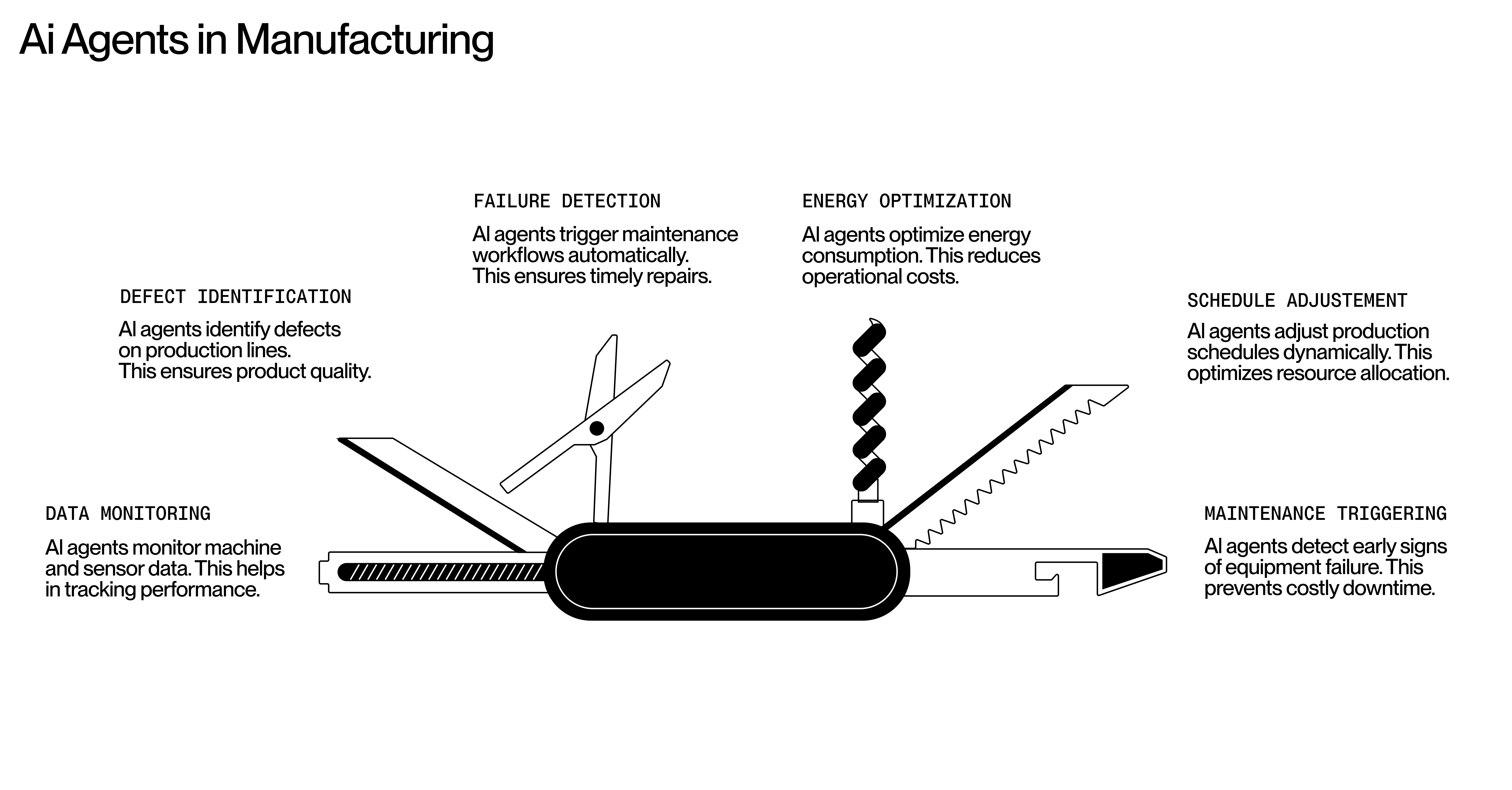
Based on that data, AI agents can perform tasks such as:
- Detecting early signs of machine failure
- Identifying defects on production lines
- Adjusting production schedules
- Optimizing energy consumption
- Triggering maintenance workflows
The key difference is autonomy: AI agents don’t just present information, they act on it. Instead of waiting for engineers to interpret dashboards, agents continuously analyze operational data and surface decisions in real time.
Why Manufacturing Needs Autonomous AI Systems
Manufacturing environments are becoming more complex every year. A single factory can run hundreds of machines across multiple production lines, each producing its own stream of operational data. Add robotics, vision systems, industrial IoT devices, and enterprise software into the mix, and the volume of information quickly outpaces what humans can monitor effectively.
That’s why many factories still operate reactively — a machine fails, production stops, engineers investigate, and maintenance teams step in. AI agents change that model. Instead of responding after a breakdown, they analyze machine behavior continuously, identifying subtle patterns that signal early problems like abnormal vibration, temperature fluctuations, or power irregularities. When the system detects a potential issue, it can alert teams before the failure happens — leading to fewer unexpected shutdowns, faster responses, and smoother production cycles.
From Traditional Automation to Agentic AI
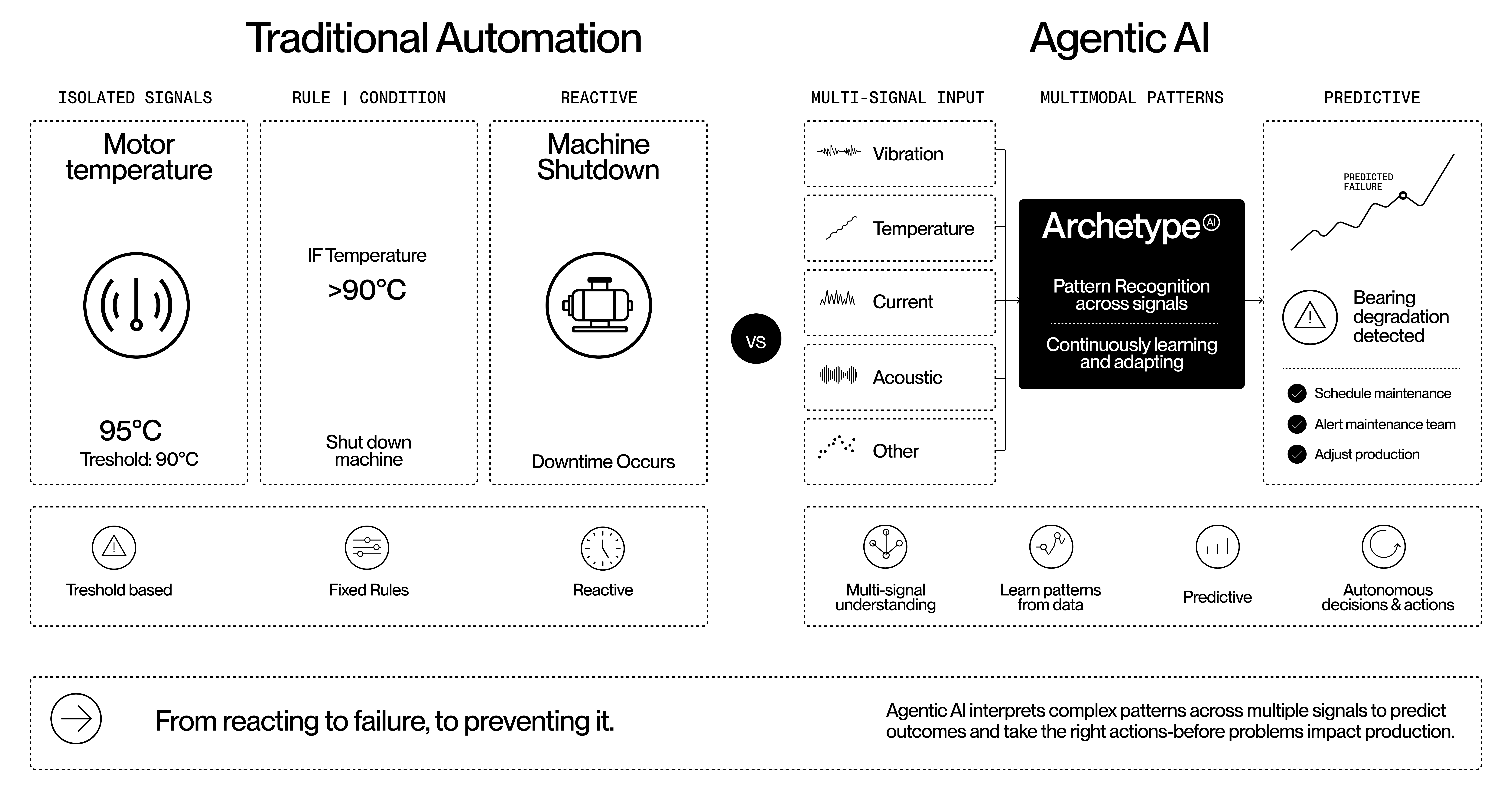
Factories have relied on automation for decades. Robotic arms assemble components, programmable logic controllers manage machine operations, and sensors trigger alarms when thresholds are crossed. But traditional automation follows fixed rules: if a temperature exceeds a limit, the system shuts down; if a sensor detects an obstruction, the conveyor stops. These rule-based systems work well for predictable processes but struggle in dynamic environments.
Agentic AI works differently. Instead of relying on rigid instructions, AI agents learn patterns from data, understanding how machines typically behave and recognizing when something looks unusual. A rule-based system might shut down a machine when a motor crosses a critical temperature. An AI agent might detect subtle temperature changes combined with vibration anomalies and predict that the motor will fail within the next few days. That shift turns reactive operations into predictive ones, and AI agents improve as they learn from new data over time.
How AI Agents Fit into Industry 4.0 and Smart Factories
Industry 4.0 refers to the transformation of manufacturing through connected systems and real-time data. Smart factories rely on technologies such as:
- Industrial IoT sensors
- Connected machinery
- Robotics and automation
- Real time data analytics
- Cloud and edge computing
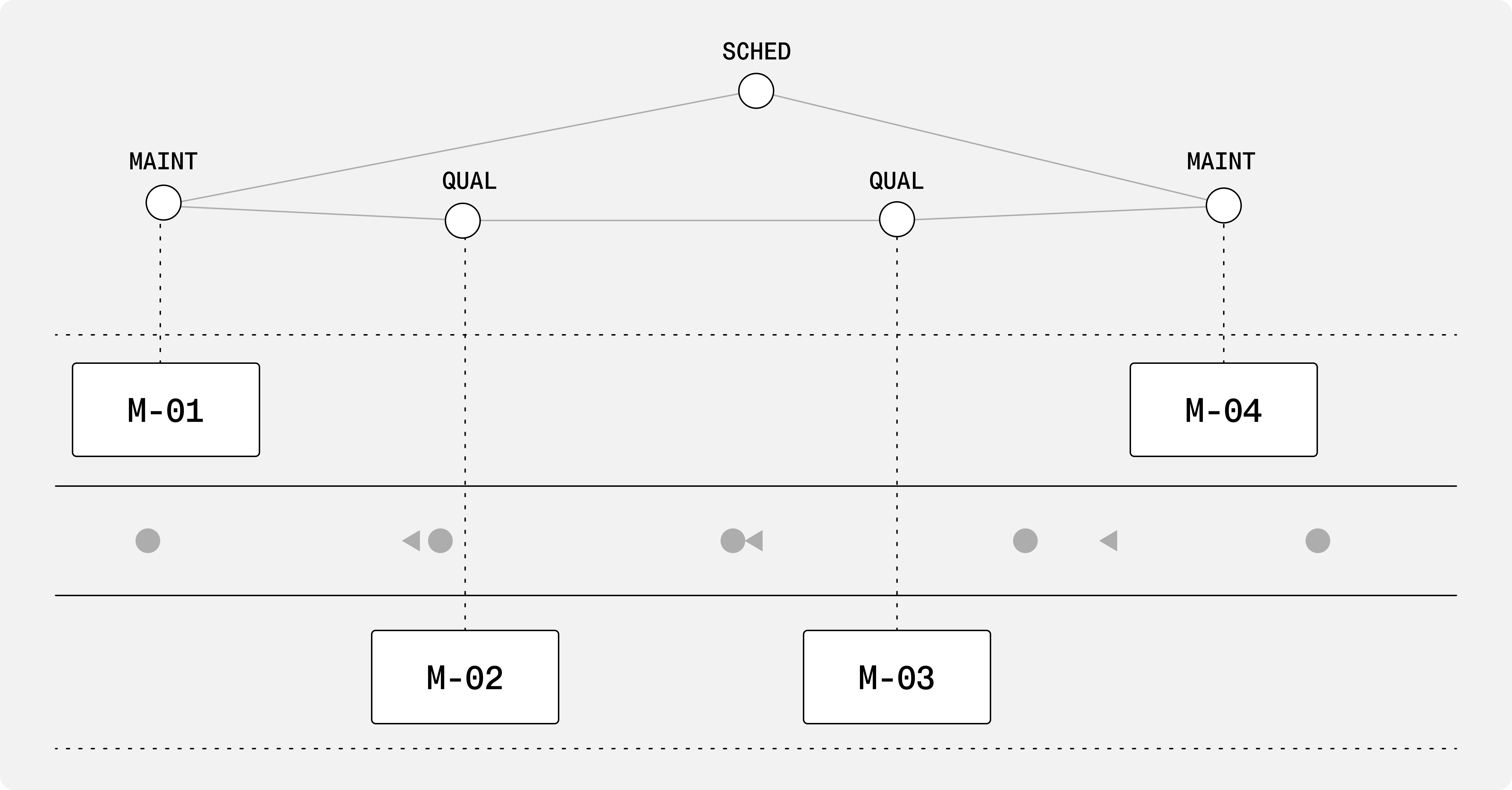
AI agents act as the intelligence layer across this ecosystem, sitting on top of machine data streams and operational systems to continuously interpret signals and coordinate decisions across the factory floor. In practice, one agent might monitor equipment health while another manages production scheduling and a third tracks inventory flow — together forming a network of intelligent systems that helps factories operate more efficiently.
As sensor networks expand and machine data becomes richer, these agents will play a bigger role in managing complex industrial environments, which is why manufacturers are starting to deploy them across their operations.
The Manufacturing Challenges AI Agents Solve
Manufacturing looks smooth from the outside. Products move down assembly lines, machines operate with precision, output numbers hit dashboards in real time. But behind the scenes, factory operations are full of friction: equipment fails unexpectedly, quality issues appear halfway through production, and small inefficiencies pile up until they slow entire lines.
Factories generate massive amounts of operational data, but very little of it gets interpreted fast enough to influence decisions. AI agents change that by continuously analyzing machine signals, production data, and operational patterns, they help manufacturers address some of the most persistent problems on the factory floor.
Unplanned Downtime and Equipment Failures
Unexpected machine failures are one of the most expensive problems in manufacturing. A single breakdown can stop an entire production line, costing lost output, missed delivery deadlines, and rushed maintenance work that often runs more expensive than scheduled repairs.
Most failures don’t come out of nowhere. Machines usually give subtle warnings first — bearings begin vibrating differently, motors start drawing more current, components heat up just a bit faster than normal. These early signals are buried in streams of sensor data that change every second, and humans rarely catch them.
AI agents monitor these signals continuously, learning what normal machine behavior looks like and flagging unusual patterns long before a breakdown occurs, letting maintenance teams intervene early and keep production running.
Quality Variability and Product Defects
Even highly automated factories struggle with quality consistency. Small variations in temperature, material properties, machine calibration, or operator adjustments can lead to defects — and sometimes the issue isn’t detected until thousands of units have been produced, creating waste, rework, and costly recalls.
AI agents help catch these problems much earlier. By analyzing production data and inspection results in real time, they can detect subtle shifts in manufacturing processes that correlate with defects. If something begins drifting outside optimal conditions, the system alerts operators — leading to more consistent product quality and far less scrap.
Production Bottlenecks and Inefficient Workflows
Manufacturing lines depend on balance. If one station slows down, processes behind it stack up; if another runs too quickly, downstream systems can’t keep up. These bottlenecks often hide inside complex production environments where dozens of machines operate simultaneously.
Traditional analytics tools identify inefficiencies after the fact. AI agents observe production flow in real time, track machine utilization, and detect patterns that indicate bottlenecks forming. When delays appear, they can recommend reallocating tasks, modifying schedules, or redistributing workloads across lines, helping factories run closer to optimal capacity over time.
Fragmented Data Across Machines and Systems
Most factories run on a patchwork of systems. Machine data lives in PLCs, production data in manufacturing execution systems, maintenance records in asset management platforms, supply chain data in ERP software. Each system holds useful information, but the data rarely connects in a meaningful way, making it difficult for teams to see the full picture of operations.
AI agents bridge these gaps by ingesting data from multiple sources and analyzing it together. Instead of isolated metrics, they evaluate how machine health, production performance, and operational decisions interact — broader context that leads to better insights and faster decisions.
Reactive Maintenance and Manual Decision Making
In many factories, maintenance still operates on fixed schedules or emergency repairs — equipment serviced after a failure occurs or according to a calendar. Both leave room for inefficiency: some components get replaced too early, others fail before the next maintenance window arrives.
AI agents shift maintenance from reactive to predictive. By analyzing sensor signals and historical performance patterns, they estimate how long components will continue functioning reliably so maintenance can be scheduled based on actual equipment conditions rather than rough timelines. The same principle applies to operational decisions: instead of waiting for engineers to investigate manually, AI agents surface insights automatically and recommend actions in real time, reducing delays and preventing small issues from escalating.
How AI Agents Improve Factory Uptime
Factory uptime is everything. When machines run consistently, production flows smoothly, deadlines are met, and costs stay predictable. When equipment stops unexpectedly, production stalls, teams scramble for fixes, and delivery timelines slip — a problem most factories deal with daily.
AI agents are getting good at preventing these interruptions before they happen. By analyzing sensor signals, machine behavior, and historical data, they help maintenance teams spot problems earlier and respond faster, turning unexpected downtime into the exception rather than the norm.
Predictive Maintenance and Failure Prevention
Traditional maintenance follows two models. The first is reactive: something breaks, then teams fix it. The second is scheduled: machines get serviced after a certain number of hours or production cycles. Reactive maintenance leads to costly downtime; scheduled maintenance often replaces parts that still have plenty of life left.
AI agents enable a third option — predictive maintenance. Instead of relying on rigid schedules, AI systems analyze how equipment behaves over time, tracking patterns in vibration, temperature, energy usage, and acoustic signals to detect early warning signs of wear. When the system recognizes a risk pattern, it alerts maintenance teams before the issue escalates.
Some emerging Physical AI systems are designed specifically to interpret these kinds of signals. For example, Archetype AI's Newton foundation model fuses any type of sensor, including vibration, temperature, current, and acoustic signals, into a unified understanding of equipment health, surfacing early-stage anomalies that existing tools miss. Because Newton already understands physical systems at scale, it can be fine-tuned to a specific facility's machines and conditions without years of labeled data.
Predictive maintenance turns unexpected shutdowns into planned service events. And that shift can save manufacturers millions in lost production.
Sensor Data Analysis (Vibration, Temperature, Current)
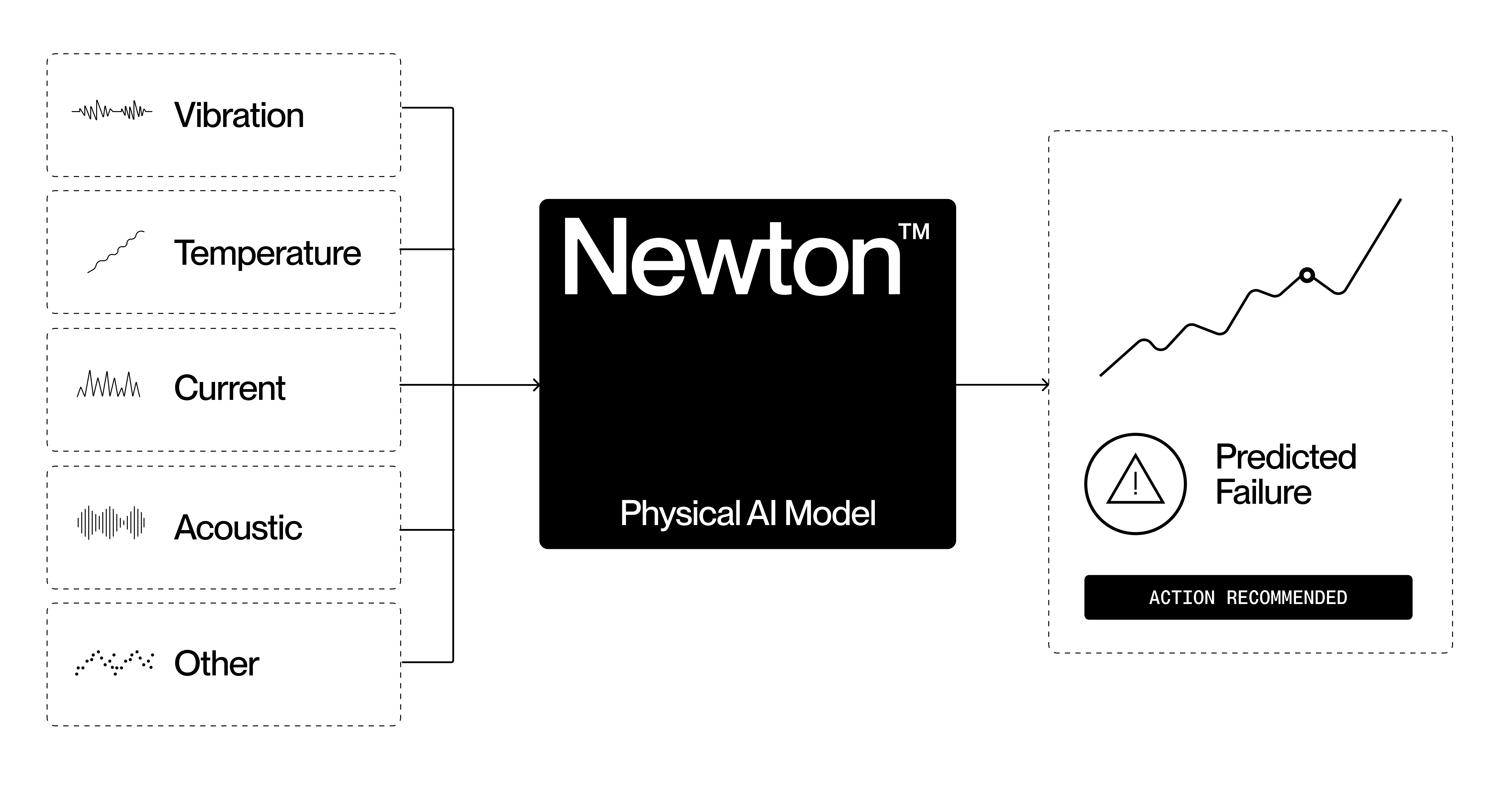
Modern machines are full of sensors. Motors track temperature, bearings generate vibration signals, electrical systems report current and voltage patterns, and pumps and compressors produce acoustic signatures that reveal how smoothly they’re operating. Each signal tells part of the story, and on their own, these streams can be difficult to interpret. But when AI agents analyze them together, patterns emerge.
For example:
- Increasing vibration may signal bearing wear
- Rising motor current could indicate mechanical resistance
- Temperature fluctuations might reveal lubrication problems
- Acoustic changes can expose airflow or pump issues
AI models trained on physical sensor signals recognize these patterns earlier than human operators. They don’t just monitor thresholds — they understand how signals evolve over time, identifying problems before they become visible through conventional alarms.
Remaining Useful Life (RUL) Prediction
One of the most valuable capabilities of predictive maintenance is estimating how long a component will continue functioning — Remaining Useful Life, or RUL. Instead of asking whether a machine is currently healthy, AI agents ask the more useful question: how long will it stay that way?
By analyzing historical failure data alongside real-time sensor readings, the system estimates how quickly a component is degrading. Bearings, pumps, motors, and other parts each show distinctive degradation patterns; once the system identifies them, it can estimate when failure is likely to occur — letting maintenance teams plan repairs during scheduled downtime rather than emergency shutdowns.
Maintenance Scheduling Automation
Predicting a failure is helpful; coordinating maintenance around it is where the real operational benefit appears. AI agents can automatically schedule maintenance once a risk threshold is detected. Instead of engineers manually reviewing reports and deciding when to intervene, the system can:
- Create maintenance recommendations
- Suggest optimal service windows
- Coordinate with production schedules
- Alert maintenance teams automatically
This ensures predicted issues are addressed quickly without disrupting production, and over time, factories develop a more proactive maintenance culture where teams spend less time responding to emergencies.
Real-Time Equipment Monitoring
Continuous monitoring is the foundation of AI-driven uptime improvement. AI agents analyze data streams from machines around the clock, comparing real-time behavior against historical baselines to detect unusual patterns. Unlike human operators who review dashboards periodically, AI systems never stop watching, catching anomalies that might otherwise slip through unnoticed. The moment something unusual appears, the system can trigger alerts or initiate diagnostics.
Industrial IoT and Machine Telemetry
The growth of Industrial IoT has made this level of monitoring possible. Factories now deploy thousands of sensors across production lines, capturing detailed telemetry from machines and environmental systems.
Data sources often include:
- Vibration sensors
- Thermal sensors
- Acoustic monitors
- Electrical current sensors
- Pressure and flow sensors
- Machine controller data
AI agents ingest these signals and analyze them together — seeing how multiple signals interact rather than isolated measurements, which provides a more accurate picture of equipment health.
Early Anomaly Detection
Many equipment failures follow a predictable path: small anomalies appear in sensor data, performance gradually degrades, then the machine fails. AI agents focus on catching the earliest stage of that sequence. By learning normal behavior patterns for each machine, the system flags subtle deviations even when equipment still appears to be functioning normally, giving maintenance teams valuable time to intervene before damage spreads.
Automated Alerts and Diagnostics
When an anomaly appears, AI agents can do more than raise alarms — they can analyze the data to determine the likely cause. Instead of simply notifying operators that something is wrong, the system may provide context such as:
- The machine component most likely affected
- Sensor signals contributing to the anomaly
- Historical cases with similar patterns
- Suggested maintenance actions
This helps maintenance teams diagnose problems faster and reduce troubleshooting time.
Autonomous Maintenance Coordination
In more advanced setups, AI agents don’t just detect problems, they coordinate the response. Once an issue is identified, the system can communicate with other operational software to prepare for maintenance work, checking schedules, confirming technician availability, and ensuring required parts are stocked. The goal is to reduce friction between detection and resolution.
AI Generated Work Orders
Maintenance management systems often rely on manual ticket creation, but AI agents can automate that step. When a predicted failure reaches a certain confidence level, the system generates a work order automatically and sends it to the maintenance platform, including diagnostic data, recommended actions, and priority levels. This eliminates delays between detection and response.
Spare Parts Availability Checks
Maintenance planning becomes far more efficient when parts are ready before repairs begin. AI agents can integrate with inventory systems to confirm required components are available, and trigger procurement requests early enough to avoid delays — preventing many maintenance bottlenecks.
Maintenance Window Optimization
Factories have limited time for repairs. Production schedules are tight, and every minute of downtime matters. AI agents analyze production calendars alongside machine health data to recommend the best time for maintenance: fixing problems before they cause unplanned downtime while minimizing disruption to production output.
As AI systems become better at interpreting physical signals and machine behavior, uptime optimization will become even more precise. Physical AI models like Archetype AI's Newton are pushing predictive maintenance toward a deeper understanding of how machines actually behave.
Using AI Agents to Improve Product Quality
Quality issues rarely start big. They usually begin as tiny shifts in a production process — a temperature drifts slightly outside its optimal range, a tool begins wearing down, a material batch behaves a little differently than expected. Everything still looks normal at first, but as small variations compound, defects start appearing — sometimes only discovered after thousands of units have been produced.
AI agents catch these problems early by monitoring production conditions continuously. Instead of relying on periodic inspections or manual reviews, they analyze signals from machines, sensors, and inspection systems in real time, leading to faster defect detection, better process control, and more consistent product quality.
AI Powered Visual Inspection
Visual inspection has always been a key part of manufacturing quality control. Traditionally, human inspectors checked products for defects like scratches, cracks, alignment problems, or assembly errors — a process that works but is slow and inconsistent. Humans get tired, and subtle defects slip through.
AI agents equipped with computer vision change that. Cameras installed along production lines capture images of each product as it moves through manufacturing stages, and AI models analyze those images instantly, looking for deviations from the expected design. These systems can detect:
- Surface defects
- Incorrect assembly
- Missing components
- Dimensional inaccuracies
- Cosmetic flaws
And they do it at production speed because the system evaluates every item rather than random samples, defect detection becomes far more reliable.
Real-Time Process Monitoring
Visual inspection catches problems after a product has been manufactured; process monitoring tries to prevent them from happening in the first place. AI agents analyze data streams from machines and environmental sensors during production, tracking variables like temperature, pressure, vibration, speed, and material flow. If a process begins drifting outside its ideal range, the system detects the change immediately, allowing operators to correct the issue before defects appear, often with a specific recommendation for which parameter to adjust.
Defect Detection and Root Cause Analysis
Detecting defects is important; understanding why they occurred is even more valuable. AI agents connect inspection results with machine data to identify patterns behind recurring defects. For example, the system might discover that a particular defect appears when:
- A machine operates above a certain vibration level
- Temperature fluctuates during a specific production stage
- A component supplier changes material properties
- A tool reaches a certain wear threshold
By linking defects to underlying causes, manufacturers can fix the root problem rather than treating symptoms.
Some Physical AI research is pushing this capability further by interpreting physical signals from equipment in more detail. Archetype AI's Newton, for example, fuses vibration, acoustic, and temperature data alongside video and process signals to reveal the mechanical conditions that lead to defects, connecting quality outcomes back to the physical behavior that caused them.
As these models improve, they will help manufacturers understand the physical causes behind quality issues much earlier.
Predictive Quality Management
Traditional quality control focuses on identifying defective products; predictive quality management focuses on preventing them. AI agents analyze historical production data alongside real-time signals from machines and inspection systems, learning which conditions tend to produce defects. Once those relationships are identified, the system can predict when quality problems are likely to occur — for example, detecting that defect rates rise when specific environmental conditions combine with certain machine settings. When that pattern appears again, the system alerts operators before defects show up on the line, letting manufacturers prevent quality drift rather than react to it.
AI Enhanced Statistical Process Control (SPC)
Statistical Process Control has long been used to monitor manufacturing performance. SPC tools track process variables and signal when values move outside acceptable ranges, but they typically rely on simple thresholds or statistical limits and miss interactions between signals. A process might remain within normal limits for temperature and pressure individually, but when both variables change together in a certain pattern, product quality may decline.
AI-driven SPC analyzes complex relationships between multiple signals simultaneously. The system continuously analyzes data streams, identifies emerging patterns, and alerts operators when a combination of variables begins drifting toward conditions that historically produced defects, helping manufacturers maintain consistent quality across large-scale production.
Key Applications of AI Agents on the Factory Floor
Once AI agents are connected to factory data, their usefulness spreads quickly. Many manufacturers deploy them for a single purpose at first — predictive maintenance or defect detection — but as more machines, sensors, and software systems become connected, the same agents start influencing other areas of production. AI agents begin coordinating decisions across planning, operations, inventory, safety, and energy management, creating system-wide optimization rather than isolated improvements.
Production Line Optimization
Manufacturing lines depend on balance. Every station needs to operate at the right pace — if one stage slows down, everything behind it stacks up; if another runs too fast, downstream equipment may not be ready. AI agents monitor production lines to identify inefficiencies that disrupt this balance, analyzing machine performance, cycle times, and throughput patterns to understand where slowdowns occur. When the system detects a bottleneck forming, it can recommend modifying machine speeds, redistributing tasks, or altering process timing — helping factories run closer to peak efficiency over time.
Worker Safety Monitoring
Safety is one of the most important responsibilities on the factory floor. Manufacturing environments include heavy machinery, high temperatures, hazardous materials, and moving equipment — and monitoring these conditions manually is difficult, especially in large facilities. AI agents analyze sensor and video data to identify potentially dangerous situations, including:
- Detecting when workers enter restricted areas
- Monitoring unsafe proximity between people and machines
- Identifying missing protective equipment
- Tracking environmental hazards such as gas leaks or overheating equipment
When the system detects a risk, it can alert supervisors immediately so corrective action can be taken.
Energy Consumption Optimization
Factories consume enormous amounts of energy. Motors, compressors, heating systems, cooling equipment, and lighting all contribute to operational energy demand — and even small inefficiencies result in large costs over time. AI agents analyze consumption patterns across the facility to identify machines drawing more power than expected, detect inefficient operating schedules, and recommend adjustments that reduce waste. An agent might discover that certain machines remain powered during idle periods, or that energy-intensive processes run during peak electricity pricing hours — patterns manufacturers can adjust to significantly lower operational costs.
Some emerging AI systems go even further by analyzing physical signals from equipment to understand how energy usage relates to machine behavior. Archetype AI's Newton interprets multimodal sensor data, vibration, current, temperature, and more, which can connect energy consumption to the underlying mechanical behavior of equipment, helping factories operate more sustainably without sacrificing production performance.
Production Planning and Dynamic Scheduling
Production scheduling sounds simple until real-world conditions get involved. Machines go offline, materials arrive late, certain processes take longer than expected, and demand changes suddenly. Traditional scheduling systems struggle with these variables because schedules are created in advance and adjusted manually when problems appear.
AI agents monitor production progress in real time and continuously update schedules based on current conditions. If a machine slows down or becomes unavailable, the system can shift tasks to other lines or adjust production priorities, helping manufacturers avoid delays and keep production targets on track.
Inventory and Supply Chain Optimization
Inventory management can make or break manufacturing operations. Too little inventory risks production interruptions; too much ties up capital and warehouse space. AI agents help manufacturers maintain the right balance by analyzing production demand, supplier timelines, and material consumption patterns, forecasting when specific components will be needed and recommending inventory adjustments ahead of time. If supply chain disruptions occur, the agent can suggest alternative production plans that reduce the impact of missing materials, keeping production lines moving even when supply conditions change.
Multi Agent Systems in Smart Manufacturing
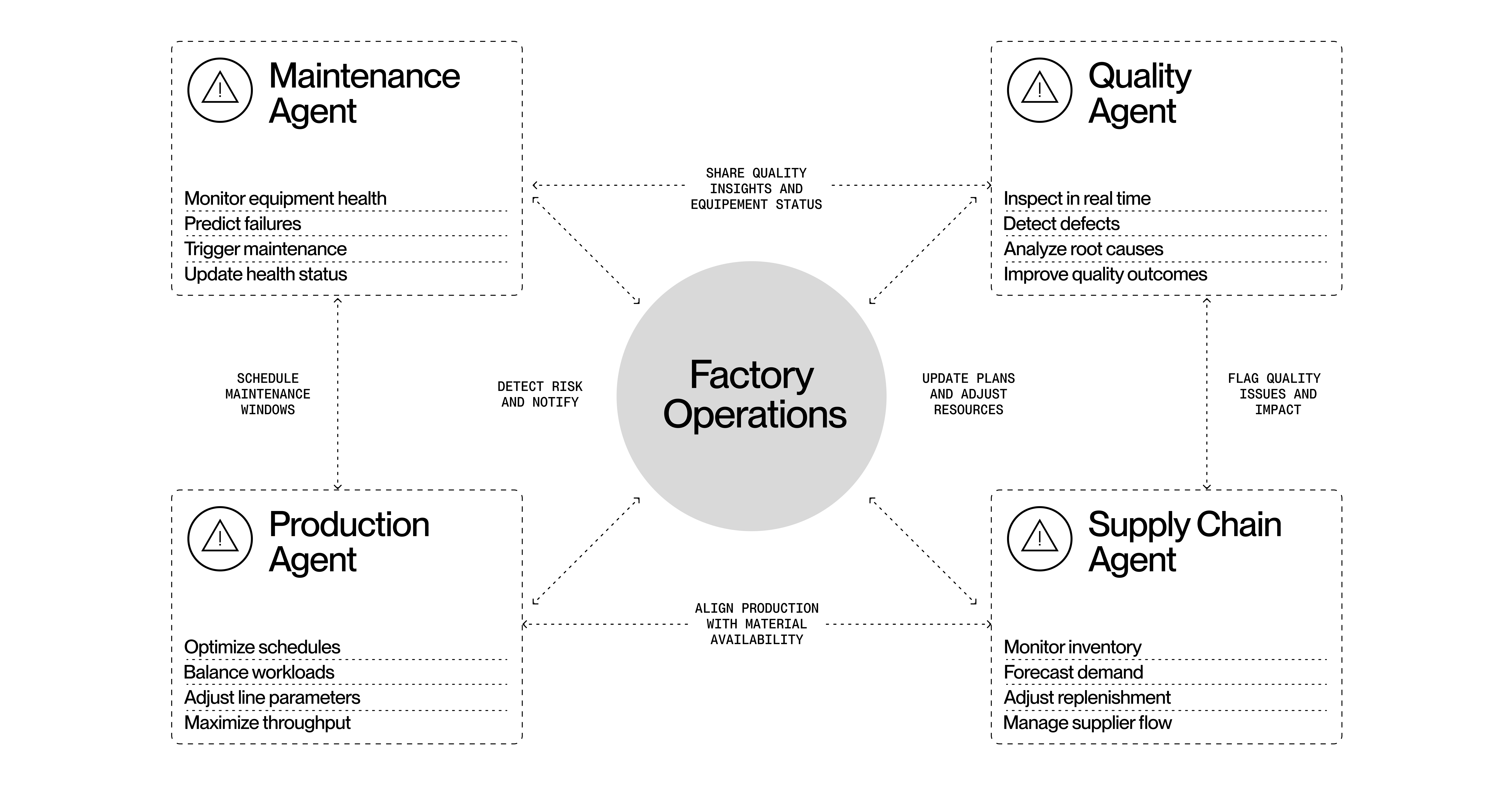
One AI agent can monitor a machine. But a modern factory has hundreds of machines, multiple production lines, logistics systems, maintenance workflows, and supply chain constraints all interacting at once. That’s where multi-agent systems come in.
Instead of relying on a single AI system to manage everything, manufacturers deploy specialized AI agents — each focused on a specific operational task — that share data and coordinate actions, creating a distributed intelligence layer across the factory. One agent watches equipment health, another focuses on product quality, another tracks inventory levels. Together they help the factory run more smoothly, and this collaborative approach is becoming a key building block of smart manufacturing environments.
Types of Manufacturing AI Agents
Factories can deploy several types of agents depending on operational priorities, including:
- Maintenance monitoring agents
- Quality control agents
- Production optimization agents
- Supply chain intelligence agents
- Safety monitoring agents
Each agent analyzes a different category of data, but the real value appears when they communicate with one another. A production agent might slow a line if the maintenance agent detects rising failure risk; a supply chain agent might adjust schedules if materials are delayed. This coordination allows factories to respond to operational changes quickly.
Predictive Maintenance Agents
Predictive maintenance agents focus entirely on equipment health, analyzing machine telemetry like vibration patterns, temperature signals, electrical current, and acoustic signatures. By learning normal operating behavior, the system detects early signs of wear or abnormal conditions and alerts maintenance teams when risk patterns appear.
Some newer systems are designed to interpret physical sensor signals more deeply. For example, Archetype AI's Newton is a Physical AI foundation model that generalizes across machines, sensor types, and environments, letting predictive maintenance agents work across an entire facility without building custom models for every piece of equipment.
Quality Control Agents
Quality agents focus on product inspection and process stability. They monitor camera feeds, measurement systems, and production data to detect defects or quality drift, alerting operators when defect rates rise or process variation looks unusual, and in some cases, recommending adjustments to machine settings to stabilize production. This helps manufacturers catch quality issues before large batches of defective products are produced.
Production Optimization Agents
Production agents analyze throughput, machine utilization, and workflow efficiency. Their goal is to keep production lines balanced and avoid bottlenecks. If a machine slows down or a queue builds, the agent can recommend schedule adjustments or task redistribution. Over time, this continuous monitoring helps factories increase throughput without adding new equipment.
Supply Chain Intelligence Agents
Supply chain agents track materials, inventory levels, and supplier timelines. They analyze demand forecasts alongside production plans to ensure the right materials are available at the right time, and suggest alternative schedules or sourcing strategies when disruptions occur, preventing production delays caused by missing components.
Agent Collaboration Across Factory Systems
The real power of multi-agent systems appears when these agents work together. A maintenance agent detecting machine risk notifies the production agent to shift workloads; the production agent communicates with the supply chain agent to adjust material deliveries. Instead of isolated decisions, the factory operates through coordinated intelligence.
Human AI Collaboration on the Shop Floor
AI agents aren’t meant to replace factory workers — they’re tools that help teams make better decisions faster. Operators still manage production processes, maintenance teams still repair equipment, and engineers still optimize systems; AI agents simply provide earlier insights and automate repetitive analysis. When humans and AI systems collaborate effectively, factories become safer, more efficient, and more resilient.
Benefits of AI Agents for Manufacturing Operations
AI agents aren’t just another layer of software. When implemented well, they change how factories operate day to day. Instead of reacting to problems, manufacturers gain systems that continuously monitor operations, detect risks early, and recommend actions in real time, creating a production environment that runs more predictably and efficiently.
Reduced Equipment Downtime
Unplanned downtime is one of the most expensive problems on the factory floor. AI agents help prevent it by analyzing machine signals and detecting abnormal patterns early, alerting maintenance teams before equipment fails so problems can be fixed during scheduled service windows rather than emergency shutdowns.
Improved Overall Equipment Effectiveness (OEE)
OEE measures how well manufacturing equipment performs across availability, performance, and quality. AI agents improve all three: keeping machines running longer, helping maintain stable production speeds, and reducing defect rates by catching process issues early, leading to higher productivity from the same equipment over time.
Higher Product Quality and Reduced Scrap
Quality issues often start with small changes in production conditions. AI agents monitor those conditions continuously and flag the issue immediately when something drifts outside optimal parameters, preventing large batches of defective products and reducing wasted materials.
Faster Decision Making and Operational Agility
Factory teams often spend hours analyzing reports and investigating operational problems. AI agents shorten that process dramatically. Instead of digging through data manually, engineers receive alerts, insights, and recommendations in real time, letting teams respond faster and keep production moving smoothly.
Lower Operational Costs and Waste
Better maintenance planning, fewer defects, and more efficient energy usage all reduce operating costs.
As AI systems become better at interpreting real world machine signals, these savings will likely grow. Archetype AI's Newton, for instance, turns existing sensor infrastructure into a deeper layer of operational intelligence, adding insight on top of the sensors a facility already has, with no new hardware required.
For manufacturers, that kind of intelligence can translate directly into more efficient operations.
Real World Examples of AI Agents in Manufacturing
AI agents are no longer experimental technology. Many manufacturers already use them to solve everyday operational problems. From equipment monitoring to production planning, these systems are quietly improving efficiency across factory environments. The most successful deployments usually start with a specific use case, then expand as teams see results.
Predictive Maintenance in Industrial Equipment
One of the most widespread applications of AI agents is equipment monitoring. Factories install sensors that track vibration, temperature, and electrical signals from machines, and AI agents analyze these signals continuously to detect early signs of wear, alerting maintenance teams when unusual patterns appear so they can fix the issue before the machine fails.
Some emerging approaches are also exploring deeper analysis of physical sensor signals. For instance, Archetype AI's Newton fuses signals from existing sensors into a unified understanding of how machines behave, and can be fine-tuned to a specific facility's operations — turning years of accumulated operational data into a model that reflects how the line actually runs.
This kind of capability can make predictive maintenance systems even more accurate.
Computer Vision for Defect Detection
Manufacturers increasingly rely on AI-powered cameras to inspect products as they move along production lines. AI agents analyze images in real time, checking for scratches, missing components, alignment issues, and other defects, reviewing every unit without slowing down production and alerting operators immediately when defects appear.
Autonomous Production Scheduling
Production schedules change constantly. Machines require maintenance, materials arrive late, demand forecasts shift. AI agents adjust schedules dynamically based on real-time conditions, reorganizing workloads across other lines or updating delivery timelines when equipment becomes unavailable. This flexibility helps manufacturers maintain output even when disruptions occur.
Smart Energy Optimization in Factories
Energy is one of the largest operating costs for many manufacturers. AI agents monitor how machines and facility systems consume energy throughout the day, identifying inefficient equipment usage or processes running during expensive peak energy periods. Factories can then adjust machine schedules or optimize facility systems to reduce waste — and even small efficiency improvements across large facilities produce significant cost savings.
Challenges and Considerations When Deploying AI Agents
AI agents offer huge potential for manufacturing, but deployment isn’t always simple. Factories operate with complex systems, legacy equipment, and strict operational requirements, and introducing AI into that environment requires careful planning. Most challenges aren’t technical limitations — they involve data readiness, integration complexity, and organizational change.
Data Quality and Integration Issues
AI systems rely heavily on data. If machine data is incomplete, inconsistent, or poorly structured, the system will struggle to generate reliable insights, and many factories still operate with fragmented data spread across platforms. Before deploying AI agents, manufacturers often need to connect data sources like sensors, production systems, and maintenance records so the agents can analyze operational data effectively.
Change Management and Workforce Adoption
Technology alone doesn’t transform operations — people do. Factory teams may initially be skeptical about AI systems making recommendations or influencing production decisions, and without proper training and communication, adoption can be slow. Successful deployments involve operators, engineers, and maintenance teams early in the process. When employees understand how AI agents support their work rather than replace it, adoption becomes much smoother.
Scalability and Infrastructure Requirements
Running AI agents across an entire factory requires reliable infrastructure. Large facilities generate huge amounts of sensor data, and systems must process it quickly while maintaining stable connections between machines, edge devices, and cloud platforms. Manufacturers often start with pilot projects on a small number of machines before scaling across multiple production lines or facilities.
Trust, Explainability, and Compliance
Manufacturing decisions often affect safety, product quality, and regulatory compliance, so teams need to trust the recommendations AI systems produce. Engineers must be able to understand why a system flagged a risk or suggested a change — and as AI models become more advanced, especially those designed to interpret physical signals from machines, explainability and trust become even more important.
Archetype takes a human-in-the-loop approach with its Physical Agents: findings surface to operators and engineers for review, so the people responsible for safety and quality remain the final decision-makers. The Archetype platform also deploys inside the customer's own infrastructure — on-premises, in a private cloud, or at the edge — keeping operational data within existing compliance and security boundaries.
When manufacturers address these challenges early, AI agents deploy more smoothly and deliver long-term operational benefits.
The Future of Agentic AI in Manufacturing
Manufacturing is moving toward a more autonomous future. Machines are becoming more connected, sensors are getting cheaper, and factories are generating more operational data than ever before. AI agents sit at the center of this shift, and as they become more capable, they’ll move beyond monitoring and recommendations to coordinate entire production environments and help factories adapt to changes automatically.
Self-Optimizing Factories
Today, most factories still rely on engineers and operators to adjust production processes. In the future, AI agents will handle many of those adjustments automatically. By continuously analyzing machine performance, production flow, and demand signals, AI systems will optimize operations in real time, adjusting production speeds, scheduling decisions, and maintenance planning dynamically. The factory essentially becomes a system that improves itself.
AI-Powered Digital Twins
Digital twins are virtual models of physical systems. In manufacturing, they represent machines, production lines, or facilities. AI agents can use these models to simulate scenarios before changes are made in the real world: testing how a scheduling adjustment would affect output, or how a machine failure could impact delivery timelines. Experimenting in a virtual environment first lets factories make better decisions with lower risk.
Autonomous Supply Chain Coordination
Supply chains are often the most unpredictable part of manufacturing. Material shortages, transportation delays, and demand changes can disrupt production quickly, and future AI agents will help manufacturers respond faster by coordinating production schedules with supply chain conditions. If materials are delayed, the system could adjust production plans, reorder components, or shift workloads to other facilities, helping manufacturers stay flexible in unpredictable environments.
Collaborative Human AI Production Systems
Even as automation increases, humans will remain essential in manufacturing. Engineers, operators, and technicians bring experience, judgment, and creativity that machines can’t replace — AI agents simply provide faster insights and better visibility into what’s happening across the factory.
As AI systems become better at interpreting physical signals from machines and environments, they’ll help humans understand complex systems more clearly. Archetype AI's recent research, for example, aligns physical and language models so operators can ask questions about sensor data in natural language, receiving contextual explanations rather than navigating layers of dashboards. In manufacturing environments filled with machines and sensors, that kind of intelligence plays a key role in the next generation of smart factories.
FAQs
What are AI agents in manufacturing?
AI agents in manufacturing are software systems that monitor factory data, analyze machine behavior, and take actions to improve operations. They observe signals from machines, sensors, and production systems, then use AI models to detect patterns or problems, triggering alerts, recommending actions, or automatically adjusting processes. Unlike traditional automation, AI agents learn from data and adapt over time.
How do AI agents reduce downtime in factories?
AI agents reduce downtime by detecting early signs of equipment failure. They continuously analyze signals like vibration, temperature, and electrical current from machines, alerting maintenance teams when patterns indicate wear or abnormal behavior, letting repairs be scheduled during planned maintenance windows instead of emergency shutdowns.
Can AI agents improve product quality?
Yes. AI agents monitor production conditions and inspection systems to detect quality issues early. Computer vision agents inspect products on the production line, while process monitoring agents track temperature, pressure, or machine calibration, alerting operators immediately when conditions drift outside optimal ranges. This helps manufacturers prevent large batches of defective products.
What technologies power manufacturing AI agents?
Manufacturing AI agents rely on several technologies working together — industrial IoT sensors, machine telemetry systems, computer vision, cloud or edge computing infrastructure, and machine learning models that analyze operational data. Some newer systems are designed to interpret physical sensor signals more deeply: Archetype AI's Newton, for example, is a Physical AI foundation model trained on real-world sensor data, paired with a platform for building and deploying Physical Agents that fuse video, time-series, and environmental signals into actionable intelligence.
How do AI agents integrate with existing factory systems?
Most AI agents are designed to connect with existing manufacturing software rather than replace it, integrating with systems like manufacturing execution systems, SCADA platforms, enterprise resource planning tools, and maintenance management software. Once connected, agents analyze operational data and feed insights back into those platforms to support decision making.
Are AI agents suitable for small and midsized manufacturers?
Yes, although adoption usually starts with smaller deployments. Many manufacturers begin by applying AI agents to a single use case like predictive maintenance or defect detection, then expand to other machines or production lines once the system proves useful. Cloud-based AI platforms have also made these technologies more accessible to smaller manufacturers.
What ROI can manufacturers expect from AI agents?
ROI depends on the specific use case, but many manufacturers see improvements across multiple areas: reduced equipment downtime, lower maintenance costs, improved product quality, and more efficient production scheduling. Even small improvements in uptime or defect reduction generate significant savings in large manufacturing operations.
What are the risks of implementing AI agents in manufacturing?
The main risks involve data quality, system integration, and organizational readiness. AI agents need reliable data from machines and operational systems to function properly, so factories with fragmented or inconsistent data may need to improve infrastructure before deployment. There can also be challenges around employee adoption and trust in AI-generated recommendations — addressing these issues early helps ensure smoother implementation and better long-term results.

.webp)