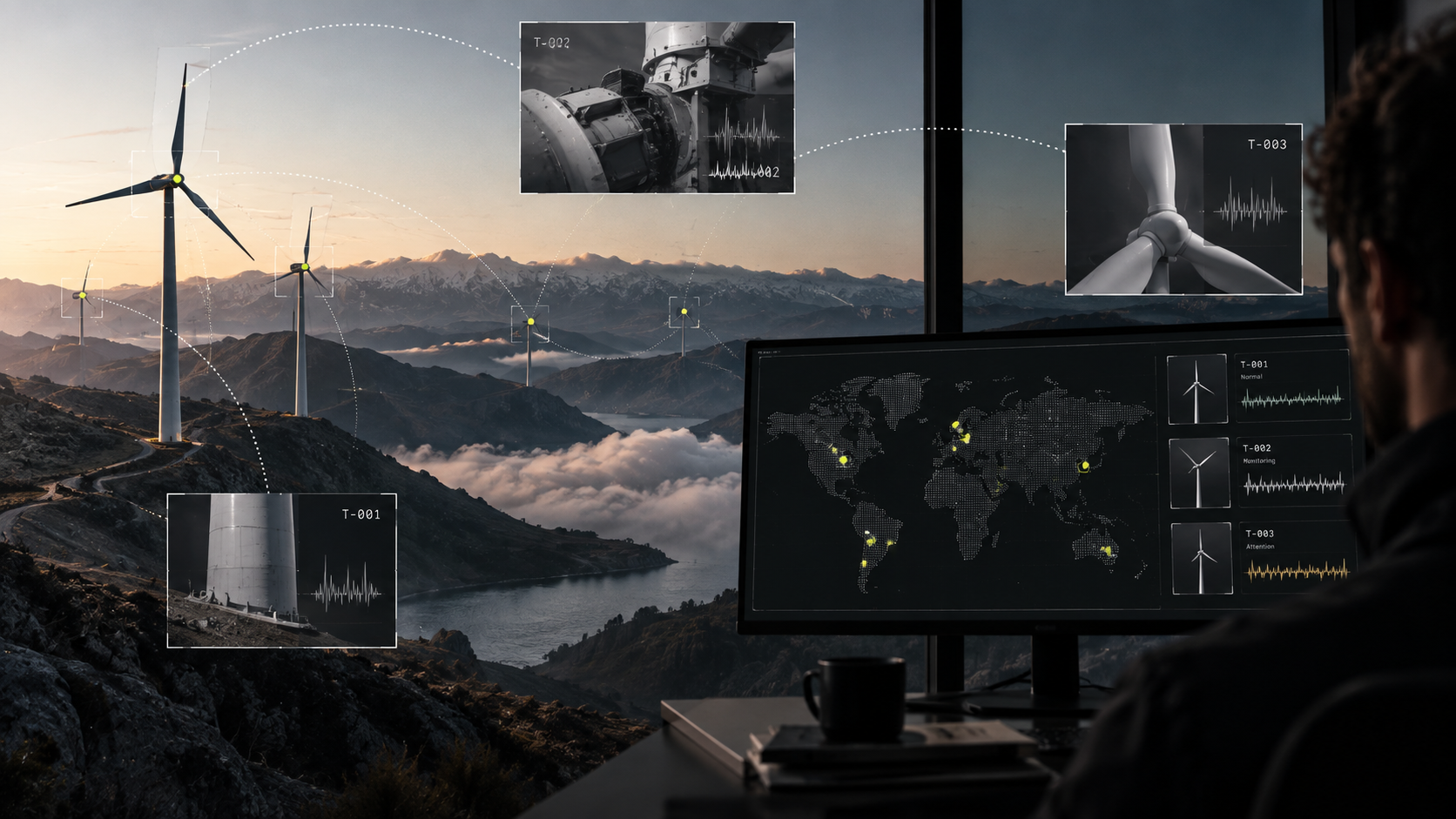
Remote condition monitoring is the practice of tracking equipment health from a distance, using networked sensors to stream condition data off the asset to wherever the analysis happens. The appeal is straightforward: the industrial assets that most need watching are exactly the ones nobody can stand next to all day. A pump on an offshore platform, a compressor at an unmanned substation, a turbine in a remote wind farm. Remote monitoring is how you keep eyes on them without sending a person.
What Is Remote Condition Monitoring, and Why Does It Matter?
At its core, remote condition monitoring extends condition monitoring across distance. The measurement techniques are the same, vibration, temperature, acoustics, current, but the data travels over a network to a central location rather than being read on-site by a technician with a handheld analyzer.
The reason it matters is scale and reach. In the 2025 HiveMQ and IIoT World survey, 70% of companies had deployed or were developing an industrial IoT strategy, and 61% named predictive maintenance as their top AI use case. The problem it addresses is expensive: Siemens' True Cost of Downtime 2024 puts unplanned downtime at $1.4 trillion a year for the world's 500 largest companies, around 11% of revenue. Remote monitoring extends the reach of a maintenance program to assets that were previously checked only on a schedule, or only after they failed.
How Does Remote Condition Monitoring Work?
A remote monitoring system runs on four layers.
Sensors capture the physical signals at the asset: accelerometers for vibration, thermal sensors for heat, acoustic and current sensors for the rest. In a remote deployment, these usually need to be rugged and, often, wireless and battery-efficient, because running cable and mains power to a distant asset defeats the purpose.
Connectivity moves the data off the asset. This is the layer unique to remote monitoring, and the one that shapes everything else. Lightweight protocols like MQTT dominate industrial telemetry precisely because bandwidth at remote sites is limited and often metered. For assets with no reliable network, data may be buffered locally and transmitted in bursts.
Analysis turns signal into judgment, either in the cloud or, increasingly, on the asset itself. This is where a healthy signature gets separated from a developing fault.
Action closes the loop: an alert with enough lead time to dispatch a technician and the right parts, which for a remote asset is a logistics problem as much as a maintenance one.
Where Does Remote Condition Monitoring Pay Off?
The value concentrates wherever physical access is expensive, dangerous, or simply infrequent.
In energy and utilities, remote monitoring watches distributed assets like substations, pipelines, and wind turbines that would otherwise be inspected only on periodic rounds. In oil and gas, it keeps continuous watch on offshore and remote-site equipment where every physical inspection means a helicopter or a boat. In manufacturing with multi-site operations, it lets a central reliability team oversee assets across many plants at once. In transportation and rail, it monitors rolling stock and trackside equipment spread across a network no team could physically cover.
The common thread: the further and costlier the physical access, the more a remote sensor earns its place.
What Challenges Trip Up Remote Monitoring Deployments?
Remote monitoring adds failure modes that on-site monitoring does not have, and honest planning accounts for them.
Connectivity and bandwidth. A monitoring system is useless when its data cannot get out. Remote sites often have intermittent or low-bandwidth connections, which forces hard choices about what to transmit and how often. Streaming raw high-frequency vibration data from a thousand remote sensors is rarely feasible.
Data security. Sending operational data off-site across networks widens the attack surface. Industrial cybersecurity has moved from good practice to formal requirement, and any remote deployment has to treat the data pipeline as something to secure, not just to build.
Integration with legacy equipment. Much industrial machinery predates the sensors now being attached to it. Retrofitting monitoring onto decades-old assets, and integrating the data with existing maintenance systems, is often the hardest practical part of a rollout.
Total cost. Sensors, connectivity, and the labor to act on alerts across dispersed sites all add up. The economics work best when they start from the most critical, hardest-to-reach assets rather than trying to instrument everything at once.
Where Is Remote Condition Monitoring Heading?
Two shifts are reshaping the field, and they point in the same direction.
The first is edge intelligence. When bandwidth is the binding constraint, the answer is to analyze data where it lives, on or near the asset, and transmit only the results. Running inference at the edge sidesteps the connectivity bottleneck entirely and enables real-time detection where cloud round-trips would be too slow.
The second is the shift from per-asset models to models that generalize. Conventional AI monitoring trains a separate model per machine on labeled failure history, which is hard enough on-site and harder still across hundreds of dispersed remote assets you rarely touch. A foundation model pre-trained broadly on physical sensor data generalizes across machines instead. Newton, Archetype's Physical AI foundation model, works this way: it deploys without labeled failure history or per-site model development. For remote fleets, that removes the single biggest barrier: you cannot easily gather run-to-failure data from an asset you visit twice a year, so a model that does not need it changes what remote monitoring can cover.
In plain terms: the future of remote monitoring is less data hauled to a distant server, and more intelligence sitting next to the machine.
Frequently Asked Questions
What Is Remote Condition Monitoring?
Remote condition monitoring tracks equipment health from a distance using networked sensors that stream condition data (vibration, temperature, acoustics, current) off the asset for analysis, so distant or hard-to-reach equipment can be watched continuously without on-site inspection.
How Is Remote Condition Monitoring Different From Regular Condition Monitoring?
The measurement techniques are the same. The difference is that data travels over a network to a central or edge location rather than being read on-site, which adds connectivity, bandwidth, and security as central design concerns.
Which Industries Use It Most?
Energy and utilities, oil and gas, multi-site manufacturing, and rail and transportation, wherever physical access to assets is expensive, dangerous, or infrequent.
What Are the Main Challenges?
Intermittent or low-bandwidth connectivity, data security across networks, integrating with legacy equipment, and the total cost of instrumenting dispersed sites. Starting from the most critical, least accessible assets manages most of these.
How Do Foundation Models Help Remote Monitoring?
They remove the need for per-asset labeled failure data, which is especially hard to collect from rarely-visited remote assets. A model like Newton generalizes across machines and deploys without site-specific training, and edge deployment lets it run where bandwidth is limited.
