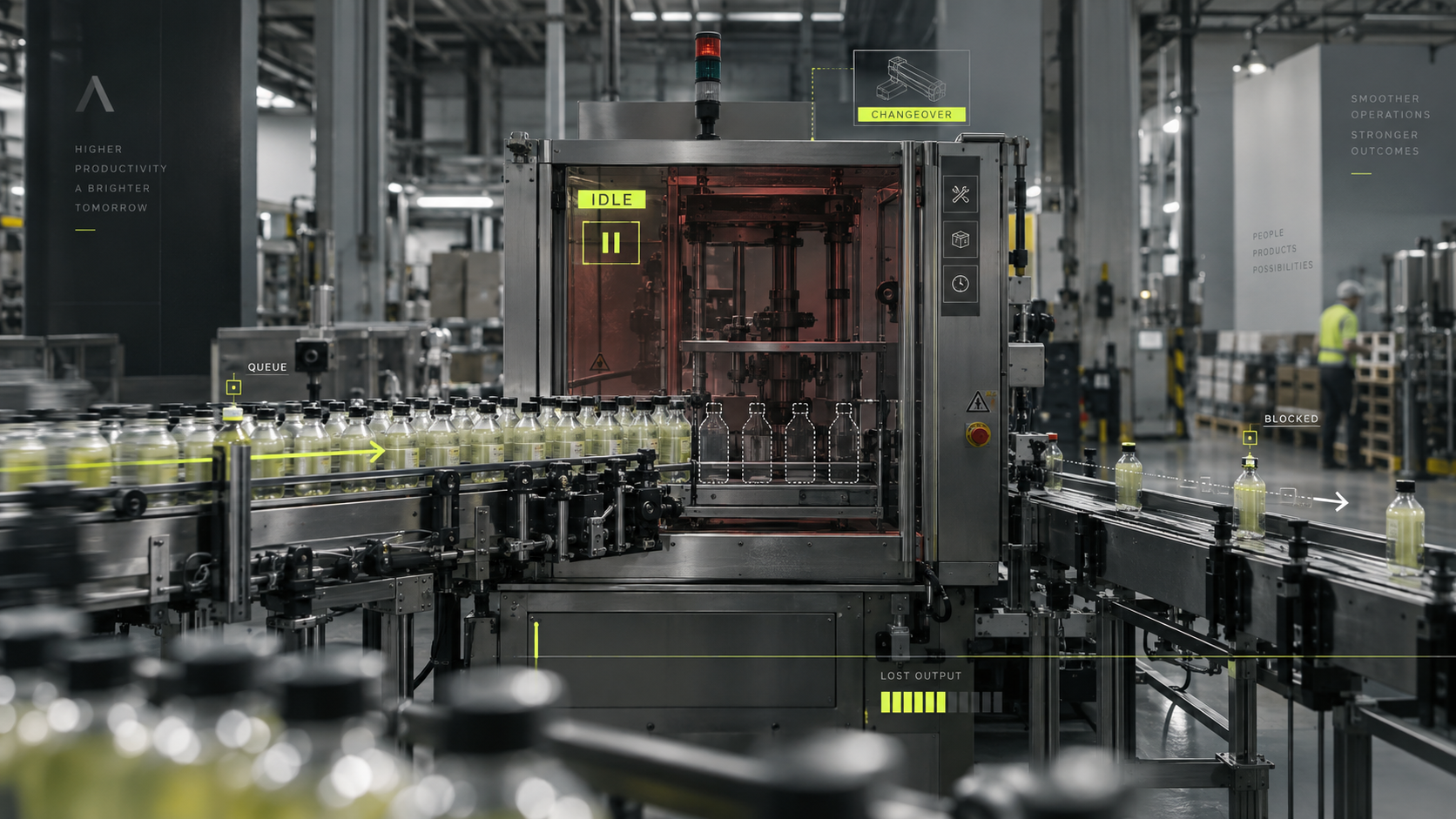
Idle time is one of the most misunderstood losses in operations, largely because it gets lumped in with downtime. They are not the same thing, and treating them as one hides where your capacity is actually going. This guide defines idle time cleanly, shows how to measure it, and covers the practical levers for reducing it.
What Is Idle Time?
Idle time is any period when a resource is available and scheduled to work but is not actively producing. A machine that is powered on, staffed, and ready, yet sitting between jobs or waiting on materials, is idle. It is a productivity loss, not a failure.
That distinction separates idle time from downtime. Downtime is when equipment is unavailable: broken, under repair, or offline for planned maintenance. Idle time is when equipment is available but unused. The difference matters because the two have different causes and fixes. Downtime points you toward reliability; idle time points you toward flow, scheduling, and coordination. Under ISO 22400-2, both surface as availability losses within Overall Equipment Effectiveness (OEE), but they sit in different loss categories and demand different responses.
Typical idle scenarios include an operator waiting through a changeover, a machine starved because an upstream station runs slower, or staff standing by during an unplanned materials shortage.
What Are the Types of Idle Time?
Idle time splits two ways: normal versus abnormal, and internal versus external.
Normal idle time is expected and often unavoidable: setup and changeover between products, scheduled breaks, or the small waits built into a balanced line. It is planned for and budgeted. Abnormal idle time is not: a late delivery, an absent operator, a bottleneck that starves downstream stations, or a quality hold that stops the flow. Abnormal idle is where most of the recoverable loss hides.
It also helps to separate internal causes the plant controls, such as slow changeovers and unbalanced lines, from external causes it does not, such as supplier delays and utility interruptions. That tells you what to fix in-house versus what to manage through suppliers and contracts.
How Do You Calculate Idle Time?
At its simplest, idle time is the gap between the time a resource was scheduled to run and the time it actually produced:
Idle Time = Scheduled Production Time - Actual Production Time - Recorded Downtime
Subtracting recorded downtime keeps failures from being double counted. If a line is scheduled for 8 hours (480 minutes), logs 30 minutes of breakdown, and produces for 400 minutes, idle time is 50 minutes: available but not producing.
The number is only as good as the state data behind it. Most plants track idle time through OEE, where it appears as an availability loss alongside downtime. ISO 22400-2 standardizes the underlying definitions so that "planned time," "downtime," and "producing" mean the same thing across shifts and sites, which is what makes idle-time figures comparable rather than anecdotal.
What Does High Idle Time Cost?
Idle time is expensive because the cost of being ready keeps running even when output stops.
Labor, energy, depreciation, and overhead accrue whether or not a machine is producing, so when a line sits idle that fixed-cost base is spread over fewer units and unit costs climb. Deloitte estimates that poor maintenance and planning practices can cut a plant's overall productive capacity by 5 to 20 percent, much of it lost to time that is available but unused. The scale is clearest at the extreme: Siemens puts the cost of a stopped automotive production line at up to $2.3 million per hour, and a stalled line bleeds that whether it is idle or down. Even in aggregate, US manufacturers run at only about three-quarters of capacity, according to the Federal Reserve, a reminder that unused capacity is the norm, not the exception.
Beyond the ledger, chronic idle time erodes morale, hides bottlenecks, inflates lead times, and masks the plant's true capacity.
How Can You Reduce Idle Time?
Reducing idle time means attacking the waits, not the workers: smoother flow, faster changeovers, and clear visibility into why machines stop.
Start with workflow. Balance line pace so no station routinely starves or blocks the next, and sequence jobs to minimize setup swings. Changeover is often the largest planned idle bucket, and structured methods such as SMED (single-minute exchange of die) convert internal setup steps into external ones performed while the machine still runs. Cross-training and disciplined material staging cut the abnormal idle caused by absent operators and late parts.
None of this works without knowing where idle time actually goes, and manual logging is coarse and unreliable because operators round, forget, or misclassify a wait as a breakdown. Continuous monitoring of machine state closes that gap. Physical AI platforms are the next step here: rather than relying on fixed thresholds or a hand-built classifier per machine, a world model like Newton learns each asset's normal behavior directly from its sensor and video streams and labels operational states such as running, idle, changeover, and stopped in real time. That turns "the line was down for two hours" into "40 minutes were a fault, 80 were waiting on material," which is the difference between a maintenance problem and a scheduling one.
How Does Maintenance Affect Idle Time?
Maintenance shapes idle time in two ways: how it is scheduled, and how well it prevents the failures that force unplanned waits.
Planned maintenance is itself a form of normal idle time, so scheduling it into low-demand windows keeps it from stealing productive hours. The larger lever is avoiding unplanned stops that ripple outward. When one asset fails, upstream and downstream stations often sit idle waiting on it, so a single breakdown creates far more non-producing time than the repair itself. That is the domain of condition monitoring and predictive maintenance, which we cover in our guide to predictive maintenance using AI and our guide to improving equipment uptime with AI. Reliable assets simply create fewer of the cascading waits that surface as idle time elsewhere on the line.
Which Tools Track Idle Time?
Idle time is tracked with OEE and MES software, machine-state sensors, and increasingly with AI that classifies why a machine is not producing.
Traditional setups fall into two camps. Rule-based systems flag idle time when a signal crosses a fixed threshold, which is simple but brittle and blind to context. Conventional machine-learning tools improve on that but usually need a model trained per asset on labeled history, which is slow to deploy and hard to scale across a mixed fleet. Foundation models are a distinct third approach: Newton, Archetype AI's Physical AI world model, generalizes across assets and can classify operational states with little or no per-machine setup, running at the edge so state data is available in real time without shipping raw sensor streams to the cloud. Whichever you choose, the feature that matters most is honest state data: a system that reliably separates producing, idle, and down turns idle time from a guess into a managed number.
FAQs
What is idle time?
Idle time is time when a resource, a machine or a worker, is available and scheduled to work but is not actively producing. Unlike downtime, which means the resource is unavailable, idle time means it is ready but unused, usually because of waiting, starvation, or a changeover.
What is the difference between idle time and downtime?
Downtime is when equipment is unavailable because of a breakdown or maintenance. Idle time is when equipment is available but not producing. Downtime is a reliability problem; idle time is usually a flow or scheduling problem.
How do you calculate idle time?
Subtract actual producing time and any recorded downtime from scheduled production time. Whatever remains, the time a resource was available but not producing, is idle time. Tracking it through OEE keeps the definition consistent across lines and sites.
What causes idle time?
Common causes include slow changeovers, unbalanced line pace, material shortages, absent operators, blocked output buffers, and waiting on an upstream or failed machine.
How can you reduce idle time?
Balance and sequence work to reduce starving and blocking, shorten changeovers with methods like SMED, stage materials and cross-train staff, and use accurate machine-state monitoring so you can see and fix the specific waits driving the loss.
