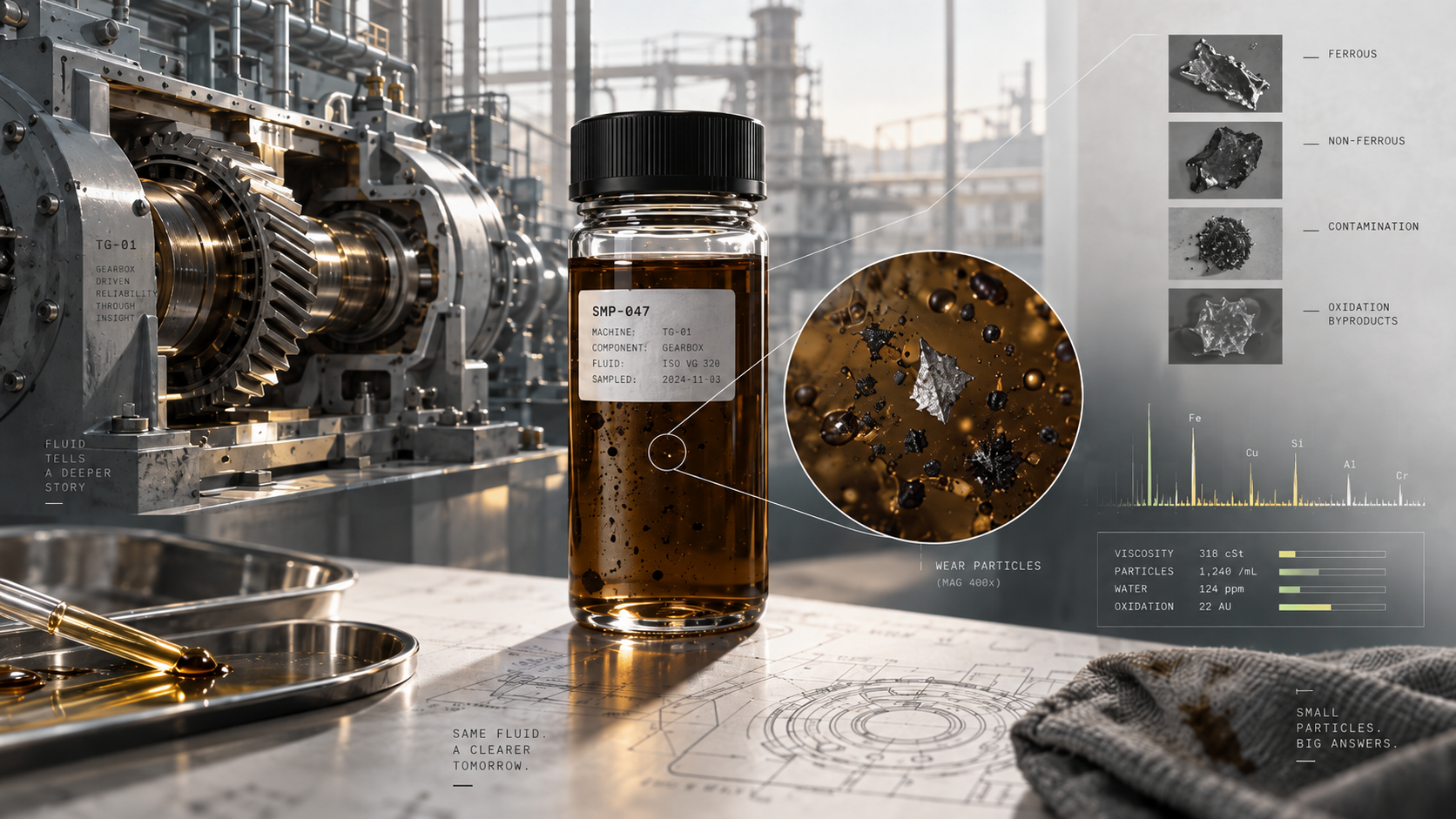
Used oil is a diagnostic record. Every hour a lubricant circulates through a machine, it collects evidence of what is happening inside: the metals wearing off moving surfaces, the contaminants getting past seals, the chemical breakdown of the oil itself. Predictive maintenance oil analysis reads that record in a lab to catch developing failures long before they stop the machine.
It is one of the three pillars of a mature condition monitoring program, alongside vibration analysis and thermography, and for a whole class of failures it gives the earliest warning of any technique.
What Is Predictive Maintenance Oil Analysis?
Oil analysis is the laboratory or field examination of a used lubricant sample to determine three things: the condition of the oil, the type and level of contamination present, and the concentration and type of wear metals it carries. Each tells a different part of the story.
The shift this enables is from calendar-based oil changes to condition-based ones. Instead of draining oil every fixed interval regardless of its state, you change it when its actual condition warrants, which reduces both unnecessary lubricant cost and the risk of running degraded oil. More importantly, the wear-metal data turns the oil into an early-warning system for the machine itself, not just the lubricant.
The economics follow the broader predictive maintenance case. Siemens' True Cost of Downtime 2024 puts unplanned downtime at $1.4 trillion a year for the world's 500 largest companies, around 11% of revenue, and oil analysis is often the technique that catches internal wear before any other signal appears.
How Does Oil Analysis Work?
A useful result depends on a disciplined process, and the first step is where most of the risk lives.
Sampling. The sample has to represent the oil actually circulating in the machine. Drawing it from the wrong point, at the wrong time, or with a contaminated bottle produces misleading data no lab can correct. Best practice is to sample from a consistent point in the live system, while the machine is at operating temperature, using clean equipment. Sample frequency scales with criticality: high-value assets with large oil systems are commonly sampled every 500 to 1,000 operating hours.
Laboratory testing. A standard analysis runs several complementary tests:
TestWhat it measuresWhat it revealsSpectrometric wear metalsConcentration of metals (iron, copper, chromium, aluminum)Which internal components are wearingViscosityOil's resistance to flowDegradation, fuel dilution, wrong oil addedParticle countNumber and size of solid particlesContamination level, ISO 4406 cleanlinessWater/moistureWater contentSeal failure, condensation, coolant ingressAcid/base numberChemical additive depletionRemaining useful life of the oil
Wear-metal analysis is the diagnostic heart of it. Different alloys map to different parts, so a rising iron count points to different components than rising copper or chromium, letting an analyst localize a developing fault. Particle counts are reported against ISO 4406, the standard cleanliness code, as three numbers for particles larger than 4, 6, and 14 microns. Trending those numbers over time matters more than any single reading: a sudden jump in the largest size band often signals abnormal wear or component distress that overall levels alone would miss.
Interpretation. Raw numbers are meaningless without a baseline. Value comes from trending each parameter against the asset's own history and against reference limits, so the analyst is reading a trajectory rather than a snapshot.
What Are the Key Benefits of Oil Analysis?
The advantages of oil analysis concentrate in three areas.
Early fault detection. For lubricated components like gearboxes, bearings, and hydraulic systems, wear-metal analysis frequently gives the longest lead time of any condition monitoring technique, catching degradation while it is still microscopic.
Optimized oil changes. Condition-based lubricant changes cut both waste and risk. You stop discarding good oil on a calendar, and you stop running degraded oil that no longer protects the machine.
Extended asset life. Catching contamination and wear early, and confirming the lubricant is doing its job, directly protects the expensive machinery the oil is meant to serve.
What Are the Limitations of Oil Analysis?
Oil analysis is powerful but not self-executing, and an honest program plans for its constraints.
Sampling error is the dominant risk. A poorly drawn sample is worse than none, because it produces confident but wrong data. Consistent technique and point-of-sampling discipline are non-negotiable.
Lab turnaround introduces lag. Off-site testing means results arrive hours or days later, which makes traditional oil analysis a periodic check rather than a continuous one. It tells you the state at the moment of sampling, not right now.
It requires expertise. Interpreting a report correctly, distinguishing a benign additive signal from an early wear event, depends on trained analysts and good baseline data. The test is only as valuable as the reading of it.
How Does Oil Analysis Fit Into a Predictive Maintenance Program?
No single technique catches every failure mode, which is why oil analysis works best as one layer of several. It excels at internal, slow-developing wear and lubricant condition. Vibration analysis catches mechanical faults like imbalance and bearing defects. Thermography finds heat-related and electrical problems. Together they cover far more of the failure space than any one alone. A gearbox program, for instance, might use oil analysis to detect gear-tooth wear debris and vibration analysis to confirm and localize the fault.
The structural limitation across the traditional toolkit is timing. Oil analysis is periodic and lab-bound; vibration routes are often periodic too. Real-time, continuous sensing fills the gap between samples, and this is where a different category of technology comes in. AI-based monitoring analyzes live sensor streams continuously rather than at sampling intervals, and a foundation model trained broadly on physical signals can generalize across assets without a labeled failure history for each one. Newton, Archetype's Physical AI foundation model, works this way, deploying without per-asset training. It does not replace the lab chemistry that oil analysis provides; it complements it, watching the continuous vibration, temperature, and current signals in the intervals between oil samples so the machine is never fully unobserved. In an integrated program, oil analysis supplies deep periodic insight into lubricant and internal wear, and real-time sensing supplies the continuous coverage between draws.
Frequently Asked Questions
What Is Oil Analysis in Predictive Maintenance?
It is the lab or field examination of a used lubricant sample to assess the oil's condition, its contamination, and the wear metals it carries. Those readings reveal internal wear and lubricant degradation before they cause failure.
What Tests Does an Oil Analysis Include?
Core tests are spectrometric wear-metal analysis, viscosity measurement, particle counting (reported as an ISO 4406 cleanliness code), water content, and acid/base number. Each targets a different aspect of oil and machine health.
How Often Should Oil Analysis Be Performed?
It depends on criticality and operating conditions. High-value assets with large oil systems are commonly sampled every 500 to 1,000 operating hours, or quarterly, with more frequent sampling for harder-working or higher-risk equipment.
What Are the Main Limitations of Oil Analysis?
Sampling error is the biggest risk, since a bad sample gives confidently wrong results. Lab turnaround also introduces lag, making it periodic rather than continuous, and correct interpretation requires trained analysts and good baseline data.
How Does Oil Analysis Fit With Other Techniques?
It complements vibration analysis and thermography, each covering failure modes the others miss. Continuous AI-based sensing can add real-time coverage in the intervals between periodic oil samples.
