
Archetype AI Team
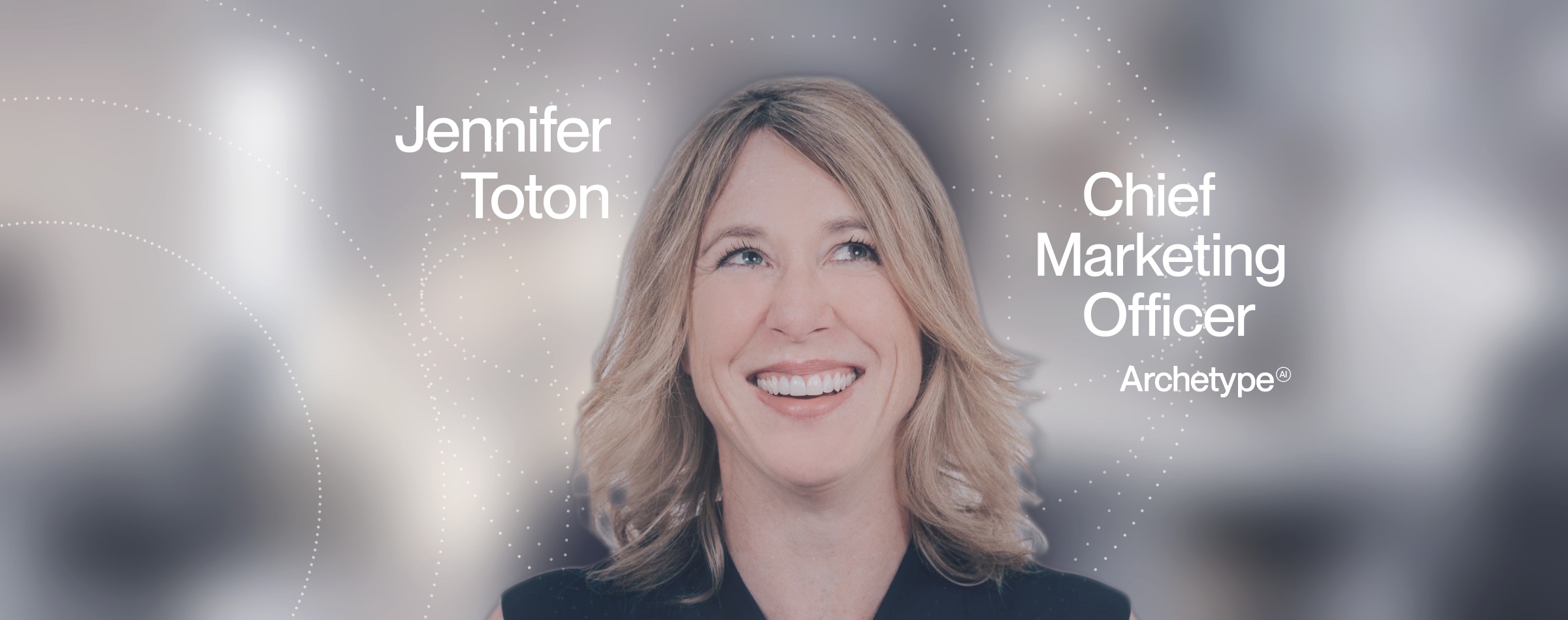
We are excited to announce that Jennifer Toton (“JT”) has joined us as Chief Marketing Officer, leading Archetype’s marketing as we scale our go-to-market and accelerate sales. JT brings more than 15 years of experience at the intersection of AI and physical-world industries. At Autodesk, she led manufacturing industry marketing and launched the company’s first cloud-based ML simulation product, helping engineers predict how things behave in the real world before anything was built. Most recently, she helped grow OpenSpace’s ARR 3.6x and reposition the company as a visual intelligence platform for the built world.
JT’s appointment comes as Physical AI moves from emerging category to enterprise-scale opportunity. Gartner has named Physical AI one of its top strategic technology trends for 2026, and sizes spatial AI, the connective tissue between physical AI and digital AI, as a $40 billion opportunity by 2036. But that scale won’t arrive as one breakthrough moment. It gets built into the machines, plants, and infrastructure already running today. And hype attracts noise. With every robotics demo and embodied-AI headline claiming the term, the race of the next ten years is a simple one: defining what Physical AI actually is, and who leads it.
A conversation with JT
We asked JT a couple of questions about what the market can expect from Archetype in 2026.
When most people hear “Physical AI,” they think robots. How do you define the category?
JT: That’s the first misconception to clear up. Physical AI isn’t about robots. It’s about bringing intelligence to the operations that keep the world running: manufacturing floors, energy grids, building systems, transportation networks. Those industries power most of the global economy, and the companies that run them are sitting on enormous amounts of sensor data, all asking the same question: how do we make this data intelligent? That’s the category. Not machines that move — operations that understand themselves.
You’ve spent your career at the intersection of AI and physical-world industries, before it had a name. What drew you to Archetype?
JT: The combination of technology, team, and proof. Newton is a ChatGPT for the physical world: it takes raw sensor data and reasons about what’s happening, in real time. Not simulating physical environments or generating synthetic worlds, but understanding the actual, messy, complex physical world as it operates. Add a world-class team and customers already in production, and that combination is rare. For me it’s not a new chapter. It’s the next one in a story I’ve been part of for fifteen years: from simulation at Autodesk to sensor fusion at Nauto, where we interpreted real-time sensor and video data to make fleets like FedEx safer, to spatial intelligence at OpenSpace, and now a physical world model that unlocks unlimited use cases.
This is a category creation moment. What does that actually mean for how you market the company?
JT: Category creation means the market doesn’t yet have the language to describe what you do, so your first job is to give it that language. I’ve lived this. At OpenSpace we moved the company from “reality capture” to a visual intelligence platform, and that wasn’t a rebrand. It changed who we sold to, the size of the deals, and the competitive set we were measured against. The same work is ahead of us here. If we let Archetype get filed under “industrial AI tools,” we’ve failed to explain the architectural shift we’re leading. The narrative has to work at the level of the category, not just the product. And you don’t invent that language in a conference room — you earn it by listening to customers and operators, then naming what they’re already living in a way the whole market can recognize itself in.
Enterprise operators have seen plenty of AI hype. How does marketing earn their trust?
JT: With proof, not promises. Operators, engineering, and machine learning teams are rightfully skeptical. They’ve watched demos that never made it to the factory floor. I’ve spent my career selling to exactly these people: fleet operators, plant managers, builders who were running job sites long before they were running companies. They don’t buy vision, they buy outcomes. So the marketing has to be built on what’s actually running in production — real deployments, real outcomes, real constraints. My rule is simple: when your message is working, customers want to talk to you, and they buy from you. If the story we tell can’t survive contact with an operator who’s been burned before, it’s the wrong story.
What should customers and the market expect from Archetype in 2026?
JT: A clear voice grounded by our customers, and a bigger presence in places that matter. You’ll see us articulate what Physical AI means online and at events, and what it makes possible in manufacturing, energy, semiconductors, data centers and more, with the customer outcomes to back it up. The opportunity is massive and the window to define this category is right now. Our job is to make sure that when industrial companies understand what Physical AI is, they learned it from Archetype.
Physical AI is changing how organizations understand and operate in the real world. JT has a track record of turning category positioning into pipeline, and pipeline into revenue. She is the right leader to tell that story to the world.
Sources: Gartner Identifies the Top Strategic Technology Trends for 2026; Gartner spatial AI research