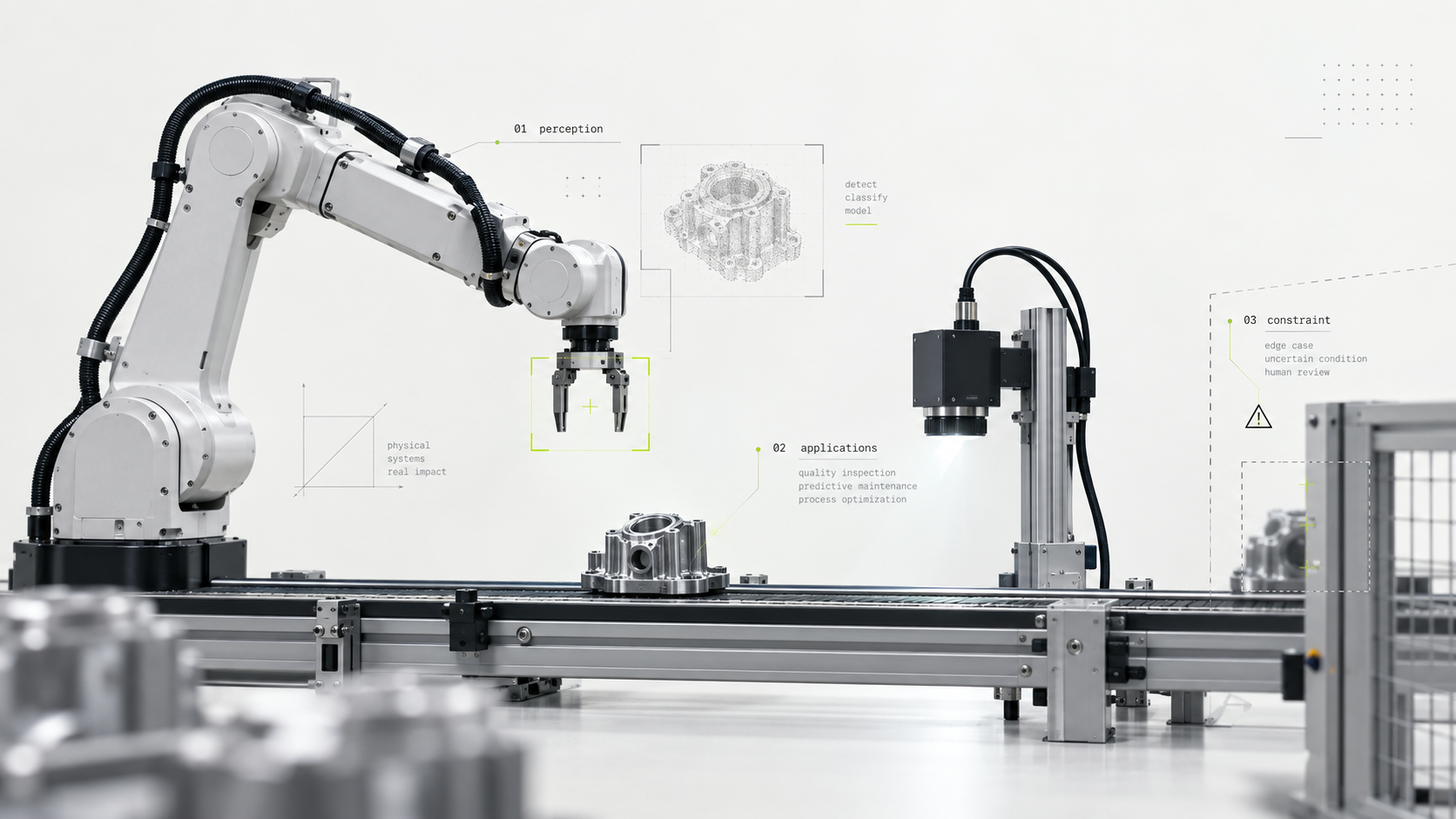
Industrial AI is artificial intelligence applied to the data that industrial equipment and processes produce: vibration, temperature, pressure, current, acoustics, and the time-series telemetry streaming off motors, pumps, turbines, and production lines. Where consumer AI works with text and images, industrial AI works with sensor signals and the physical constraints of real operations. Its job is practical: forecast a bearing failure before it stops a line, catch a defect before it ships, or flag a process drifting out of spec. Done well, it turns raw machine data into decisions that cut downtime, waste, and cost.
That problem is expensive enough to justify the field. Siemens' True Cost of Downtime 2024 report put unplanned downtime at roughly 11% of annual revenue for the world's 500 largest companies, about $1.4 trillion a year. The global industrial AI market reached $43.6 billion in 2024 and is forecast to grow at a 23% compound annual rate through 2030, according to IoT Analytics. The interest is real. The results, as we will see, are harder to scale than the headlines suggest.
How Is Industrial AI Different From General AI?
Industrial AI differs from general-purpose AI in what it learns from and what it has to guarantee. A large language model is trained on text and tolerates the occasional wrong answer. An industrial model reads continuous physical signals and feeds decisions where a mistake can mean a scrapped batch, an unplanned outage, or a safety incident. A chatbot can fail gracefully. A production line cannot.
Three differences matter most. First, the data: sensor streams are high-frequency, noisy, and specific to each machine's design and installation, not clean labeled text. Second, the stakes: predictions drive physical action, so accuracy, latency, and explainability are not optional. Third, deployment: much of the work has to run at the edge, close to the equipment, because sending everything to the cloud adds latency and cost. For a fuller comparison of model types, see Physical AI vs Generative AI.
What Technologies Power Industrial AI?
At its core, industrial AI combines sensing, machine learning, and edge computing. Sensors capture the physical state of equipment, machine learning models learn what normal and abnormal look like, and edge hardware runs inference where the data is generated.
Historically the modeling has leaned on two approaches. Rule-based systems trip an alert when a reading crosses a fixed threshold, which is straightforward but blind to anything the rules do not anticipate. Conventional machine learning improves on that by learning patterns from historical data, though it typically needs a labeled dataset and a separate model trained for each asset and failure mode. The trade-offs between these approaches are worth understanding before you buy, and we cover them in AI vs Rule-Based Monitoring Systems.
Where Is Industrial AI Used?
The highest-value applications cluster around keeping equipment and processes running.
Predictive maintenance is the anchor use case. By reading sensor data for early signs of wear, models forecast failures in time to fix them on a planned schedule. The U.S. Department of Energy's Operations and Maintenance Best Practices guidance estimates that a functioning predictive maintenance program saves 8% to 12% over preventive maintenance, and considerably more against a purely reactive approach. Our full Predictive Maintenance Using AI guide goes deeper on methods and deployment.
Quality control is the second pillar. Computer vision and anomaly detection catch surface defects, dimensional drift, and assembly errors faster and more consistently than manual inspection. See AI for Manufacturing Quality Control for the specifics.
Process and asset optimization rounds it out. Models tune set points for energy and yield, and monitor fleets of assets for degradation across a site. AI for Industrial Asset Monitoring covers that ground.
What Makes Industrial AI Hard To Scale?
The obstacles are less about algorithms than about the realities of industrial data and deployment.
The first is data. Sensor data sits siloed across historians, control systems, and spreadsheets, and much of it is unlabeled. Failures are rare by design, so there are few examples to learn from.
The second is structural, and it is the reason so many programs stall. Conventional industrial AI is built one model at a time: one model per machine, one pipeline per failure mode, one project per site. A plant with a hundred asset types across fifty sites can face thousands of models to build, validate, and maintain. That approach is fragile and expensive, and it explains a broader pattern. In McKinsey's 2025 State of AI survey, most organizations report using AI, but only about a third have moved beyond pilots to scale it across the enterprise. Building a bespoke model for every asset is a direct route to pilot purgatory.
The third is people. The engineers who can read these systems and the data scientists who can model them are both scarce, and the two rarely sit at the same desk.
Where Is Industrial AI Heading?
The field is moving from one-model-per-asset toward foundation models for the physical world. This is the step past conventional industrial AI, and it is a distinct category: not rule-based, and not a bespoke model trained per machine.
Physical AI is that category, and Archetype AI's physical world model, Newton, is built for it. Newton is pretrained on billions of cross-modal sensor measurements, so instead of training a model from scratch for each asset, teams adapt one model across machines and sites. In practice that means Newton can reach up to 90% accuracy out of the box on a new asset with no model training, and adapt to a new machine from as little as one labeled example. It runs where the data lives, from the cloud down to a small edge GPU. And because it learns what healthy operation looks like rather than matching preset rules, it surfaces failure modes no one wrote a rule for. In one wind-energy deployment, Newton fused more than 40 sensor types across 63 turbines from unlabeled data and surfaced nine previously unknown failure patterns. For the full picture of the category, see What Is Physical AI?.
Frequently Asked Questions
What is industrial AI in simple terms?
It is AI that reads the data coming off industrial equipment, such as vibration, temperature, and current, to predict failures, catch defects, and optimize how machines and processes run.
How is industrial AI different from a large language model?
A language model learns from text and tolerates occasional errors. Industrial AI learns from continuous sensor signals and drives physical decisions, so accuracy, low latency, and running at the edge matter far more.
What is the most common use of industrial AI?
Predictive maintenance. Reading equipment condition to schedule repairs before a failure is the highest-value and most widely deployed application.
Does industrial AI need labeled data?
Conventional approaches usually do, which is a major barrier because failures are rare. Foundation models for sensor data reduce this, adapting to a new machine from a handful of examples or fewer.
Can industrial AI run without the cloud?
Yes. Much of it runs at the edge, on hardware near the equipment, to cut latency and cost and to keep operational data on-site.
