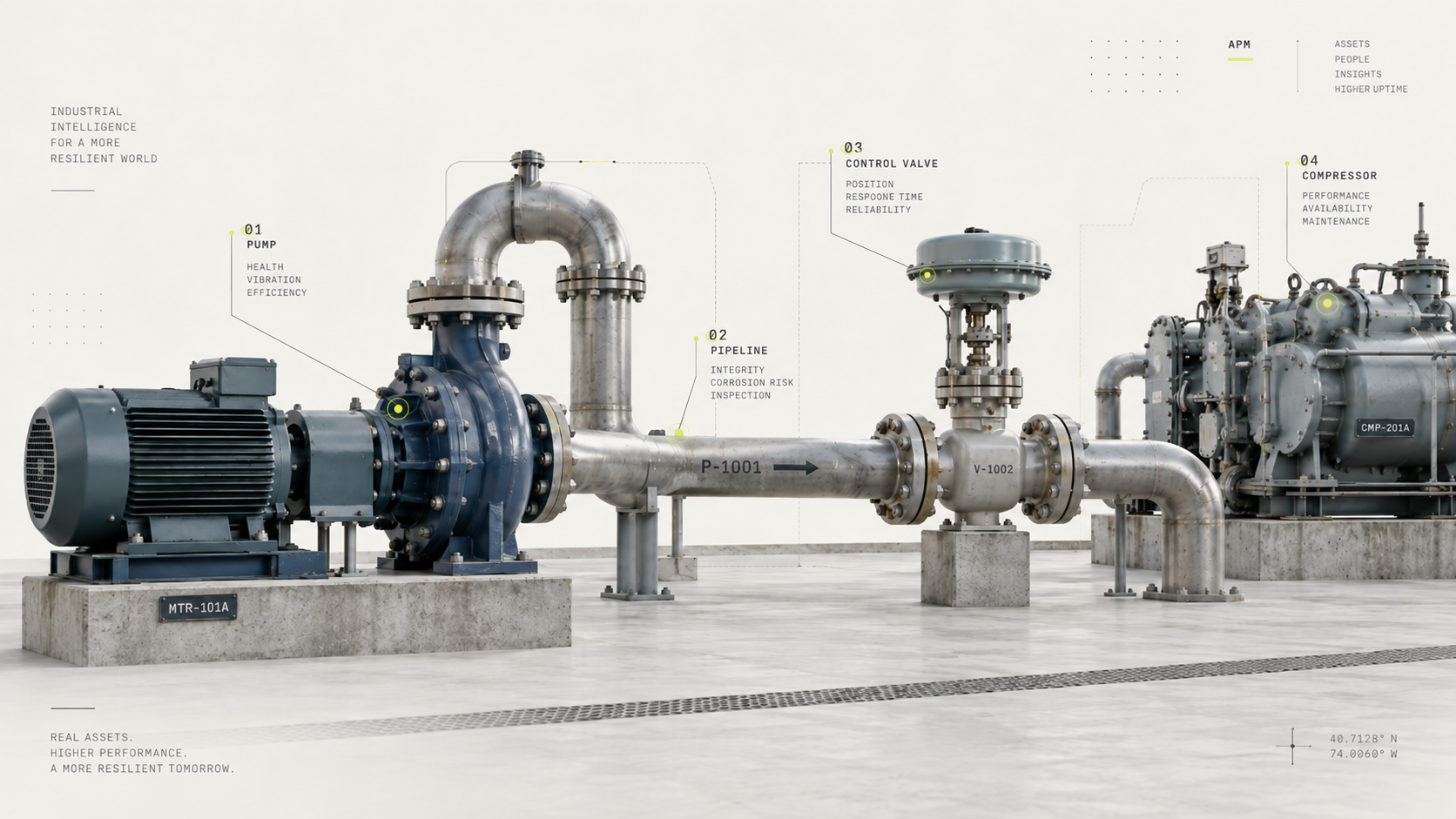
Asset performance management (APM) is the discipline of using data to keep physical assets reliable, available, and productive across their entire lifecycle. It sits above any single maintenance task or sensor: APM is the strategy layer that decides which assets matter most, how to measure their health, and when to act. Where a work order fixes one machine, APM governs how an organization gets the most value and least risk out of its whole fleet across the asset lifecycle.
What Is Asset Performance Management (APM)?
APM is a structured approach to maximizing the reliability, availability, and value of physical assets while managing cost and risk. It brings together condition data, analytics, and maintenance decisions under one framework so that spending follows evidence rather than habit.
The core principle is a shift from reactive to proactive management. Reactive programs wait for equipment to fail, then absorb emergency labor, expedited parts, and lost production. Proactive programs watch asset condition, forecast problems, and intervene on the organization's schedule instead of the failure's. That shift is what the international standard for asset management, ISO 55001, updated in 2024, formalizes: it defines the requirements for an asset management system that links asset condition to strategic objectives, decision-making, and lifecycle value rather than treating maintenance as an isolated cost center.
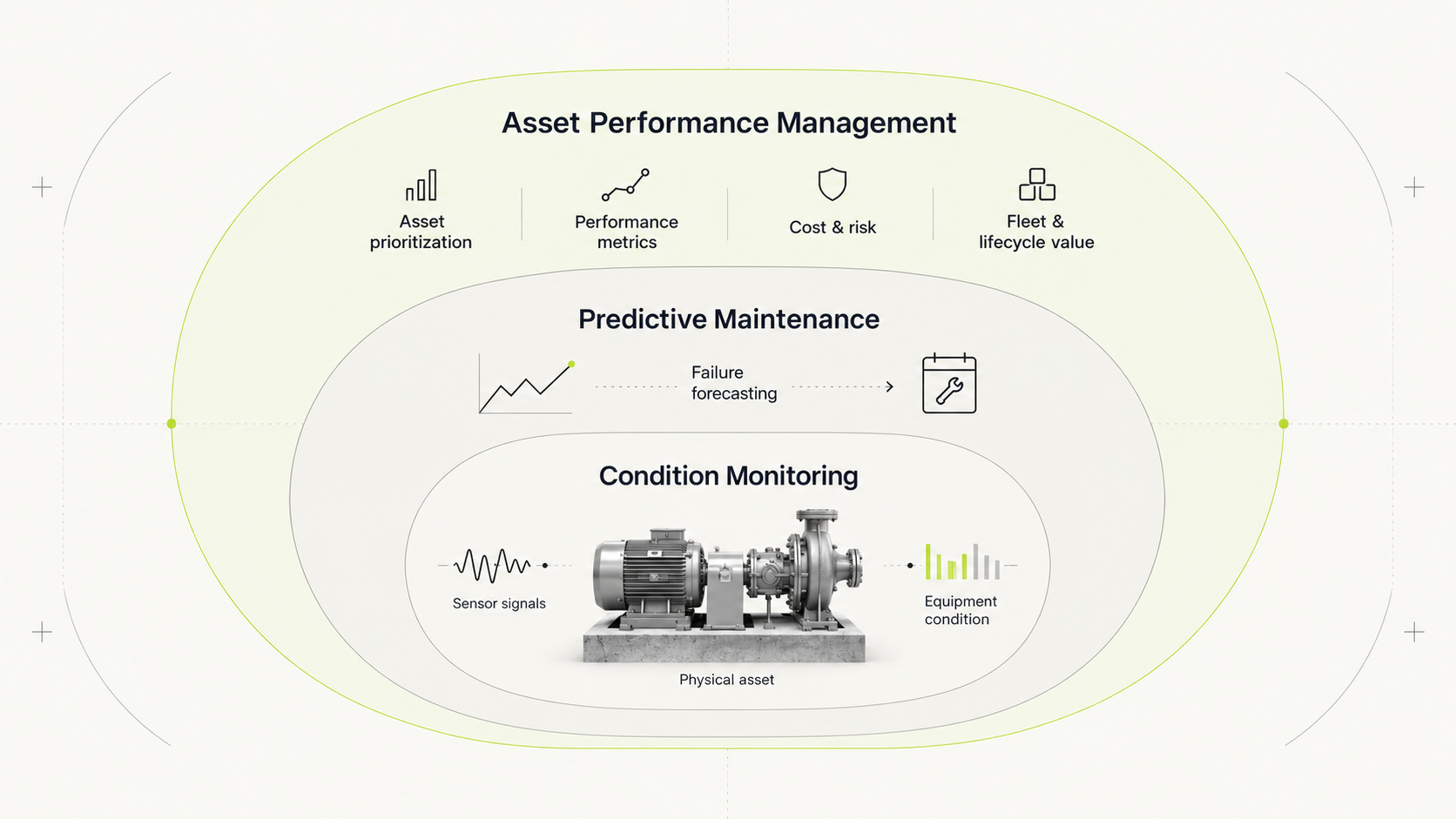
A useful way to place APM is by scope. Condition monitoring gathers the signals. Predictive maintenance turns those signals into failure forecasts. APM is the wider system that prioritizes assets, sets the metrics, and ties both back to business outcomes.
Why Does Asset Performance Management Matter?
APM matters because unplanned failure is one of the largest recoverable costs in asset-intensive operations. Deloitte estimates that unplanned downtime costs industrial manufacturers roughly $50 billion a year, and notes that poor maintenance strategies alone can cut a plant's overall productive capacity by 5 to 20 percent.
The scale grows with the size of the operation. Siemens' True Cost of Downtime 2024 report found that unplanned downtime drains the world's 500 largest companies about $1.4 trillion a year, equal to 11 percent of their combined revenue. In automotive plants, an idle line can cost $2.3 million an hour.
Beyond avoided downtime, a working APM program extends asset life by catching wear before it becomes damage, sharpens capital planning by grounding replace-or-repair decisions in real condition data, and improves safety by flagging failure modes that put people at risk. The return comes from spending maintenance effort where the evidence says it counts.
Which Technologies Drive Modern APM?
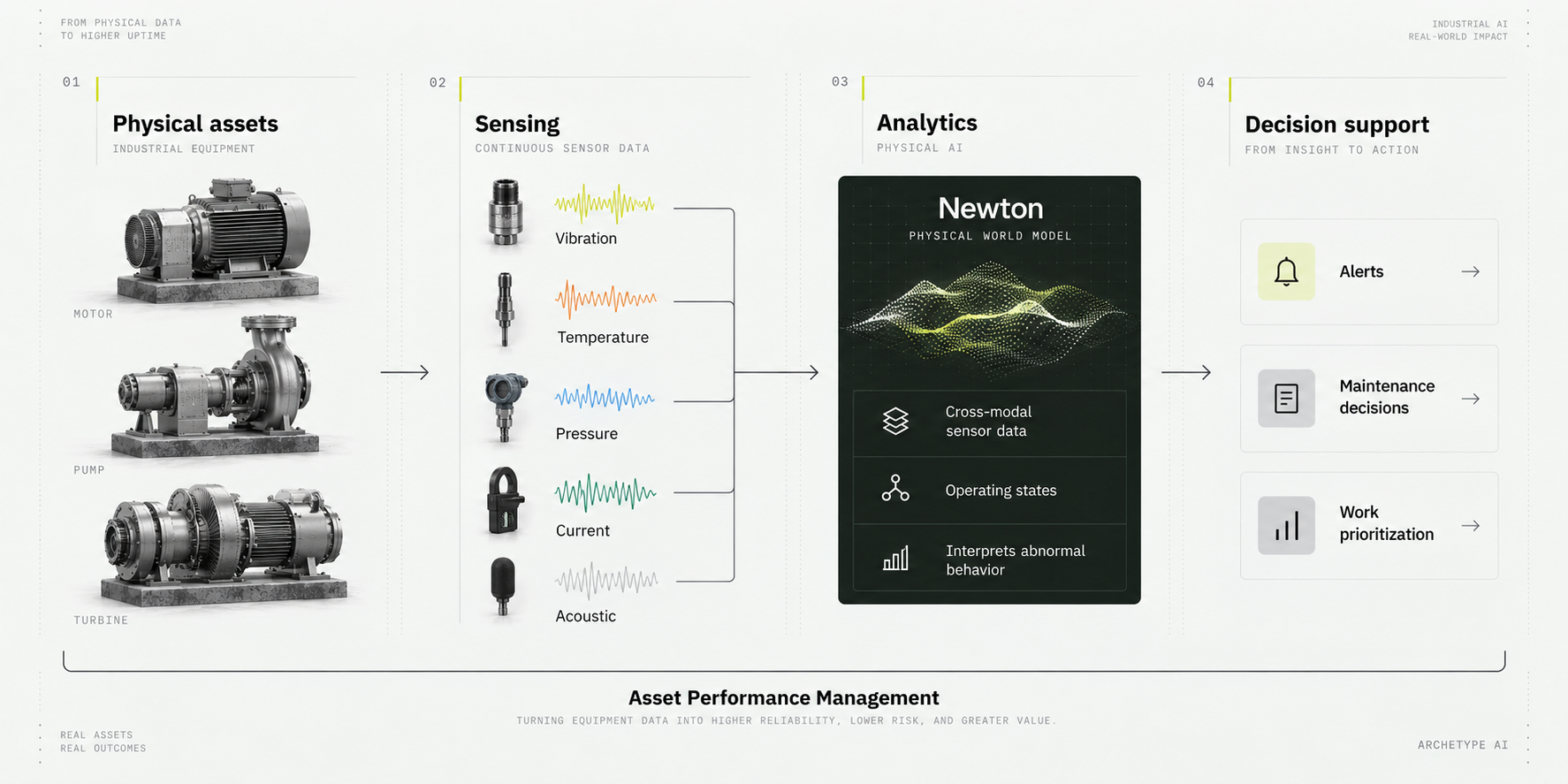
Modern APM runs on three technology layers: sensing, analytics, and decision support. Each has matured, and each is now being reshaped by better models.
Sensing is the foundation. Networked sensors stream vibration, temperature, pressure, current, and acoustic data off equipment continuously, replacing the periodic manual rounds that miss problems between inspections. The richer the signal coverage, the earlier a developing fault becomes visible.
Analytics is where raw signals become decisions. Traditional programs lean on fixed thresholds and hand-built machine learning models, one per asset or failure mode. Those models work, but they are brittle and expensive to scale: a fleet of 100 machine types across 50 sites can demand hundreds of separately trained and maintained models, and each new asset starts the cycle over.
Physical AI platforms are the next step in that analytics layer, which is why a growing number of reliability teams are evaluating them. Newton, the physical world model built by Archetype AI, is pretrained on billions of cross-modal sensor measurements, so instead of building a model per asset, teams adapt one pretrained model to new equipment from as little as a single labeled example. It fuses many sensor types into one shared representation, reaches up to 90 percent accuracy out of the box on new operating contexts with no training, and reports what it finds as named operating states in the operator's own language rather than as raw anomaly scores.
How Do You Build an APM Strategy?
Start by deciding what to protect, then decide how to measure it. A strong APM strategy is built in three moves.
First, rank assets by criticality. Not every machine deserves continuous monitoring. Score each asset by the consequence of its failure, in safety, production loss, and repair cost, and concentrate instrumentation and analytics on the assets that would hurt most.
Second, build a phased roadmap. Prove the program on a critical asset class, establish the data pipeline and alerting workflow, then expand. Trying to instrument everything at once is the most common way APM initiatives stall.
Third, define the metrics before you deploy. The KPIs that anchor most programs are asset availability, overall equipment effectiveness (OEE), mean time between failures (MTBF), and mean time to repair (MTTR). Availability and OEE tell you whether assets are producing; MTBF tracks reliability; MTTR tracks how fast the team recovers. Pair those outcome metrics with leading indicators, such as the share of alerts that convert to real work orders, so you can tell early whether the program is on track to hit its targets.
What Challenges Slow APM Adoption?
The hardest parts of APM are rarely the sensors. They are data, integration, and scale.
Data quality comes first. Models are only as good as the signals feeding them, and industrial data arrives noisy, unlabeled, and inconsistent across equipment vintages. Many organizations also never analyze the vast majority of the sensor data they already collect.
Integration is the second barrier. APM has to connect operational technology on the plant floor with the IT systems that hold work orders and asset records, and those worlds were rarely designed to talk to each other.
Scale is the challenge that compounds the others. The one-model-per-asset approach that works in a pilot becomes unmanageable across a real fleet, because every new machine, site, or failure mode restarts the engineering. This is the specific bottleneck a pretrained physical world model is designed to remove: because Newton generalizes across machines and sites, teams can apply examples learned on a few assets to similar ones with no retraining, which is what makes fleet-wide coverage practical rather than perpetual.
What Does APM Look Like Across Industries?
APM shows up wherever downtime is expensive and assets are complex, though the priorities shift by sector.
In manufacturing, the focus is uptime and quality: keeping production lines and their motors, gearboxes, and pumps running to schedule. In energy and utilities, it is availability of distributed, hard-to-reach assets like turbines and transformers. In oil and gas, it is safety and the cost of failure on remote, high-consequence equipment, where a platform can identify meaningful operating states from surface and downhole sensors using only a handful of examples.
Wind energy shows how far generalizing models push this. In one deployment, Newton fused data from more than 40 sensors across 63 turbines out of the box, using roughly a year of unlabeled data, and surfaced nine previously unknown failure patterns that per-asset models had never been built to look for. Finding failure modes nobody thought to define is what separates a program that reacts from one that anticipates.
Where Is Asset Performance Management Heading?
APM is moving from many narrow models toward a shared intelligence layer that spans an entire operation: less hand-built engineering per asset, more reasoning that transfers across assets, and analysis that runs closer to where the data is created.
Two shifts stand out. Monitoring is moving to the edge, so decisions happen in real time on-site instead of waiting on a round trip to the cloud. Newton runs there, distilled from 7 billion parameters to a 1-billion-parameter model that fits on a roughly 2GB GPU, keeping sensitive operational data local. And the analytics themselves are consolidating: rather than a separate model for every machine, one physical world model can serve streaming alerts and fleet-wide analysis alike. For APM leaders, that means a program that gets broader without getting proportionally more expensive to maintain, which has always been the constraint on scaling reliability.
Frequently Asked Questions
What Is Asset Performance Management in Simple Terms?
APM is the practice of using asset data to decide where to spend maintenance effort so that equipment stays reliable and available at the lowest sensible cost and risk. It coordinates monitoring, analysis, and maintenance under one strategy across an asset's full lifecycle.
How Is APM Different From a CMMS?
A CMMS manages maintenance work: work orders, schedules, parts, and labor records. APM is broader and more analytical. It uses condition and performance data to decide what maintenance should happen and when, then often hands the resulting work to a CMMS to execute.
How Does APM Relate to Predictive Maintenance?
Predictive maintenance is a technique inside APM. Predictive maintenance forecasts when a specific asset will fail so teams can act before it does. APM is the wider framework that prioritizes assets, sets the metrics, and turns those forecasts into reliability and cost outcomes across the fleet.
What Metrics Measure APM Success?
The most common are asset availability, overall equipment effectiveness (OEE), mean time between failures (MTBF), and mean time to repair (MTTR). Availability and OEE measure productivity, MTBF measures reliability, and MTTR measures recovery speed.
Can AI Improve Asset Performance Management Without Labeled Failure Data?
Yes. Traditional models need labeled examples of past failures, which most operations lack. A pretrained physical world model like Newton learns normal and abnormal behavior from unlabeled sensor data and adapts to new assets from as little as one labeled example, so a program can start without years of failure history.
